The complete guide
School management software, what it must do, and what it costs
School management software replaces the registers, Excel sheets and scattered chat groups a school runs on with one connected system, so attendance, fees, exams, admissions and parent communication stop living in separate places. This page explains what a complete system should include, how to evaluate vendors without getting demo-dazzled, what honest pricing looks like, and exactly what Edutris covers today.
30-day guided pilot · Guided onboarding on your workflow · Tiers from ₹2,999/month · No credit card

At a glance
| Item | Detail |
|---|---|
| Modules | Admissions, attendance, fees, examinations and report cards, timetable, communication and parent portal, staff and payroll, library, transport, certificates, documents, analytics: one login |
| Boards | CBSE and ICSE report-card formats plus a standard format; state-board schools run on the standard format |
| Not an LMS | No classroom content or courses: administration only; DIKSHA or your LMS stays separate |
| Pricing | Starter ₹2,999/month (≤250 students) · Professional ₹7,999 (≤1,000) · Growth ₹14,999 (≤3,000) · Enterprise custom: no per-student add-ons |
| AI | Professional tier and up |
| Getting started | 30-day guided pilot, not a free trial; guided onboarding included |
What it looks like
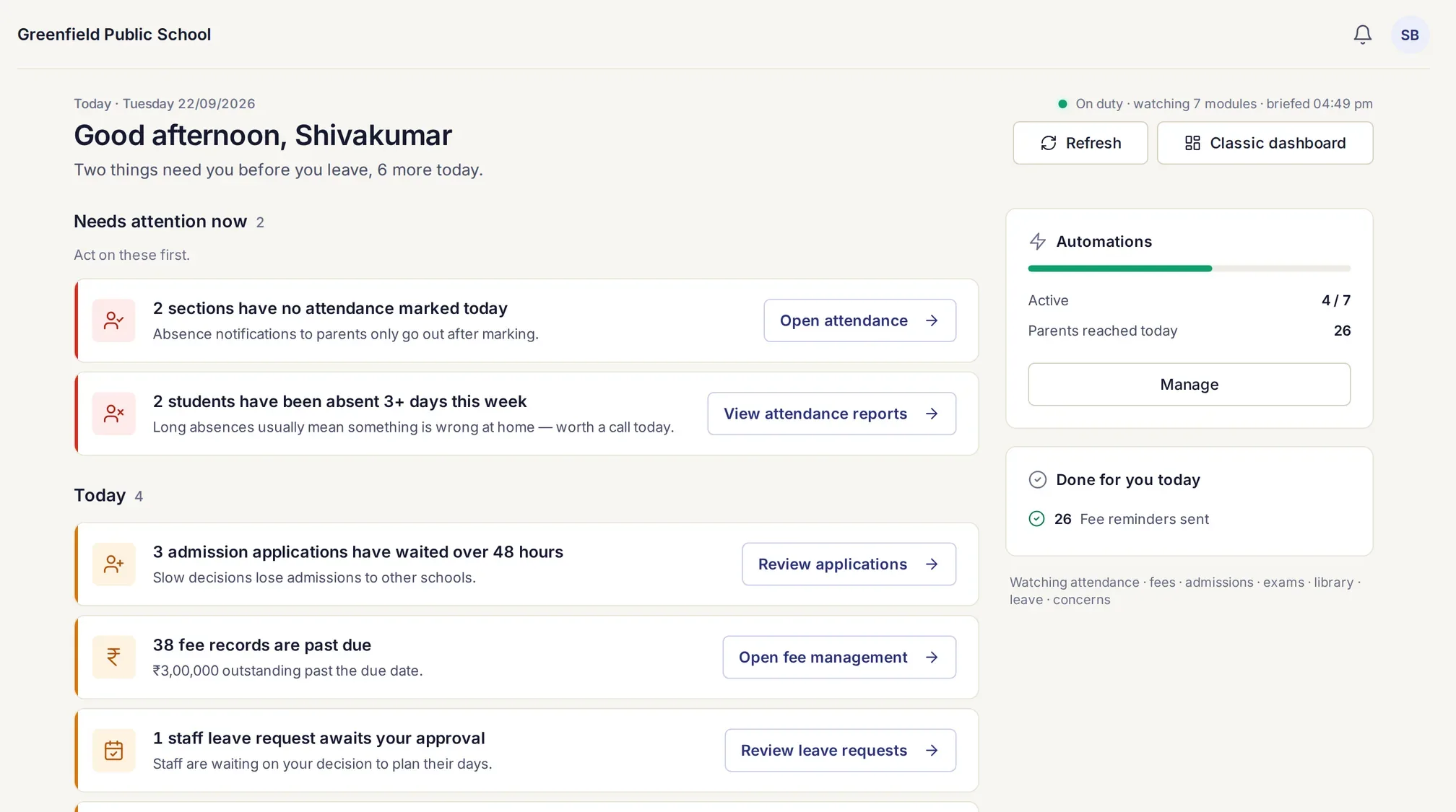


What does school management software actually replace?
Most Indian schools run on a familiar stack: a paper attendance register in every classroom, a fee ledger and receipt book in the office, marks compiled in Excel at term end, and announcements scattered across notice boards and chat groups. Each of these works in isolation, and that isolation is the problem. The office re-enters the same student's name dozens of times a year, the principal learns about a fee shortfall weeks late, and parents miss circulars because there is no single channel of record.
School management software puts all of that into one system with one student record at the centre. Mark attendance once and the absence shows in the parent portal. Collect a fee and the receipt, the ledger entry and the defaulter list update together. Enter marks once and report cards compute themselves.
The real test of a system is not the feature list. It is whether the school still runs on it in week three of a real term. That means one login for the office instead of five tools, one student record every module reads from, and numbers the principal can trust without phoning three people first. Everything on this page is written against that standard, and against what Edutris actually ships today, not a roadmap dressed up as a product.
What must a complete school system include?
Student information
One profile per student (guardians, health records, discipline log, history, and the certificates and printable documents issued to them) that every other module reads from.
Attendance
One-tap daily marking from any device, with absences showing in the parent portal as soon as the register is saved.
Fees
Fee heads and structures, payments recorded at the counter, automatic receipts and defaulter tracking with one-click reminders. Parents see fee status and receipts in the parent portal; online fee payment is not switched on yet.
Exams & report cards
Exam scheduling, marks entry, auto-computed grades and printable term report cards with per-section release control.
Admissions
An application-to-enrolment pipeline with a public admissions portal, so no application is lost in a notebook.
Communication & parent portal
Announcements and in-app notifications, and a parent web portal that opens in any phone or laptop browser. An Android parent app is built and not yet released.
Timetable, staff & HR
Clash-free auto-generated timetables and staff records in the same system.
Which modules does Edutris include in one login?
Here is the complete module map. Every link below goes to a detailed page for that module (what it does, screen by screen) because 'all-in-one' is easy to say and expensive to discover isn't true. Each module reads and writes the same student and staff records, so nothing is re-entered and nothing contradicts.
Admissions management
An application-to-enrolment pipeline with a public online admission form and document upload, parents apply and attach documents from home, the office reviews from one queue.
Student attendance software
One-tap daily marking from any device, absence alerts to parents, and attendance reports the principal sees the same morning.
Fee management software
Fee heads and structures, counter collection, automatic receipts, defaulter tracking and automated fee reminders.
Examination management
Exam scheduling, marks entry on a roster grid, auto-computed grades and hall-ticket release control per section.
Report card software
Term report cards computed from entered marks, with publish control per section and print-ready output.
Timetable generator
Auto-generated, clash-free timetables (teachers are never double-booked) with a grid editor and a print view.
Certificates & TC generation
Bonafide, transfer and conduct certificates generated from the student record, so names and dates always match the register.
Staff & HR management
Staff profiles, roles, leave and records in the same system as everything else: no parallel HR spreadsheet.
School payroll software
Salary structures and monthly payroll runs connected to the same staff records HR maintains.
Transport management
Routes, stops and rider assignments, with each child's bus route and stop shown to parents in the parent portal.
Library management
Catalogue, issue and return, and overdue tracking, with optional scheduled overdue reminders.
School communication software
Announcements and circulars with audience targeting, delivered as in-app notifications and messages in the parent portal.
Parent web portal
Opens in any phone or laptop browser: attendance, results, fee status and receipts, the child's bus route and messages. An Android parent app is built and not yet released.
School analytics dashboards
Attendance, fee-collection and results analytics with CSV exports: the numbers leadership actually asks for.
Document management
School documents in one searchable place, shared with families or kept staff-only, instead of a filing-room search.
How does it fit the way Indian schools actually run?
Edutris is India-first by design: fees in rupees, data handling designed with DPDP Act principles in mind, and positioning for CBSE, ICSE, State-board and Kannada-medium schools. Multi-campus trusts run all their schools under one account with per-school data isolation.
Pricing is deliberately boring: published tiers from ₹2,999/month with no per-student or per-module charges inside a plan, so the invoice doesn't grow every time you enrol a student.
There is also a paperwork reality no vendor slide mentions: Indian schools are expected to keep records the state can ask for. The DPDP Act 2023 makes schools accountable for the personal data of the children they hold. The annual UDISE+ cycle wants enrolment, teacher and facility data. APAAR ties every student to a permanent academic ID that is only as reliable as the school records beneath it. None of this is optional, and all of it is miserable when the underlying records live in seventeen spreadsheets.
DPDP Act 2023
Schools are accountable for children's personal data. Edutris is designed around DPDP principles, role-based access, per-school data isolation, encryption in transit, activity audit logs and automated backups.
UDISE+ record-keeping
UDISE+ season starts from complete enrolment, student and teacher records. Edutris keeps them current and exportable, a head-start on the paperwork. It does not auto-submit to government portals, and we won't pretend otherwise.
APAAR & student registries
A lifelong academic ID only works if the school's student records are accurate and current, keeping them that way is exactly what this software is for.
School compliance in India (the full guide
DPDP, UDISE+, APAAR and record-keeping duties explained for Indian schools) what to track, and where software honestly helps.
How do you evaluate school management software?
Any vendor demo looks good for thirty minutes. What separates systems is what happens in week three of a real term: does attendance actually take one tap, do receipts reconcile, do report cards print without a consultant? Ask every vendor for published pricing, a pilot on your own data, and a straight answer on which claimed features actually ship today. We hold ourselves to that same standard, and our comparison pages acknowledge what competitors do well.
Take this checklist into every vendor conversation, including ours. A vendor that squirms at these questions is telling you something.
Is pricing published?
Unpublished pricing means negotiated pricing. Ask for the full cost in writing (licence, onboarding, training and every add-on) before you sit through a single demo screen.
Who migrates our data?
If the answer is 'you can import CSVs', budget weeks of office time. Ask whether the vendor's team migrates your registers and Excel into the system, and whether that costs extra.
Can we pilot on real records?
A demo on dummy data proves nothing. Insist on a pilot with your own students, your own fee structures and your own staff marking real attendance.
What happens in week three?
Ask a reference school what broke after the first month: attendance shortcuts, receipt reconciliation, report-card printing. That is where systems die.
Which claimed features actually ship?
Ask 'is this live today, or on the roadmap?' for every feature you care about, and get it in writing. A vendor that blurs that line before you sign will blur it after.
Can we leave?
Ask how you export all your data if you stop subscribing. A vendor confident in the product answers instantly; a vendor relying on lock-in hedges.
Will parents actually use it?
Parent adoption decides half the value. Check what parents actually get today (an app they can install, or a portal in the phone browser), whether fees can be paid online, and that alerts arrive without parents hunting for them.
Who answers when it breaks?
Ask what support looks like on a fee-collection morning, which channel, what hours, and who picks up. 'Raise a ticket' is not a plan for the first day of term.
How much does school management software cost in India?
Most vendors in this category make you 'request a quote'. Then come the asterisks: per-student pricing that grows every admission season, per-module add-ons, an 'implementation fee', and an annual maintenance contract. The quote is unpublished precisely because it varies by how hard you negotiate.
Edutris publishes its pricing and holds every page of this site to it: Starter at ₹2,999/month for up to 250 students, Professional at ₹7,999/month for up to 1,000 students with AI features included, Growth at ₹14,999/month for up to 3,000 students, and custom Enterprise pricing for larger groups. Every module in this guide is included in your plan. There are no per-module add-ons. AI features are Professional and up; Starter deliberately excludes them, and we say so here rather than burying it in a footnote.
There is no free-trial funnel and no card-on-file trap. Every school starts with a 30-day guided pilot: our team migrates your data and trains your staff, and you evaluate the system running on your real records before you pay anything.
Full pricing breakdown
Every tier side by side: student limits, what each plan includes, and exactly which plans carry AI. No 'contact us for pricing' games.
Registers and Excel vs school management software
The honest comparison, spreadsheets are free until you price the re-entry, the errors and the things nobody noticed.
| Aspect | Registers, Excel & chat groups | School management software (Edutris) |
|---|---|---|
| Student record | Fragments across the admission register, fee ledger and marks files: no single complete copy | One profile per student that every module reads, from admission to transfer certificate |
| Attendance | Paper register; parents learn about absences at the PTM | One-tap marking; parents alerted the same morning |
| Fees | Manual receipts; the defaulter list is rebuilt by hand each month | Counter collection with automatic receipts, live defaulter tracking, automated reminders |
| Report cards | Marks compiled in Excel at term end; formulas break silently | Grades computed from entered marks: publish-controlled and print-ready |
| Parent communication | Chat groups nobody can audit; circulars parents miss | Targeted announcements in the parent portal |
| Oversight | The principal knows what people remember to report | Live dashboards and audit logs, who changed what, and when |
| Cost | 'Free', plus office hours of re-entry and errors no one prices | Published tiers from ₹2,999/month, every module included |
Frequently asked questions
What does school management software cost in India?
Pricing models vary widely, some vendors charge per student per month, which grows with enrolment. Edutris publishes simple tiers: ₹2,999/month for up to 250 students, ₹7,999/month for up to 1,000, and ₹14,999/month for up to 3,000, and custom Enterprise pricing, with no per-module add-ons inside a plan. Every school starts with a 30-day guided pilot, no credit card required.
How long does it take to go live?
Guided onboarding is included: our team migrates your data from existing registers and Excel sheets, trains your staff, and helps roll out the parent portal, so you start on complete records with staff who already know the system.
Is our student data safe?
Edutris is designed with DPDP Act principles in mind: encryption in transit, strict role-based access, per-school data isolation on multi-tenant infrastructure, activity audit logs and automated database backups.
Do we need separate software for fees, exams and communication?
No, that fragmentation is exactly what school management software removes. Attendance, fees, exams, report cards, admissions, communication, the parent portal, timetables and staff records are all modules of one Edutris system reading one student record.
What is the difference between school management software and a school ERP?
In practice the terms overlap heavily. 'ERP' emphasises the operations-and-finance side (fees, payroll-style staff records, consolidated reporting), while 'school management software' is the broader everyday term. Edutris covers both readings, see our dedicated school ERP page for the operations-first view.
Which is the best school management software in India?
Honest answer: there is no universal 'best', only the best fit for your size, budget and boards. Distrust any listicle that crowns a winner without disclosing pricing. Use the checklist on this page: published pricing, real data migration, a pilot on your own records, and a written answer on which features ship today. Edutris competes on exactly those terms, and our comparison pages acknowledge what the alternatives do well.
Does school management software work in Hindi or regional languages?
The Edutris interface is in English today, we say that plainly rather than hiding it. What you send to parents is a different matter: AI-assisted drafting can translate announcement content into Hindi and other regional languages before it goes out (Professional plan and up). Interface-language plans live on our public roadmap, and we never market roadmap items as shipped.
Can school management software handle UDISE+ and APAAR requirements?
It can keep you ready. Edutris keeps enrolment, student and staff records complete and exportable, which is where UDISE+ season and APAAR record-keeping start: a head-start on the paperwork rather than a scramble. Edutris does not auto-submit to government portals, and we would encourage suspicion of any vendor claiming one-click filing.
Sources
- CBSE Affiliation Bye-Laws (2012 edition), Read 2026-09-10. The only edition available as extractable text, the current 2018 edition is published as scanned images, so nothing on this site is attributed to it. Check the current bye-laws on cbse.gov.in before relying on any wording.
- DPDP Rules, 2025: notified (Press Information Bureau, Government of India), Read 2026-09-11. Records that the Rules were notified on 14 November 2025, giving full effect to the Digital Personal Data Protection Act, 2023, with an eighteen-month phased compliance period. On children: “verifiable consent from a parent or guardian is required… unless the processing relates to essential services such as healthcare, education or real-time safety.”