Attendance That Takes 30 Seconds: Best Practices for School Attendance Management
Walk past any classroom at 8 AM and you will hear it: a name called out, a "present, ma'am", a tick in a register. Multiply that by 40 students and 25 sections and your school spends a serious chunk of every teaching day on a task whose only output is a tick mark that nobody will look at again until someone needs to tally it.
Attendance does not have to work this way. Done well, marking a class should take under 30 seconds, and the data it produces should quietly do useful work for the rest of the term. Here are the school attendance management best practices that make that possible.
Best Practice 1: Mark All Present, Then Fix the Exceptions
The single biggest time-saver in attendance is reversing the default. On most days, most students are present. So instead of recording 40 individual statuses, record one: everyone is present, then change the two or three who are not.
This "all present, then exceptions" pattern turns a two-minute roll call into a handful of taps. The teacher glances at the empty desks, taps those names to absent, and submits. Thirty seconds, done, and the class starts on time.
A good system also needs to be forgiving. A student who walks in at 8:10 after being marked absent should be a one-tap correction, not a phone call to the office. In Edutris's attendance module, submissions are resubmit-safe: the teacher simply updates the status and resubmits, and the record reflects the correction without duplicates.
Best Practice 2: Tell Parents the Same Morning
An attendance record that sits in a drawer until the monthly tally is bookkeeping. An absence that reaches the parent the same morning is a safety mechanism.
The logic is simple. If a child left home for school and never arrived, the parent needs to know at 9 AM, not at 4 PM. And if a student is bunking, the knowledge that an absence reaches home within the hour changes behaviour faster than any disciplinary measure. There is no such thing as an "invisible" absence any more.
The practical requirement is that the alert must go out without anyone in the office doing extra work. When the teacher submits attendance, the notification to parents of absent students should follow from that same action (via the parent app or SMS) not depend on a clerk remembering to send messages.
One honest caveat: this only works if attendance is actually marked first thing. A school where teachers mark attendance "sometime before lunch" gets alerts that arrive too late to matter. Make first-period marking a hard norm before you promise parents same-morning alerts.
Best Practice 3: Let the Monthly Rollup Compute Itself
The monthly attendance percentage is where paper registers hurt most. Someone (usually office staff, usually in the last week of the month) counts ticks across pages and computes percentages by hand for hundreds of students. It is slow, error-prone, and the output is a number with no context.
With digital attendance, the rollup is a report, not a project. Each student's monthly and term-to-date percentage is always current, and the principal can see attendance across all sections on one dashboard without asking anyone to compile anything.
A simple monthly rhythm that works well:
| Week | Who | Action |
|---|---|---|
| Week 1 | Class teachers | Review last month's report; note home for students below 80% |
| Week 2 | Coordinator | Look for cross-section patterns (a section, a day of the week, a locality) |
| Week 4 | Principal | Scan the school-wide view; follow up on flagged students |
The pattern-finding step is the one paper can never do. If four students from the same area go absent in the same weeks, that is usually a transport problem, not four discipline problems, but you only see it when the data is queryable.
Best Practice 4: Track the 75% Line All Year, Not at Registration Time
For CBSE schools (and most state boards) the 75% attendance requirement for board-exam eligibility is the deadline that turns attendance from routine into risk. The failure mode is always the same: the shortfall is discovered while filling in exam registration forms, when nothing can be done.
The fix is to treat 75% as a line you watch all year. A student sitting at 78% in October is a conversation with a parent; the same student discovered at 71% in January is a crisis. Set your internal alarm higher than the board's (many schools use 80% as the "talk to the parent now" trigger) so there is always a buffer to recover within.
Digital attendance makes this a standing report rather than an annual scramble: every Class 9–12 student's running percentage, sorted, with the at-risk names on top. Pull it monthly, act on it early, and exam registration becomes uneventful, which is exactly what you want it to be.
Best Practice 5: Keep the Scope Honest
Two things worth knowing before you set expectations with your management committee:
- Daily attendance is the right starting point. Period-wise attendance sounds attractive but multiplies teacher effort eightfold for data most schools never use. Get daily attendance reliable first; that is where the safety and eligibility value lives. (Edutris tracks daily attendance, one submission per class per day.)
- Cloud systems need connectivity. There is no magic offline mode; the teacher's phone needs a data signal at the moment of submission. In practice a 4G connection is plenty, but if your campus is a true dead zone, solve that first.
How Edutris Handles Attendance
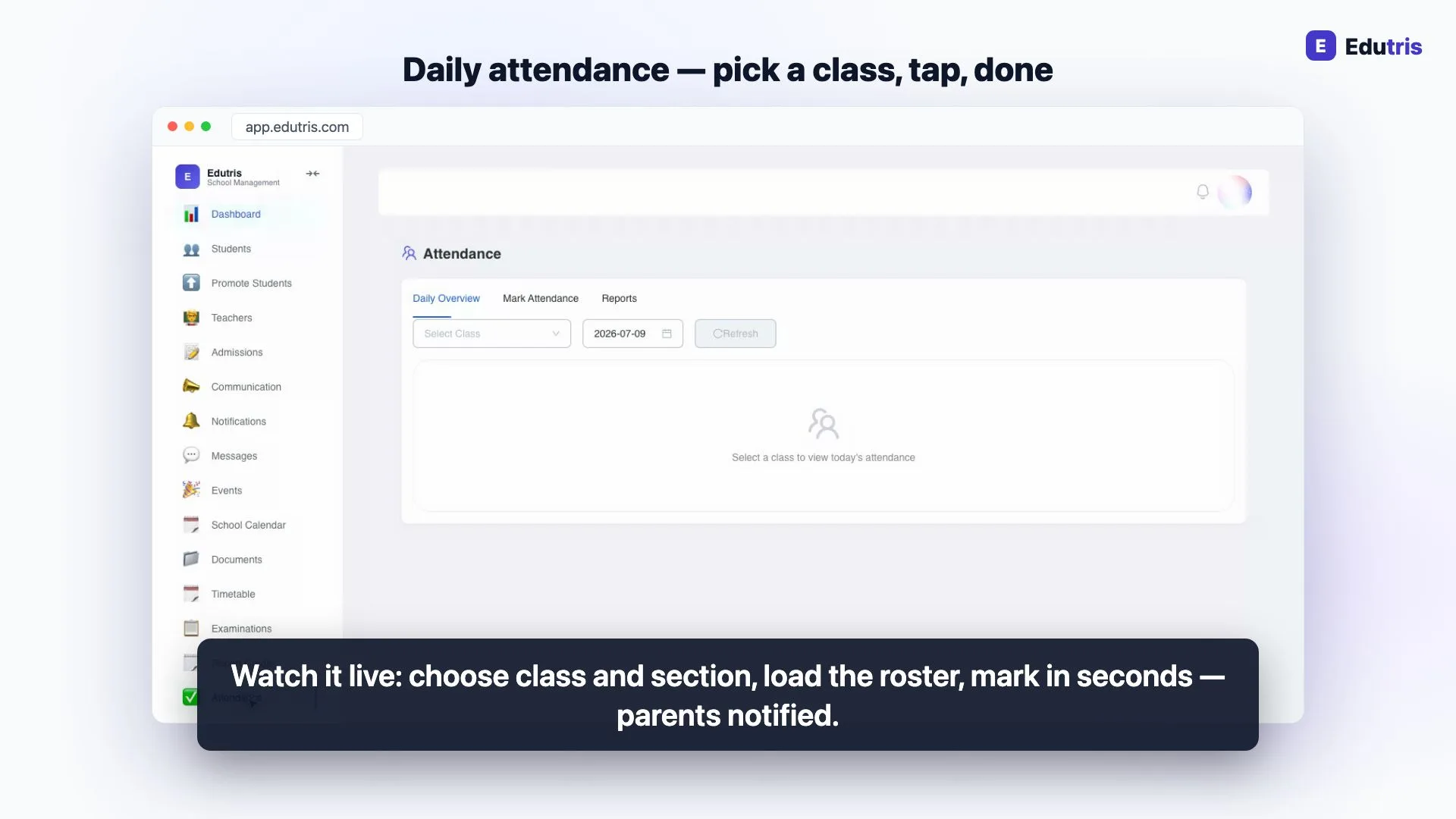
In Edutris, the class teacher opens the attendance screen on any device, taps All Present, changes the exceptions, and submits: resubmit-safe if a latecomer needs correcting. Parents of absent students are notified the same morning through the parent app or SMS. The principal's dashboard shows the school-wide attendance ring daily, monthly reports and per-student percentages compute themselves, and attendance analytics with CSV export cover the term-end and eligibility reviews. It is one module of a full school platform, see the attendance feature page for the details, or pricing for plans starting at ₹2,999/month.
Written by the Edutris team, led by Manjunath Shedabal, Founder
Every product claim traces to verified capability; unshipped features live on the roadmap. Read our editorial policy.Free: The School Digitalisation Checklist
25 checkpoints across records, attendance, fees, communication, and compliance: score your school in 5 minutes and see exactly where time and fee revenue leak.
How Edutris removes the daily chaos for principals
Frequently Asked Questions
What is the fastest way for a teacher to mark attendance?
The fastest workflow is 'all present, then exceptions'. Instead of ticking every student one by one, the teacher marks the whole class present with a single tap and then changes only the two or three students who are absent. For a class of 40 with typical attendance, that is three or four taps instead of forty. In Edutris, the teacher's attendance screen has a one-tap All Present button built exactly for this, and the submission is resubmit-safe, so a correction later does not create duplicate records.
How does digital attendance help with the CBSE 75% eligibility rule?
CBSE requires students to maintain 75% attendance to be eligible for board examinations, and most state boards have similar requirements. With paper registers, schools usually discover a shortfall only at exam registration time, when it is too late to fix. Digital attendance keeps a running percentage per student, so the class teacher and principal can see who is drifting towards the threshold months in advance and involve parents while there is still time to correct course.
Should parents be told the same day their child is absent?
Yes, same-morning notification is the single most effective absenteeism measure a school can adopt. When parents learn about an absence within the hour rather than at the next parent-teacher meeting, unexplained absences get explained immediately and casual bunking becomes much harder. It also protects the school: if a child left home for school but never arrived, the parent finds out at 9 AM, not 4 PM.
Does digital attendance work if the school's internet is unreliable?
Edutris is cloud-first, so it does need a connection at the moment of saving. There is no offline mode. In practice the attendance screen is deliberately lightweight, and an ordinary mobile-data signal on the teacher's phone is enough to submit a class in seconds. Schools with patchy broadband typically have teachers mark attendance over 4G without any trouble.
Sources
- CBSE, official site, The board’s own site, and the place a school must check its current circular. Board schemes change by session, which is why this site states rules as “check your board’s circular” rather than quoting one.
Read next
- 01For Principals
How to Track Student Attendance Digitally, and What to Do with the Data
Digital attendance goes beyond replacing the register. How schools in India use attendance data to catch problems early, engage parents and improve outcomes.
- 02For Principals
5 Admin Tasks Your Teachers Should Never Do by Hand Again
Teacher workload reduction starts with naming the clerical work. Five tasks (from attendance tallying to remark writing) that software should be absorbing.
- 03For Principals
AI-Drafted Report-Card Remarks: How They Work, and Why the Teacher Still Signs Off
How AI-drafted report-card remarks work in practice (the teacher always reviews and signs off) and why generic copy-paste remarks fail parents.
- 04For Principals
The CBSE School Software Checklist: What Your School Actually Needs the System to Do
A practical checklist for CBSE principals: attendance percentage tracking, assessment records, TC issuance, hall tickets and board-eligibility visibility.
- 05For Principals
Fixing the WhatsApp-Group Problem: Why Schools Need Real Parent-Teacher Communication Tools
Class WhatsApp groups bury notices, expose teachers' personal numbers and leave no record. Here is a better structure for school-to-parent communication.
- 06For Principals
Parent Communication That Actually Works: SMS vs WhatsApp vs Dedicated App
Indian schools rely on WhatsApp for parents, but it brings legal, operational and accountability problems. Comparing SMS, WhatsApp and dedicated parent apps.