5 Admin Tasks Your Teachers Should Never Do by Hand Again
Ask teachers what exhausts them and the answer is rarely teaching. It is everything wrapped around the teaching: the registers, the tallies, the transcription, the notices, the last-minute period adjustments. A teacher who leaves school drained at 5 PM has often spent ninety minutes of that day on work that requires no pedagogy whatsoever, only patience and a pen.
Principals feel this too, usually as a retention problem or a quality problem. The correction starts with naming the clerical work precisely. Here are five tasks that, in 2026, no teacher should still be doing by hand.
1. Attendance tallying
Marking attendance takes two minutes. Tallying it is the thief: month-end percentage calculations per student, term-end summaries, the register audit before board-exam eligibility checks. It is pure arithmetic, done by a postgraduate, on a deadline.
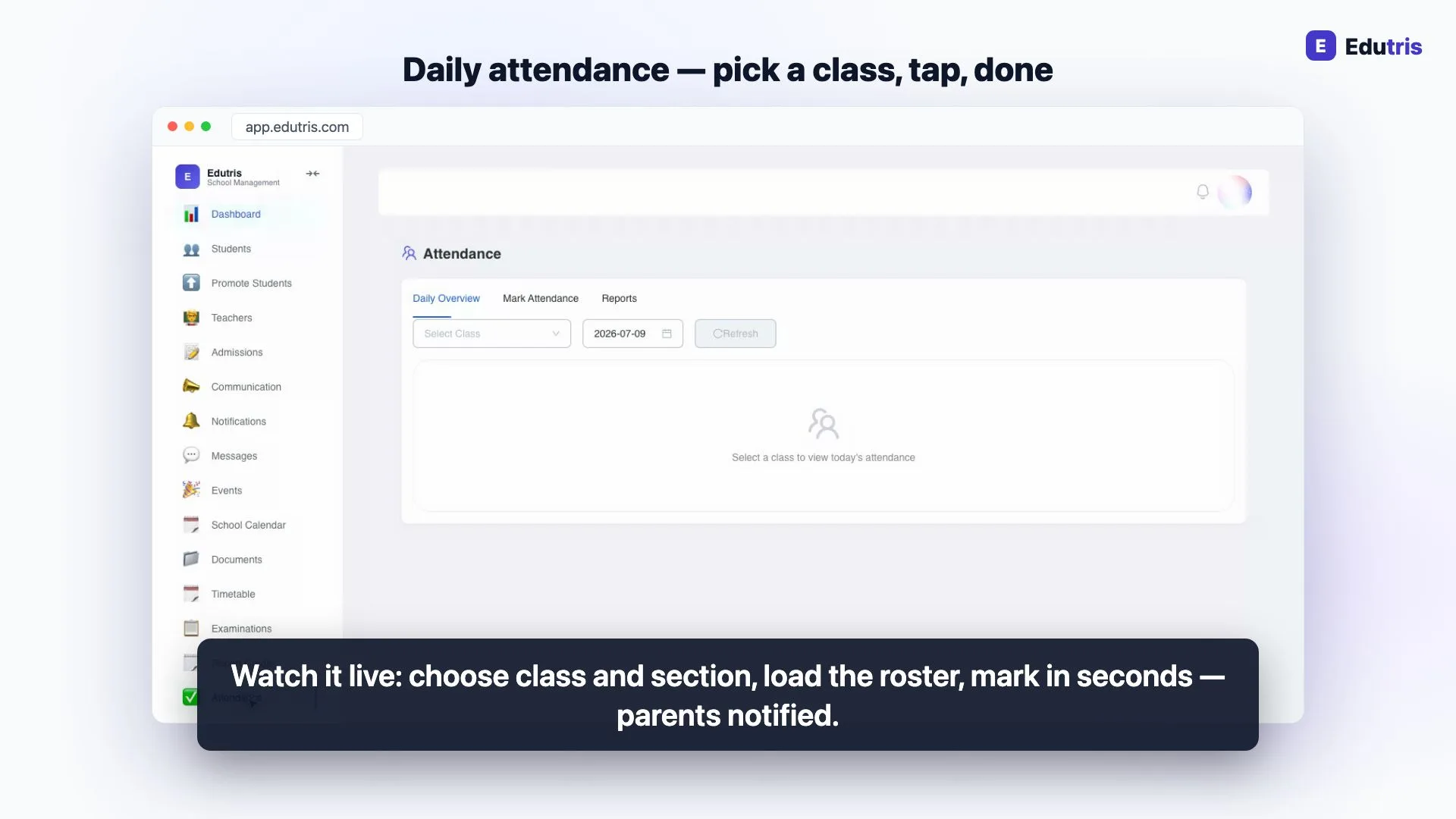
With digital attendance, marking is a single screen. In Edutris, a class teacher can tap "All Present" and then change only the exceptions, and can safely resubmit if a correction is needed. From that moment the tallying ceases to exist as a task: per-student percentages, class summaries and attendance reports are computed continuously. The teacher's job returns to what it should be (noticing which child is absent and why) while the arithmetic runs itself. (We've written more on what to do with that data in our attendance guide.)
2. Marks re-transcription
Follow one exam mark on its journey through a manual school: written on the answer sheet, copied to the teacher's personal list, copied again to the class register, copied again onto the report card, and often copied once more into a summary for the office. Four or five transcriptions per mark, and every transcription is a fresh chance for a 63 to become a 36.
The fix is to enter each mark once. In Edutris, marks entry happens against the exam schedule on a roster grid: the teacher works down the class list for their subject and is done. Grades are computed automatically from the marks, the gradebook stays current, and report cards draw from the same single record. Nothing is copied because nothing needs to be. The hours saved are real, but the bigger win is the category of error that disappears with the copying.
3. Report-card remark drafting
Forty students, three lines each, twice a year: remarks are where conscientious teachers lose entire weekends. The result of that fatigue is visible in report cards everywhere: by student twenty-five, every child "is a sincere student who should focus more".
This is the one task on this list where AI drafting genuinely earns its place, with a firm boundary. In Edutris, the report-card remarks skill (part of the AI assistant, included on Professional plans and above) produces a draft remark grounded in the student's own records in the system. The teacher reviews it, edits what the data cannot know (effort, character, the term's quiet improvement) and approves it. Nothing reaches a parent without the teacher signing off. The blank box becomes a considered starting point, and the fortieth student gets the same thoughtfulness as the first.
4. Circular distribution
The manual circular is a small logistics operation: draft it, photocopy it, distribute per class, have students paste it in diaries, and then absorb the inevitable "we never received it" the following week. For urgent notices (an early closure, a postponed exam) the diary route is simply too slow, so schools fall back on hurried phone trees.
Digital announcements collapse the whole chain. In Edutris, the office or principal writes the notice once, targets the audience (whole school, specific classes, staff only), sets a priority, and publishes. It goes out over the channels the school uses: SMS, email, push notification, and in-app. On AI-enabled plans, a teacher or principal can also turn rough bullets into a polished announcement draft, and translate the content into a regional language before a human reviews and sends it. What no teacher does any more is stand at a photocopier.
5. Substitution scheduling
Every morning absence sets off the same scramble: who is free period 3? Someone walks the corridor with the master timetable, negotiates, and too often the same three obliging teachers absorb the load: a quiet, cumulative unfairness that shows up later as burnout.
Software doesn't (and in Edutris, honestly, doesn't claim to) pick the substitute for you. What it changes is the information cost. Leave requests arrive through the system rather than by morning phone call; the live timetable shows every teacher's week, so "who is free period 3" is a lookup, not a corridor walk; and on AI-enabled plans, a teacher workload analysis shows how load is distributed across the staff, so the head can see who is already stretched before assigning one more period. The decision stays human. The detective work stops.
The pattern across all five
| Task | What it really is | What software does |
|---|---|---|
| Attendance tallying | Arithmetic | Computes it continuously |
| Marks transcription | Copying | Enter once, flows everywhere |
| Remark drafting | Writing at volume | AI drafts, teacher approves |
| Circular distribution | Logistics | Publish once to targeted channels |
| Substitution scheduling | Information lookup | Live timetable + workload view |
None of these five requires a teacher's training. All five currently consume teachers' hours. That is the entire case for teacher workload reduction through software, not that machines teach, but that they should absorb everything that isn't teaching.
How Edutris handles this
Edutris covers the non-AI foundations on every plan: one-tap attendance with automatic summaries and reports, roster-grid marks entry with auto-computed grades feeding gradebook and report cards, targeted announcements across SMS, email, push and in-app, and a live timetable visible to every teacher. The AI drafting layer (report-card remarks, announcement drafts, lesson-plan and quiz drafts, workload analysis) is included from the Professional plan (₹7,999/month) upwards, and every AI output is a draft that a human reviews and approves before it goes anywhere. If you want to test the claim, the honest method is a 30-day guided pilot: put your own teachers in front of the attendance and marks screens and watch whether they are faster than the register.
Written by the Edutris team, led by Manjunath Shedabal, Founder
Every product claim traces to verified capability; unshipped features live on the roadmap. Read our editorial policy.Free: The School Digitalisation Checklist
25 checkpoints across records, attendance, fees, communication, and compliance: score your school in 5 minutes and see exactly where time and fee revenue leak.
How Edutris removes the daily chaos for principals
Frequently Asked Questions
What takes up most of a teacher's non-teaching time?
Across most Indian schools it is a familiar set: taking and tallying attendance, transcribing marks between answer sheets, registers and report cards, writing report-card remarks for every student, circulating and confirming notices, and covering for absent colleagues. None of these is teaching, yet together they routinely consume several hours a week. The common thread is that each one is either arithmetic, copying, or distribution: exactly the categories of work software handles better than people.
Can AI really write report-card remarks?
AI can draft them; it should never finalise them. In Edutris, the report-card remarks skill produces a draft remark grounded in the student's own records, which the teacher then reviews, edits and approves: nothing is published without a human signing off. This matters because the teacher knows things the data doesn't. The honest gain is not that AI knows your students; it is that the teacher starts from a considered draft instead of a blank box, forty times per section.
Do teachers need training to use a school management system?
Less than most principals fear, provided the tool is built for speed. The daily surfaces teachers touch (attendance marking, marks entry) are deliberately simple in Edutris: one screen, the full roster, minimal taps. The realistic adoption pattern is that teachers embrace whatever is genuinely faster than their register and resist whatever is slower. That is why we recommend judging any system by watching a teacher mark attendance and enter marks during a pilot, not by counting features.
Which Edutris features that reduce teacher workload need an AI plan?
The core workload reducers need no AI at all: one-tap attendance with automatic summaries, marks entry with auto-computed grades, targeted announcements over SMS, email, push and in-app, and the live timetable that makes finding a free teacher a lookup. AI adds a drafting layer on top (report-card remarks, announcement drafting, lesson-plan and quiz drafts, teacher workload analysis) and is included from the Professional plan upwards. Every AI output is a draft a human approves.
Read next
- 01For Principals
AI-Drafted Report-Card Remarks: How They Work, and Why the Teacher Still Signs Off
How AI-drafted report-card remarks work in practice (the teacher always reviews and signs off) and why generic copy-paste remarks fail parents.
- 02For Principals
The CBSE Grading System Explained: Grade Bands, Grade Points and CGPA
How CBSE's 9-point grading works: the A1–E band table, grade points, and how CGPA and an indicative percentage are calculated, in plain English.
- 03For Principals
Setting Up a New Academic Year: Promotions, Sections, Fees and Timetables
The year-end rollover in the order the work has to happen, the students who don't roll over cleanly, and a reconciliation that proves the new roll.
- 04For Principals
Attendance That Takes 30 Seconds: Best Practices for School Attendance Management
Attendance management best practices for Indian schools: one-tap marking, exception-first workflows, same-morning parent alerts, 75% eligibility tracking.
- 05For Principals
The CBSE School Exam Flow: From Scheduling and Marks Entry to the Printed Report Card
How a CBSE school's internal exam cycle runs digitally: scheduling, hall tickets, marks entry, auto-computed grades, controlled report-card release.
- 06For Principals
The CBSE School Software Checklist: What Your School Actually Needs the System to Do
A practical checklist for CBSE principals: attendance percentage tracking, assessment records, TC issuance, hall tickets and board-eligibility visibility.