How to Track Student Attendance Digitally, and What to Do with the Data
Why the Paper Attendance Register Is a Liability
Every morning, across tens of thousands of Indian schools, a teacher calls out names. Students say "present." The teacher ticks a box. The register closes and goes into a drawer.
At the end of the month, someone (usually the office staff) manually tallies each student's attendance to compute the percentage. If a student is below 75%, someone calls the parent. Sometimes.
This process has three problems:
1. The data is trapped. It lives in a physical register. Nobody can access it remotely. A principal asking "which Class 8 students have attendance below 70% this term?" gets no answer without someone manually counting ticks in a dozen registers.
2. Parents are informed late. A student skips school on Monday. Their parent finds out on Saturday when they meet the class teacher. Five days lost.
3. The data dies. When a student moves to the next class, the old register goes to storage. Historical attendance patterns ("this student's attendance drops every October-November") are invisible.
Digital attendance solves all three problems. But the real question is: what do you do with the data once you have it?
What Digital Attendance Actually Looks Like in Practice
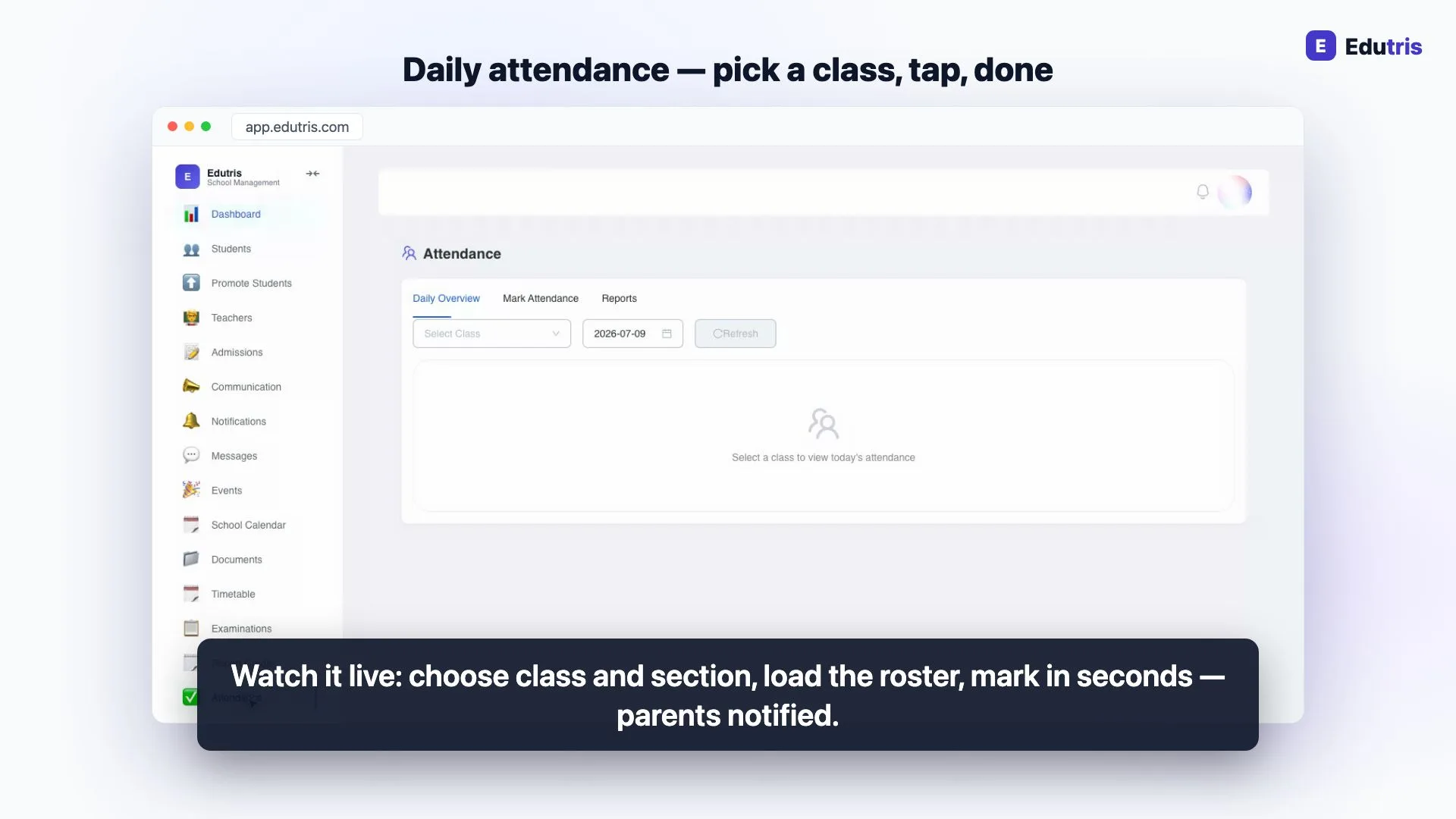
In a school using Edutris, the attendance process looks like this:
- 7:45 AM: Teachers open the attendance screen on their phone or the school's tablet
- 7:50 AM: Class teacher marks present/absent for each student in under two minutes
- 7:51 AM: Parents of absent students receive an automatic SMS or app notification: "Your child [Name] was marked absent in [School Name] today (27 Jun 2026). If this is a mistake, please contact the school."
- End of day: The vice-principal's dashboard shows attendance across all classes. Any class below 85% is flagged in red.
No registers. No manual tallying. No missed calls.
Three Things You Can Do With Attendance Data That You Couldn't Before
1. Catch the pattern before it becomes a problem
Paper registers show you that a student missed 12 days last month. Digital attendance shows you which 12 days, and whether it's always Mondays, or always the week before a test.
Consider the kind of pattern a paper register hides. Four students from the same neighbourhood, each with scattered absences in the same weeks. Read case by case, that is four unrelated attendance problems and four separate parent calls. Sorted by locality and date in a queryable record, it is one problem (a shared transport arrangement that keeps failing) and one conversation fixes all four.
This kind of pattern recognition is only possible when attendance data is queryable, not locked in a register.
2. Involve parents before absenteeism becomes chronic
The operational logic of early intervention is simple enough not to need a study behind it: a pattern caught in week three is a conversation, and the same pattern caught in month three is a habit with a term of missed teaching behind it. But most schools only contact parents after the problem is already chronic.
With automatic same-day absence notifications, parents are in the loop immediately. For most absences, this means a parent calls the school or sends a note the next day. The student knows there's no "invisible" absence.
For students showing a pattern (say, absent every Friday) the school can proactively call the parent after the second occurrence instead of the eighth.
3. Protect the school during board compliance reviews
CBSE schools are required to maintain 75% minimum attendance for board examination eligibility. State board schools have similar requirements. Principals often discover that a student doesn't meet the requirement only when they're filling in the board exam registration forms.
Digital attendance with automated threshold alerts changes this entirely. Edutris flags any student who drops below 80% attendance with a notification to the class teacher and the principal, giving the school four to six weeks to alert the parent and correct the situation before exam registration opens.
The Parent Communication Loop
The most visible impact of digital attendance isn't for the school, it's for parents.
For working parents who drop their child at the gate and trust the school to handle the rest, an immediate notification when something is wrong is genuinely reassuring, and it is the difference between finding out today and finding out at the end of term.
That is what a same-day alert workflow is designed to change:
- Unplanned absence becomes visible to a parent within the hour, not at the end of the month, and a student who knows that has less room to bunk
- The office fields fewer "did my child reach school?" calls, because the answer already went out
- The parent portal earns its place on day one, which is what keeps parents opening it
Implementing Digital Attendance: What to Expect
The most common question we hear from school principals is: "Will our teachers actually use it?"
The honest answer: it depends on the implementation. Teachers who have been doing paper attendance for 15 years will resist if the new tool is complicated. Teachers who find it genuinely faster than the register adopt it within a week.
Edutris's attendance screen is designed for speed, one screen, all students, one tap per student. Most teachers complete attendance in under 90 seconds for a class of 40.
The second question is: "What about internet connectivity?" Edutris is cloud-first (it needs a connection to save attendance) but the attendance screen is deliberately lightweight and fast on low-bandwidth connections, so an ordinary mobile-data signal is enough. For most schools in areas with unreliable broadband, marking attendance over a phone's 4G connection works without trouble.
What to Do With the Data: A Monthly Attendance Review Protocol
Once you have digital attendance data, build a simple monthly review process:
-
Week 1 of every month: Class teachers review attendance reports for the previous month. Students below 80% get a written note home.
-
Week 2: Academic coordinator reviews cross-class patterns. Are certain subjects or periods showing systematic low attendance? (This often reveals a timetabling problem or a teacher-specific issue.)
-
Before exam registration: Run the attendance eligibility report for all board exam classes. Address any shortfalls with at least 6 weeks to go.
-
Annual report: Export the full-year attendance data when preparing your annual UDISE submission. Edutris's CSV export gives you the complete source data in one click; entering it into the UDISE portal remains a separate step, but you start from clean figures instead of register tallies.
Getting Started
If your school is still on paper attendance, the transition to digital doesn't need to happen all at once. Start with one section, demonstrate the value to teachers and parents, and expand.
See how Edutris handles attendance for your school → Book a free demo
Edutris is a school management system built for Indian schools, CBSE, ICSE, State Board, and international curricula. Attendance, fee management, grades, parent communication and more in one platform. Starting at ₹2,999/month.
Written by the Edutris team, led by Manjunath Shedabal, Founder
Every product claim traces to verified capability; unshipped features live on the roadmap. Read our editorial policy.Free: The School Digitalisation Checklist
25 checkpoints across records, attendance, fees, communication, and compliance: score your school in 5 minutes and see exactly where time and fee revenue leak.
How Edutris removes the daily chaos for principals
Frequently Asked Questions
Can a school track attendance from a mobile phone?
Yes. Modern school management systems like Edutris allow teachers to mark attendance from any device, phone, tablet, or desktop. Attendance is saved instantly and parents receive an automatic notification if their child is absent. No paper register is needed.
What is the best way to reduce absenteeism in Indian schools?
The most effective approach is a combination of real-time parent alerts (so parents know the same day) and weekly attendance reports to class teachers. The mechanism matters more than the tool: when a parent hears about an absence the same day instead of at the end of the month, the conversation happens while it can still change the outcome.
How does digital attendance help during board exam preparation?
For Class 9-12 students, attendance data helps teachers identify which students are at risk due to low attendance before board exams. Edutris flags students below 75% attendance threshold automatically, allowing class teachers and principals to intervene early.
Sources
- CBSE, official site, The board’s own site, and the place a school must check its current circular. Board schemes change by session, which is why this site states rules as “check your board’s circular” rather than quoting one.
- UDISE+, official portal (Ministry of Education), The system schools file enrolment, teacher and facility data into, and the origin of the PEN that identifies a student nationally. Login-driven, so the public page carries little beyond the name.
Read next
- 01For Principals
Attendance That Takes 30 Seconds: Best Practices for School Attendance Management
Attendance management best practices for Indian schools: one-tap marking, exception-first workflows, same-morning parent alerts, 75% eligibility tracking.
- 02For Principals
5 Admin Tasks Your Teachers Should Never Do by Hand Again
Teacher workload reduction starts with naming the clerical work. Five tasks (from attendance tallying to remark writing) that software should be absorbing.
- 03For Principals
AI-Drafted Report-Card Remarks: How They Work, and Why the Teacher Still Signs Off
How AI-drafted report-card remarks work in practice (the teacher always reviews and signs off) and why generic copy-paste remarks fail parents.
- 04For Principals
Fixing the WhatsApp-Group Problem: Why Schools Need Real Parent-Teacher Communication Tools
Class WhatsApp groups bury notices, expose teachers' personal numbers and leave no record. Here is a better structure for school-to-parent communication.
- 05For Principals
What a Student Information System Actually Stores: A Plain-English Tour
A plain-English tour of what a student information system stores (profiles, attendance, marks, fees, documents) and why it beats five registers.
- 06For Principals
Going Paperless: Digitising TC, Bonafide, and Character Certificates in Indian Schools
Transfer, Bonafide and Character Certificates are the most-requested (and most time-consuming) documents in Indian schools. Here's how to digitise them.