Parent Communication That Actually Works: SMS vs WhatsApp vs Dedicated App
The WhatsApp Problem No One Talks About
Across India, the unofficial school communication channel is a WhatsApp group. One for each class. One for the PTA. One for the sports team. One that was created three years ago and no one can remember why.
The logic was sound at the start. WhatsApp is free, every parent has it, and messages arrive instantly. For a 200-student school in 2018, it was a reasonable workaround.
In 2026, it is a liability.
The accountability gap. When a school sends a WhatsApp message about a fee deadline or an exam schedule change, that message exists in a personal chat on a staff member's phone. If the staff member leaves, the chat history may go with them. If a parent disputes receiving a notice, there is no institutional record: only a screenshot on someone's personal device, which can be fabricated or cropped. Courts and consumer forums increasingly require schools to demonstrate that communication was sent via an official, auditable channel.
The group fatigue problem. A parent in a Class 6B WhatsApp group receives messages from 40 different people: birthday wishes, forwarded health tips, political commentary, debates about the school canteen menu, and somewhere in there, an important circular about the PTM schedule. The signal-to-noise ratio is catastrophic, and the failure mode is structural rather than statistical: a circular competes for attention with everything else in the thread, has no read state the school can see, and scrolls out of view within hours. We are not going to quote you a figure for how often that costs a parent a notice, because we have no survey of our own and none we could source, but every school office has the dispute that starts with “nobody told us”, and the group is usually where the telling happened.
The privacy exposure. Every parent in a WhatsApp group can see every other parent's phone number. This is a violation of basic data privacy norms. When a school creates a WhatsApp group for a class, it is effectively sharing the personal contact details of 35–40 families with each other without explicit consent. India's Digital Personal Data Protection Act, 2023, places obligations on any entity that processes personal data, and schools are not exempt.
The no-two-way accountability. If a teacher sends an attendance alert via WhatsApp, there is no way to know if the parent saw it, unless the parent replies with a blue tick screenshot. There is no read receipt that the school controls, no escalation if a critical message goes unread, and no structured way to log parent responses.
SMS: Reliable but Reaching Its Limits
Before WhatsApp, schools used SMS. Many still do, and for good reason: SMS reaches any mobile phone, regardless of internet connectivity, and has near-100% delivery on active numbers.
But SMS has constraints that matter at scale:
Cost accumulates fast. Bulk SMS in India costs ₹0.12–₹0.18 per message through Transactional SMS routes (required for school communication under TRAI regulations). A school with 600 students sending 3 messages per week (a Monday circular, an attendance alert, and a Friday reminder) spends approximately ₹1,300–₹2,000/week on SMS alone. That is ₹55,000–₹85,000 per year, just for text messages.
SMS is one-way. A parent cannot reply to a Transactional SMS. If the fee reminder goes out and a parent has a question about it, they have to call the school office. The office staff take the call, check the fee ledger, and answer: adding 10–15 minutes of staff time per query, multiplied across hundreds of parents.
SMS is unstructured. An SMS that says "Dear Parent, your child's fee of ₹8,500 is due by 15 July" has no context, no attachment, no direct link to a payment page, and no history. The parent cannot see previous messages in context, cannot attach a receipt, and cannot acknowledge receipt in a trackable way.
No media. Exam schedules, timetable PDFs, event photos, report cards: none of these can be delivered via SMS. Schools end up using a patchwork of SMS + email + WhatsApp to cover what a single app would handle.
The two problems compound. Every message sent over SMS carries a per-message cost that scales with enrolment, and every message sent over WhatsApp carries no delivery record the office can audit later. A dedicated app removes both constraints at once: structured messages with no per-message fee, and a delivery trail the school can actually check. SMS then stays where it is genuinely better, critical alerts to the parents who do not use a smartphone.
Why a Dedicated Parent App Solves These Problems
A purpose-built school parent app is designed around the specific communication needs of a school, not around general-purpose messaging. The difference is structural:
Push notifications replace SMS for app users. A push notification costs nothing per message and can carry rich content: the student's name, the amount due, a link to the fee payment screen, and a PDF of the fee receipt, in a single tap. For a school that previously spent ₹10,000/month on SMS, the savings are immediate.
Two-way communication with structure. Parents can send messages to class teachers or the school office through the app. Every message is logged, tagged to the student's record, and visible to authorised staff. A teacher who replies has a complete history of the conversation. There are no "I never said that" disputes.
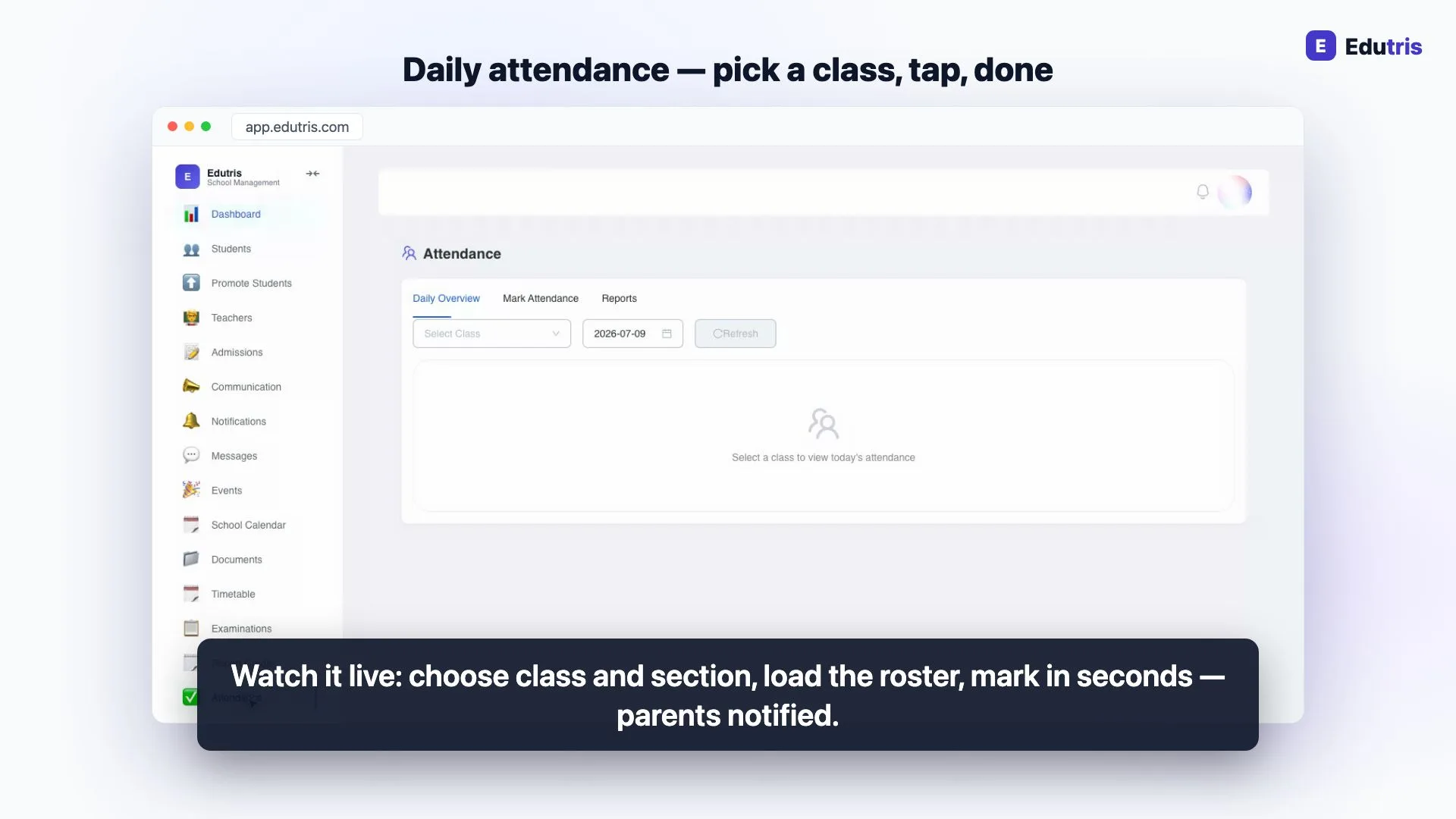
Attendance alerts are automatic and instantaneous. When a teacher marks a student absent in Edutris at 8:00 AM, the parent receives a push notification by 8:01 AM. The alert is generated by the system, not by a staff member remembering to type a message. If the absence is legitimate, the parent can submit a leave application directly through the app. No phone calls required.
Read receipts at the school's end. When the school sends a circular about the annual exam schedule, the principal can see (in the Edutris dashboard) which parents have opened it, which have not, and send a follow-up reminder to only the parents who have not read it. This is not possible with WhatsApp or SMS.
Organised by student, not by group. All communication in Edutris is tied to a student's profile. A parent with three children in the same school sees separate, organised streams for each child, not a single chaotic group chat mixing messages about three different classes.
Archive and audit trail. Every message, circular, attendance alert, and fee reminder is stored in the school's account, accessible to authorised administrators for the duration of the school's subscription. If a parent claims they never received a fee reminder in October, the school can pull the exact timestamp, delivery status, and read status in under 30 seconds.
Migration Tips: Moving Away From WhatsApp Without Losing Parents
The biggest fear schools have about moving to a dedicated app is parent adoption. "Our parents are already on WhatsApp. Getting them to download another app will be impossible."
The data says otherwise. Schools that implement Edutris with a structured rollout typically see 80–90% parent app activation within the first two weeks, for one simple reason: the app does something WhatsApp cannot: it tells them when their child is absent, in real time, automatically.
How to run the migration:
Week 1, App launch without turning off WhatsApp. Send all circulars through both channels simultaneously. Announce to parents that the school is moving to a dedicated app and that WhatsApp groups will be wound down after two weeks. Every app notification reinforces the switch.
Week 2, Activate attendance alerts. Once teachers are marking digital attendance, the automatic absence alerts go to every parent who has activated the app. Parents who activate the app receive the alert instantly. Parents who have not activated it miss it. This self-selects for adoption.
Week 3, Reduce WhatsApp to reminders only. Use WhatsApp only to remind parents who have not yet activated the app. Identify which parents have not logged in and have the class teacher make personal contact, usually one phone call is enough.
Month 2 (Archive WhatsApp groups. By this point the app is where most families check first) but measure your own activation rather than trusting a number from a vendor, ours included, because it varies with how the rollout was run and with what fraction of your parents have a smartphone. The WhatsApp group becomes a read-only archive. No new messages are sent through it.
For primary schools, where parents are more deeply involved in day-to-day school life, the transition is typically smoother than for secondary schools: parents of younger children have more touchpoints with the school and check the app more frequently. See how Edutris works for primary schools →
Schools in Bengaluru running this migration typically complete it in under four weeks. Read how Bengaluru schools are using Edutris →
See how Edutris handles parent communication → Book a free demo
Edutris is a school management system built for Indian schools (CBSE, ICSE, and State Board) with built-in parent communication, attendance alerts, fee management, and more. Plans start at ₹2,999/month.
Written by the Edutris team, led by Manjunath Shedabal, Founder
Every product claim traces to verified capability; unshipped features live on the roadmap. Read our editorial policy.Free: The School Digitalisation Checklist
25 checkpoints across records, attendance, fees, communication, and compliance: score your school in 5 minutes and see exactly where time and fee revenue leak.
How Edutris removes the daily chaos for principals
Frequently Asked Questions
Is it legal for Indian schools to use WhatsApp for official parent communication?
Using WhatsApp for official school communication creates several risks. WhatsApp messages are not covered by any formal data processing agreement between the school and Meta, meaning student information (names, attendance, fee details, health records) may be processed outside the school's control. There is no accountability trail: messages can be deleted by any party, groups can be exited, and there is no official record for dispute resolution. While WhatsApp itself is not banned, schools that rely on it exclusively for official communication have no audit trail if a parent disputes a notice or a fee reminder. A dedicated school communication app keeps all records archived, time-stamped, and accessible only to authorised parties.
What is the best parent communication app for Indian schools?
Edutris includes a built-in parent communication module that covers push notifications, in-app messaging, attendance alerts, fee reminders, and circular distribution. Every message is time-stamped and archived, so the school has a complete record of what was communicated and when. Read receipts are tracked at the school's end, so staff know which parents have seen a notice. Unlike WhatsApp, the communication is organised by student, class, or school-wide broadcasts, and cannot be accidentally sent to the wrong group.
How much does a school parent communication app cost in India?
Parent communication features (including push notifications, attendance alerts, fee reminders, and in-app messaging) are included in all Edutris plans starting at ₹2,999/month. There is no per-message charge for app notifications. Schools that previously spent ₹8,000–₹15,000/month on bulk SMS often recover the Edutris subscription cost from the SMS savings alone in the first month.
Read next
- 01For Principals
AI-Drafted Report-Card Remarks: How They Work, and Why the Teacher Still Signs Off
How AI-drafted report-card remarks work in practice (the teacher always reviews and signs off) and why generic copy-paste remarks fail parents.
- 02For Principals
Attendance That Takes 30 Seconds: Best Practices for School Attendance Management
Attendance management best practices for Indian schools: one-tap marking, exception-first workflows, same-morning parent alerts, 75% eligibility tracking.
- 03For Principals
Beyond WhatsApp: Building an Official School Communication Channel Parents Actually Trust
WhatsApp groups are a workaround, not a channel. How schools build an official one: targeted announcements via push, SMS and email, no personal numbers.
- 04For Principals
Fixing the WhatsApp-Group Problem: Why Schools Need Real Parent-Teacher Communication Tools
Class WhatsApp groups bury notices, expose teachers' personal numbers and leave no record. Here is a better structure for school-to-parent communication.
- 05For Principals
How to Track Student Attendance Digitally, and What to Do with the Data
Digital attendance goes beyond replacing the register. How schools in India use attendance data to catch problems early, engage parents and improve outcomes.
- 06For School Owners
Reducing Student Dropout: How Schools Improve Retention Year on Year
Why families leave a school mid-cycle (fees, communication, academics, transport) and a practical retention playbook that protects enrolment and revenue.