Managing 3 Schools Under One Trust: What Changes Operationally
The Coordination Gap, What Breaks When You Add School Number Two
Adding a second school to an existing trust is usually an exciting milestone, new campus, expanded reach, more students served. But most trust founders discover, within 6-12 months of opening school number two, that their operational model has broken.
The reason is straightforward: everything that worked at one school because of proximity and informal coordination stops working across two separate buildings with separate staff. The principal who could walk over to the accounts office to check the fee collection status for the day now needs to call or send a message and wait for a response. The trustee who reviewed the month-end attendance report now receives two separate Excel files in two different formats.
By school number three, these coordination problems compound. Three separate fee collection registers. Three different report card formats. Three separate parent communication channels. Three accountants who each track fee defaults in their own way.
A trust in Pune managing three CBSE schools (one in Kothrud, one in Hadapsar, one in Pimple Saudagar) once described their reporting process: "On the 5th of every month, we call each school and ask them to WhatsApp us the fee collection figures. One school sends a photo of their register. One sends an Excel file. One sends a typed message. We then manually compile these into one sheet for the trustee meeting."
This is not a technology problem. It is an organisational design problem that technology can solve, if the right platform is in place.
Data Silos Between Campuses
The most damaging consequence of running multiple schools on separate systems is that data exists in silos that cannot be consolidated without manual effort.
At the trust level, the questions that matter are:
- What is total fee collection across all campuses this month vs. last month?
- Which campus has the highest fee default rate?
- What is total headcount across all schools broken down by grade?
- How does attendance compare across campuses this week?
- Which school has the most staff vacancies right now?
With siloed data, answering any of these questions requires calling each campus, waiting for a response, and manually combining figures. In a trust with three schools and a monthly trustee meeting, this is 3-6 hours of administrative work per meeting: work that produces numbers that are already a week out of date by the time they are presented.
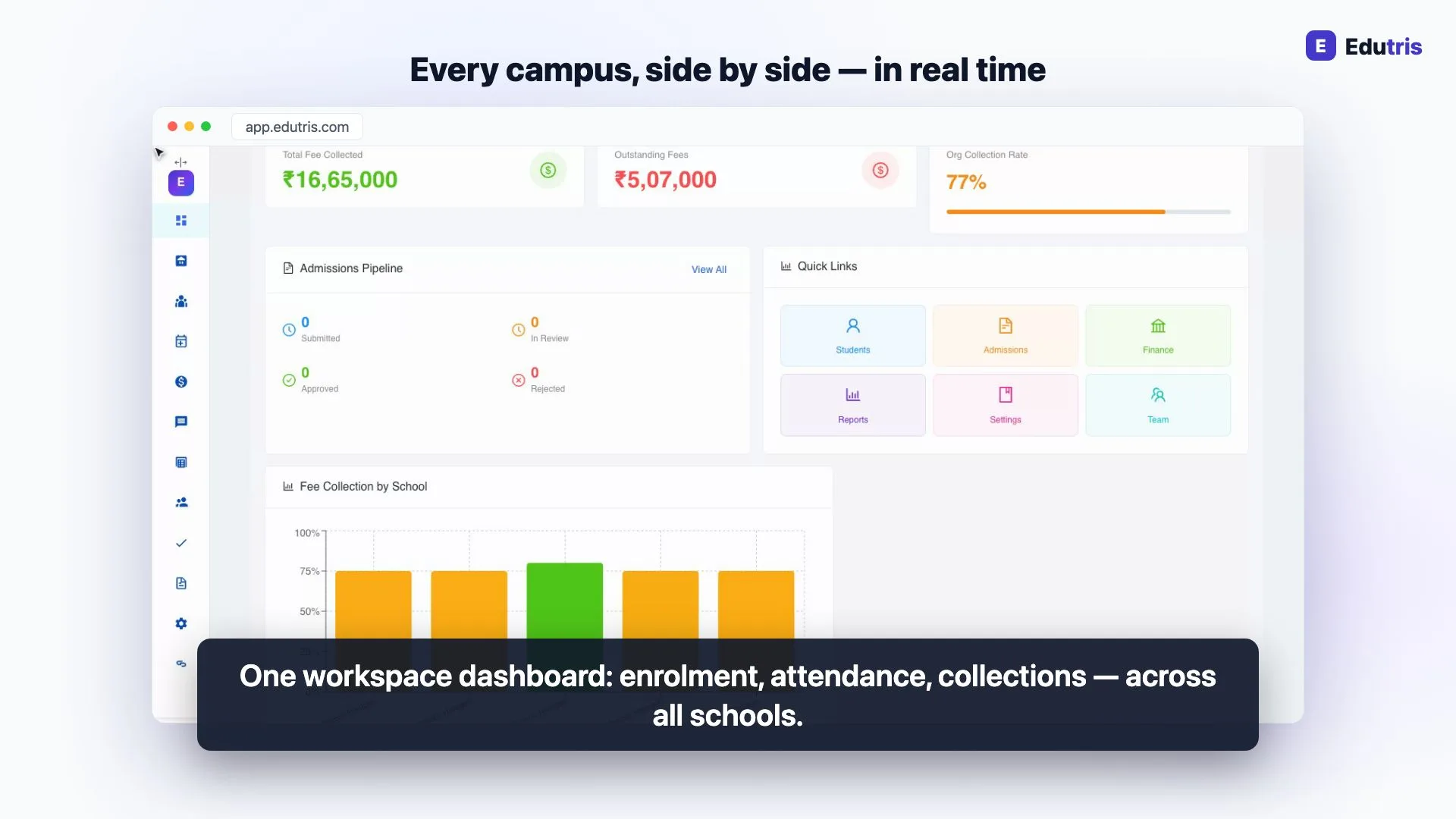
The alternative is a shared data platform where all campuses operate in the same system, and trust-level reports are generated in real time. The trustee can open a dashboard on a Wednesday morning and see exactly what they need without involving any staff member at any campus.
This is not a luxury. It is the operational foundation that allows a trust to make data-driven decisions about resource allocation, expansion, and performance.
The Standardisation Challenge
Multi-school trusts in India consistently struggle with one specific problem: each campus develops its own operational practices over time, and these diverge in ways that make consolidation harder.
Fee structure drift: School A charges ₹45,000/year tuition for Class 6. School B (opened 3 years later) charges ₹52,000/year for the same grade. Both have different heads: School A calls it "Tuition Fee", School B splits it into "Tuition" and "Academic Development Fee". The trust has no common fee structure, which means consolidated fee reports require manual reconciliation.
Calendar inconsistency: Each school negotiates its own calendar with its teaching staff. School A has its annual day in December; School B has it in February. School C took a different exam schedule from the board and its mid-terms fall in different weeks. The trust cannot send a common academic calendar to parents across all three schools.
Report card formats: If each school uses different report card formats (because they built their own or their previous software generated different layouts) the trust cannot compare academic performance across campuses on any standard metric.
Fixing these problems mid-operation is painful. It requires decisions at the trust level, communication to school principals, retraining of staff, and parent communication. The right time to standardise is at the beginning, or at the point when you adopt a common platform.
What Trust-Level Visibility Looks Like in Practice
When a multi-school trust runs on a unified platform, the trust administrator's experience is fundamentally different.
A trust managing three schools with a combined 2,400 students should be able to:
- See total fee collection for all three schools in one view: ₹1.8 crore collected this month vs. ₹2.1 crore expected, with campus-by-campus breakdown
- See attendance by campus as a percentage: Campus A: 91%, Campus B: 87%, Campus C: 94%
- See staff headcount per campus and identify which school has unfilled positions
- See admission pipeline across all campuses: how many enquiries, visits, registrations, and confirmed admissions per school for next academic year
- Generate a consolidated report for the trustee meeting in under 5 minutes
With separate systems at each campus, none of these views exist naturally. Each requires manual aggregation.
Edutris supports multi-school management under a single trust account, with one trust-level admin login and separate logins for each school's principal and accounts team. The data structure ensures each school sees only its own records, while the trust administrator sees consolidated data across all schools.
How to Structure Staffing Across Multiple Campuses
A question trust owners frequently ask is: how many administrative staff do we need per school as we expand?
Benchmarks from schools using unified school management systems:
| School size | Administrative staff (manual processes) | Administrative staff (with school software) |
|---|---|---|
| Up to 300 students | 3-4 admin staff | 2 admin staff |
| 300-800 students | 5-7 admin staff | 3-4 admin staff |
| 800-1,500 students | 8-10 admin staff | 4-5 admin staff |
These reductions are not theoretical. They come from automating the tasks that consume most administrative time: fee follow-up and receipt generation, attendance compilation for reports, exam schedule communication, and report card preparation.
For a trust expanding to a third campus, the question is not just "do we hire another accountant for School C?" but "can we restructure so that one accountant at the trust level oversees fee management across all three schools, with school-level cashiers handling walk-in payments?" Unified software makes this model possible. Separate siloed systems make it impossible.
The staffing efficiency gains across three schools typically offset the cost of a multi-school software subscription within 3-6 months.
See how Edutris handles this → Book a free demo
Edutris supports multi-school trust management with consolidated dashboards, per-campus data separation, and trust-level reporting: available on all paid plans.
Written by the Edutris team, led by Manjunath Shedabal, Founder
Every product claim traces to verified capability; unshipped features live on the roadmap. Read our editorial policy.Free: The School Digitalisation Checklist
25 checkpoints across records, attendance, fees, communication, and compliance: score your school in 5 minutes and see exactly where time and fee revenue leak.
How Edutris gives school owners real-time control
Frequently Asked Questions
Can Edutris manage multiple schools under one login?
Yes. Edutris supports multi-school management from a single trust-level login. The trust administrator sees consolidated reports across all campuses (fee collection, attendance, headcount) while each school's data remains separate and accessible only to that school's staff. Individual school principals see only their own campus data.
What operational problems arise when managing multiple schools?
The most common problems when expanding from one to multiple schools are: data silos (each school maintains separate registers, making trust-level reporting impossible); duplicate administrative effort (the same work is done independently at each campus); inconsistent fee structures (different schools charge different amounts for the same grade without a common policy); no consolidated financial view (the trust cannot see total fee collection across campuses without calling each school); and complex cross-campus student transfers.
How do you standardise operations across multiple schools in India?
Standardisation across multiple schools under one trust requires: (1) a common admission process and form with school-specific fields; (2) standardised fee heads (tuition, development, transport) even if amounts differ per campus; (3) a shared holiday and academic calendar, with school-specific deviations managed centrally; (4) unified reporting formats so the trust board receives consistent data from every campus; (5) a software platform that enforces these standards at data entry rather than relying on staff compliance.
Read next
- 01For School Owners
Running 3+ Campuses From One Console: An Operational Guide to Multi-Campus School Management
A practical walkthrough of multi campus school management: structuring schools under one organisation, consolidated reporting, and governance.
- 02For School Owners
The Admission Season Playbook: What the Office Needs Ready Before the First Application Arrives
An operational playbook for whoever actually runs admission season: the readiness list, a stage-by-stage calendar, and the front-desk capacity math.
- 03For School Owners
CBSE Affiliation, Explained for School Owners: Requirements, Process and the Records That Decide It
Affiliating to CBSE, or renewing? What the Affiliation Bye-Laws expect, how SARAS runs, the mandatory disclosures, and what inspections actually check.
- 04For School Owners
How to Design a School Fee Structure: Heads, Terms, Concessions and Due Dates
A practical guide to designing a school fee structure in India: choosing fee heads, class-wise amounts, collection frequency, concessions and due dates.
- 05For School Owners
How to Increase School Admissions: What Actually Moves the Number, and What Never Will
Most of what decides a school's intake is outside any software. Here is the narrow part you can move this season, and the part you cannot.
- 06For School Owners
NEP 2020 for School Owners and Principals: What Actually Changes in How You Run the School
What the policy says, quoted from the document, and what actually binds your school today. They are not the same thing, and the gap is the whole story.