NEP 2020 for School Owners and Principals: What Actually Changes in How You Run the School
At a glance
| Item | Detail |
|---|---|
| What NEP 2020 is | A policy setting direction for school and higher education, published by the Ministry of Education in 2020 |
| What it is not | A statute. It does not bind a school directly and carries no penalties of its own |
| What actually binds you | Your board's circulars and your state's notifications, which is where the policy turns into a rule |
| The structure it sets out | 5+3+3+4, Foundational, Preparatory, Middle and Secondary, covering ages 3 to 18 (para 4.1) |
| Read the source yourself | The full text is one PDF; every claim below is quoted with its paragraph number |
| What to do this year | Check your own board's current circular before changing anything, and diarise the check |
The National Education Policy 2020 has produced more conference panels than any Indian education document in a generation, and five years on many school owners still cannot answer the only question that matters to them: what exactly do I have to change?
The honest answer is shorter than the coverage suggests. NEP 2020 is a policy, not a statute. It binds no school directly, sets no deadline for one, and carries no penalty. What reaches your school is your board's circular and your state's notification, and those arrive later, separately, and sometimes not at all. Everything below quotes the policy by paragraph number so you can tell the two apart.
Is NEP 2020 actually binding on a school?
No, and getting this wrong is expensive in a specific way.
A policy document sets direction for governments. It is implemented through the bodies that do bind you: your board, through its circulars and affiliation rules, and your state, through notifications. Those bodies may implement a paragraph fully, partially, on their own timetable, or in a form you would not have predicted from the text.
So the sentence "NEP requires us to…" is almost always wrong, and the school that acts on it reorganises twice: once on the policy, once again when the board publishes something different. The sentence that holds up is "our board's circular of date requires us to…".
This does not make the policy irrelevant. It is the best available statement of the direction of travel, which makes it genuinely useful for decisions with long lead times: hiring, buildings, language strategy, and what records you start keeping now. Use it to plan. Do not use it to comply.
What does the 5+3+3+4 structure actually say?
Para 4.1 sets it out precisely, and it is worth reading the actual ranges rather than the diagram everyone reproduces:
| Stage | Grades | Ages | What the policy says about it |
|---|---|---|---|
| Foundational | 3 years of Anganwadi or pre-school, then Grades 1–2 | 3–8 | Five years of flexible, multilevel, play and activity-based learning (para 4.2) |
| Preparatory | Grades 3–5 | 8–11 | Builds on play and discovery, begins light textbooks and more formal interactive learning (4.2) |
| Middle | Grades 6–8 | 11–14 | Introduces subject teachers for more abstract concepts across the sciences, mathematics, arts, social sciences and humanities (4.2) |
| Secondary | Grades 9–12, in two phases | 14–18 | Grades 9 and 10 in the first phase, 11 and 12 in the second (4.1) |
The consequential part is the first row. The policy is explicit that this is new territory: "Currently, children in the age group of 3-6 are not covered in the 10+2 structure as Class 1 begins at age 6. In the new 5+3+3+4 structure, a strong base of Early Childhood Care and Education (ECCE) from age 3 is also included."
For an operator running a pre-primary section, that is the difference between an informal annexe and a stage of school education with curricular expectations attached. It is a planning signal about staffing and space, not a rule that arrived with a date.
Two things it is not. It is not an instruction to rename your classes, and nothing in the text asks for that. And it is not a change to your admission age by itself, the age at which a child may enter Class 1 is set by your state's notification, the cut-off date varies across states, and it is the notification you print your admission notice from, not this document.
What does the policy say about assessment and report cards?
Para 4.35 is the one to read, because it is quoted loosely everywhere. The policy says the progress card "will be completely redesigned by States/UTs under guidance from the proposed National Assessment Centre, NCERT, and SCERTs", and that it "will be a holistic, 360-degree, multidimensional report" including self-assessment and peer assessment alongside teacher assessment.
Notice who is assigned the work: states and union territories, under guidance. The policy does not hand a school a format. So a vendor or a consultant offering you an NEP-compliant report card is offering you an interpretation, and you should ask which state's or board's published format it implements.
On examinations, para 4.37 continues board exams for Grades 10 and 12 and says students "will be allowed to take Board Exams on up to two occasions during any given school year, one main examination and one for improvement, if desired". Again: what your students can actually do next year is whatever your board's scheme for that year says.
The operational reading of this section is not about formats at all. It is that every version of assessment reform asks for more evidence per student than a marks column, project work, portfolios, group work, self-assessment. A school that has been keeping only final marks has nothing to redesign a progress card from, regardless of which format eventually lands. Start keeping the evidence, and the format question becomes a printing question later.
What does it expect of teachers?
Para 5.15 is unusually concrete: "Each teacher will be expected to participate in at least 50 hours of CPD opportunities every year for their own professional development, driven by their own interests."
Whether anyone asks you to prove it, and what they accept as proof, is a board and state matter. But the record-keeping consequence is the same under every version: a school should be able to say, per teacher, what training they did and when. That is a register, and most schools do not keep it, or keep it as a folder of certificates nobody can total.
Para 4.11 carries the language provision, and its qualifier matters: "Wherever possible, the medium of instruction until at least Grade 5, but preferably till Grade 8 and beyond, will be the home language/mother tongue/local language/regional language… This will be followed by both public and private schools." Read it as strategy. It affects hiring, materials and the promise you make to parents, on a horizon of years, and it is being implemented very differently across states.
Which paragraph reaches you, and through whom?
This is the table worth keeping, because it separates the two things that get conflated. The left column is what the document says. The right column is who has to act before it becomes a rule for your school, and therefore what you should actually go and read.
| What the policy says | Paragraph | Who turns it into a rule | What to check, and where |
|---|---|---|---|
| The 5+3+3+4 stages and their age ranges | 4.1 | Boards and states, through curriculum framing | Your board's curriculum circulars; nothing to do until one lands |
| Ages 3–6 brought inside school education | Part I, 4.1 | States, for pre-primary regulation | Your state's rules for pre-primary sections, if it has them |
| Home language as medium until at least Grade 5 | 4.11 | States, and your own school policy | State language notifications; then your hiring and materials plan |
| The redesigned holistic progress card | 4.35 | States and UTs, guided by NCERT and SCERTs | Your state's published format, when there is one; until then, keep the evidence |
| Board exams on up to two occasions a year | 4.37 | Your board, in its scheme for each year | The board's examination scheme for the coming session |
| At least 50 hours of CPD per teacher per year | 5.15 | Boards, through affiliation and inspection | Your board's affiliation bye-laws and inspection checklist |
Two patterns fall out of the right-hand column, and both are useful.
First, nothing in it lands on you automatically. Every row needs somebody else to publish something before it becomes your problem, which is exactly why acting early on the left column is the mistake. The rows also move independently: your board can implement the examination scheme years before your state publishes a progress-card format.
Second, the last two rows are the ones with a named checker. Affiliation and inspection processes are where a school is actually asked to produce evidence, so if you are going to spend effort ahead of a circular, spend it there (on records you can produce on request) rather than on curriculum design you may have to redo. That is not a prediction about policy. It is just where the existing machinery already asks questions.
A practical habit that costs nothing: whenever you read one of these circulars, write its date and reference on the one page where you keep your own position. A school that can say "we do X because of circular Y dated Z" is in a completely different conversation with an inspector than one quoting a policy paragraph.
What does this look like at your size?
A single school under 300 students. Your realistic NEP work this year is two hours, not a project. Read your board's most recent circular, note which paragraphs it actually implements, and write one page saying what changes and what does not. Then start the teacher-training register, because it costs nothing and every version of the reform wants it. Do not restructure anything.
A 900-student school with a pre-primary section. The foundational stage is your live question, and it is a staffing and curriculum question rather than a software one. Decide what your pre-primary is for and what qualifications you are hiring against, on a multi-year horizon. Separately, start capturing assessment evidence beyond marks in at least one grade as a pilot, so that if a redesigned progress card arrives you are populating it rather than inventing history.
A trust with several schools across two states. Your hardest problem is that the two states will not implement the same paragraphs at the same time, and your head office will be tempted to standardise anyway. Do not. Keep a single register of what each board and state has actually notified, with dates, and let the schools differ where the notifications differ. Standardise the record-keeping, which is safe, rather than the curriculum, which is not.
What goes wrong
In the order it actually happens.
Acting on the policy instead of the circular. The expensive one. A school restructures, reprints, or retrains on a paragraph its board has not implemented, then does it again when the board publishes its own version. The fix is a rule: no operational change without a circular reference written next to it.
Buying "NEP-ready" software. The phrase has no definition. Ask the specific question instead: which published board format does it print, and what happens when the board issues a new one? A vendor who answers with an implementation and a change process is telling you something real. One who answers with the word "compliant" is not.
Confusing the stage ages with the admission age. They are different numbers from different documents. The stages come from this policy; the admission cut-off comes from your state's notification for that year. Schools that quote the policy at a parent in an admission conversation end up correcting themselves.
Starting a teacher-training register and not totalling it. A folder of certificates is not a record. If you cannot produce hours per teacher per year without an afternoon of counting, you do not have the thing the policy describes.
Assuming the direction will reverse. Whatever the implementation timetable, the direction of the last five years has been consistently towards more evidence per student and more record-keeping per teacher. Planning as though it might all go away is the one bet the document gives no support for.
What can software honestly do here?
Less than the marketing around this policy suggests, and something real.
It can hold the records every version of the reform asks for: accurate ages and enrolment, assessment evidence per student rather than a single marks column, and training per teacher with dates you can total. It can print the report-card formats a board has actually published, Edutris prints CBSE and ICSE formats alongside a standard format, and a new board format would be something we build, not something that appears.
It cannot make a curricular decision, cannot tell you what your state has notified, and cannot make a claim on your behalf to an inspector. Nobody's software is NEP-compliant, because the policy does not define compliance for a school. If you want a software claim you can check, ask for the format list and the change process, and get both in writing.
The honest bottom line
Read the document once, by paragraph, and keep it as the direction of travel. Then act only on your board's circular and your state's notification, and write the reference next to every change you make.
The work that pays off under every version of this reform is unglamorous and available now: accurate ages and enrolment, assessment evidence beyond a marks column, and a teacher-training register you can total. None of that is a restructure, and all of it is what you would be scrambling to reconstruct if a format landed tomorrow.
Written by the Edutris team, led by Manjunath Shedabal, Founder
Every product claim traces to verified capability; unshipped features live on the roadmap. Read our editorial policy.Checked against the product and its sources on .Free: The School Digitalisation Checklist
25 checkpoints across records, attendance, fees, communication, and compliance: score your school in 5 minutes and see exactly where time and fee revenue leak.
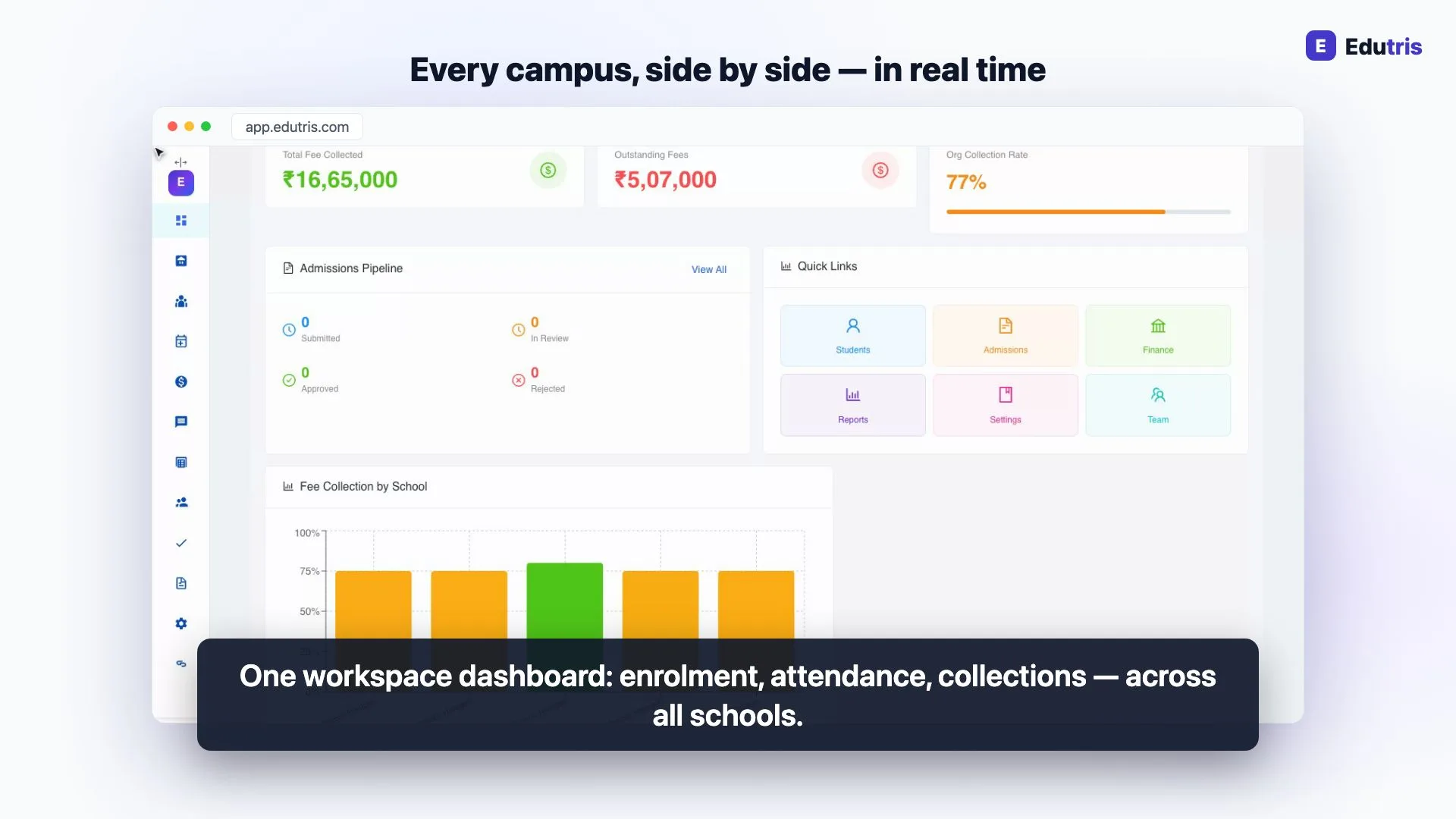
How Edutris gives school owners real-time control
Frequently Asked Questions
Is NEP 2020 legally binding on my school?
Not by itself. It is a policy document, not an Act, and it contains no penalties and no compliance deadlines for an individual school. What binds you is the circular your board issues and the notification your state makes, each of which may implement part of the policy, implement it differently, or not implement it yet. So the operational question is never what the policy says; it is what your board has told you to do.
What is the 5+3+3+4 structure in NEP 2020?
Para 4.1 defines it as the Foundational Stage in two parts, three years of Anganwadi or pre-school plus Grades 1 and 2, together covering ages 3 to 8; the Preparatory Stage, Grades 3 to 5, ages 8 to 11; the Middle Stage, Grades 6 to 8, ages 11 to 14; and the Secondary Stage, Grades 9 to 12 in two phases, ages 14 to 18. The significant part for a school operator is that ages 3 to 6 are inside the structure for the first time.
Do we have to rename our classes to match the four stages?
Nothing in the policy asks you to rename anything, and renaming your sections helps nobody. The stages are a curricular and pedagogical framing, not a labelling requirement. If your board asks for stage-wise reporting at some point, that is a reporting question your records should be able to answer, which is a different problem from what the classes are called on the timetable.
What does NEP 2020 say about the medium of instruction?
Para 4.11 states that wherever possible the medium of instruction until at least Grade 5, but preferably till Grade 8 and beyond, will be the home language, mother tongue, local language or regional language, and that this will be followed by both public and private schools. Read the qualifier carefully: it says wherever possible, and implementation sits with states. Treat it as direction for your language and hiring strategy rather than as a switch to flip.
Is the holistic progress card mandatory?
Para 4.35 says the progress card will be completely redesigned by States and Union Territories under guidance from the proposed National Assessment Centre, NCERT and SCERTs, into a holistic, 360-degree, multidimensional report including self-assessment and peer assessment. The redesign is explicitly assigned to states, so whether it applies to you and in what form is a question for your state and board, not for the policy text.
How many hours of teacher training does NEP 2020 expect?
Para 5.15 says each teacher will be expected to participate in at least 50 hours of continuous professional development opportunities every year, driven by their own interests. Whether anyone checks that, and what evidence they ask for, depends on your board and state. The practical consequence is that a school should be able to show what training each teacher did and when, which is a record-keeping habit rather than a purchase.
Will board exams really be held twice a year?
Para 4.37 says all students will be allowed to take board exams on up to two occasions during any given school year, one main examination and one for improvement, if desired. That is the policy's stated direction. What your students can actually do in a given year is set by the board's own scheme for that year, which is the document your exam calendar has to follow.
What should a school actually change first?
Nothing, until you have read your own board's current circular. The most common expensive mistake is reorganising around a policy paragraph that your board has not implemented, then reorganising again when it does so differently. The genuinely safe work is record-keeping: being able to show training per teacher, assessment evidence per student, and accurate ages and enrolment, because every version of the reform asks for those.
Does school software make a school NEP-ready?
No, and be wary of anyone selling that phrase. Software can hold records that any implementation will ask for, and can print the report-card formats your board publishes. It cannot make a curricular decision, cannot tell you what your state has notified, and cannot make a claim to an inspector on your behalf. Edutris prints CBSE and ICSE board formats alongside a standard format; if your board issues a new format, that is a change we would have to build.
Where do I get the policy text without going through a summary?
It is a single PDF published by the Ministry of Education and it is readable. This article links it in the Sources section below and quotes it by paragraph number so you can check every claim here against the original. That is worth doing at least once, because most secondary coverage of this policy, including coverage written for schools, does not distinguish between what the document says and what any particular board has implemented.
Sources
- National Education Policy 2020, full text (Ministry of Education, hosted by PIB), Read 2026-09-11. Every paragraph number quoted in this article comes from this document. The copy on education.gov.in returned 403 when we tried it; this PIB-hosted copy is the same file.
Read next
- 01For School Owners
CBSE Affiliation, Explained for School Owners: Requirements, Process and the Records That Decide It
Affiliating to CBSE, or renewing? What the Affiliation Bye-Laws expect, how SARAS runs, the mandatory disclosures, and what inspections actually check.
- 02For Principals
UDISE+ for School Administrators: What It Is, What You Must File, and How to Stop Dreading It
Every recognised school in India files UDISE+, and every year the same scramble begins. What it collects, who's responsible, and how to stay ready all year.
- 03For School Owners
The Admission Season Playbook: What the Office Needs Ready Before the First Application Arrives
An operational playbook for whoever actually runs admission season: the readiness list, a stage-by-stage calendar, and the front-desk capacity math.
- 04For School Owners
How to Design a School Fee Structure: Heads, Terms, Concessions and Due Dates
A practical guide to designing a school fee structure in India: choosing fee heads, class-wise amounts, collection frequency, concessions and due dates.
- 05For School Owners
How to Increase School Admissions: What Actually Moves the Number, and What Never Will
Most of what decides a school's intake is outside any software. Here is the narrow part you can move this season, and the part you cannot.
- 06For School Owners
Reducing Student Dropout: How Schools Improve Retention Year on Year
Why families leave a school mid-cycle (fees, communication, academics, transport) and a practical retention playbook that protects enrolment and revenue.