The Admission Season Playbook: What the Office Needs Ready Before the First Application Arrives
At a glance
| Item | Detail |
|---|---|
| What this covers | Running the season inside the office, sequencing, capacity and failure modes, not marketing tactics |
| Stages | Four, freeze the facts, open one intake channel, protect the peak weeks, close the season with written numbers |
| The real constraint | Front-desk attention in the peak weeks, not enquiry volume: one interruptible person is the bottleneck |
| Most common failure | Follow-up stopping in the busiest fortnight, because nobody is standing in front of you asking for it |
| Most expensive failure | Two records of the truth, an application in one place and a promise in a WhatsApp thread |
| What varies by state | Age cut-off dates and RTE admission windows are state-notified, check your own notification for the target year |
| Where software helps | One application record with documents attached and every decision logged; the enquiry before it is still your register's job |
A quick disclosure: Edutris is school software, and we wrote this. This is not the marketing side of admission season. That is how to increase school admissions. This is the operational side: what the office does, in what order, with how many hands. Most of it works with a register and a disciplined person, and where software genuinely helps is named plainly, along with where it does not.
The short version: freeze the facts before enquiries start, run one intake channel instead of four, protect the front desk through the peak fortnight, and write the numbers down while the season is happening. Admission season is not won by working harder in February. It is won by deciding things in October so that February is only execution.
What should the office have ready before the first enquiry arrives?
Nine things, and the test for each is that a new staff member could answer a parent correctly from what is written down.
| Ready before enquiries start | Who owns it | What it costs to skip |
|---|---|---|
| Next year's fee structure, approved and publishable | Management | The desk quotes last year's number, and a family later argues from what it was told |
| The age eligibility rule for the target year, in writing | Principal | Two staff give two answers, and a child is admitted into the wrong class |
| Admission form, print and online, identical fields | Office | The versions collect different data, and the gaps get filled by phone in the peak |
| Parent-facing document checklist | Office | Applications sit incomplete while each side assumes the other asked |
| One place where an application lives | Principal | The problem this whole article is about |
| One named person answering enquiries, plus a backup | Principal | Whoever is free answers, so nobody owns the follow-up |
| One named person allowed to promise a seat | Principal | Two staff promise the same seat, which is the expensive failure |
| The seat count per class, written down and current | Principal | Nobody knows whether there is room, so the honest answer is never given |
| What "waitlisted" means at your school | Principal | Waitlist becomes a polite no, and parents work that out |
Two rows deserve more than a cell.
The age rule. NEP 2020 aligned Class 1 entry at six years, with three, four and five for the pre-primary years, but the cut-off date, the date on which age is measured, is notified by each state, and 1 April, 31 May, 1 June, 31 July and 30 September all exist across India. So the rule you write down is your own state's current notification for the target year, not a number carried over from last year or borrowed from a neighbouring state. Our age-for-admission calculator takes the cut-off as your input for that reason. Put the rule on one sheet, with the date it came from, next to the phone.
The RTE quota, where it applies. The RTE 25% quota runs on the state's own notified process, portal and dates, often with a lottery. Keep that calendar separately and precisely. It will not align with your general timeline, and treating the two as one workstream is how a deadline gets missed.
What does admission season look like week by week?
The months below assume the April-session calendar most Indian schools follow. Shift them if your session starts elsewhere; the sequence does not change, and the sequence is the part that matters.
| Stage | When (April session) | What must be true when it ends | Cost of skipping |
|---|---|---|---|
| Groundwork | Roughly October | Every row of the table above is decided and written down | Each decision gets made mid-call instead, differently each time |
| Ramp | November | One intake channel live, visit slots published, every teacher taught the gate handoff: "let me take your number for the office" | The season starts before the office does, and the earliest enquiries are handled worst |
| Peak | December to February | Visits happening, every enquiry carrying an owner and a dated next action, follow-up inside 48 hours | Nothing looks broken; enquiries go quiet and you cannot say which |
| Conversion | February | Every family who visited and did not apply has been called once, honestly | Fence-sitters resolve themselves elsewhere by default |
| Close | March | Waitlists answered, four numbers written down, three fixes diarised for October | Next October opens with a reconstruction instead of a record |
The logic of that order is what people break, so state it outright: nothing in the peak stage is a strategy decision. By December the office should be executing choices already made, the fee number, the age rule, who may say yes, what waitlisted means. Any decision still open when the peak arrives gets taken by whoever is on the phone, under time pressure, without the principal, and taken differently on Tuesday than on Monday. That is a sequencing problem, not a discipline problem, and it is fixable in October for free.
How do you stop the enquiry list and the WhatsApp thread being the system of record?
By deciding, once, which one is the record, and treating everything else as a conversation.
The failure has a recognisable shape: a register, plus a WhatsApp thread where the real conversation happened, plus a note on the desk about a family coming on Saturday. Each is partly true. None answers the only question that matters in the peak weeks, who is waiting for us to do something? Chat threads especially cannot answer it, are invisible to everyone but the staff member holding the phone, and leave the building when that person goes on leave.
Whatever holds your list needs four fields per enquiry and no more: source, owner, status, next action. Source tells you where to spend next year. Owner is a person's name, not a role. Status is short and honest. Next action carries a date: an enquiry without one is not being followed up, whatever everyone intends.
Then adopt one rule and enforce it visibly: a promise that is not in the record did not happen. It sounds bureaucratic and it is the cheapest fix here, because it turns "I think someone spoke to them" into a question with an answer.
Reply wherever the parent starts, WhatsApp included: insisting families come to your channel is a good way to lose them. But log the enquiry in the school's record in the same sitting, before the next call arrives. And be clear-eyed about tooling: Edutris does not send on WhatsApp. School-side updates go out by app notification, SMS, email and in-app message.
An application link earns its place by removing a class of retyping and chasing: in Edutris, families apply through a public per-school link with no login, attach their documents in the same visit, and get a tracking ID and status page, so "what is happening with our form?" has a self-service answer. The online admission pipeline covers that mechanism; the plain limits are at the end of this article.
What happens when two staff promise the same seat?
Prevent it structurally, because care alone stops working once three people answer the phone.
Prevention is three decisions. One named person may promise a seat in each class. The seat count per class lives in one place and is current, on paper is fine, in someone's head is not. And a promise is real only once recorded as a decision on the application, not once it is said. In Edutris, approving, rejecting, waitlisting or withdrawing an application is an explicit action that is timestamped, attributed and written to the audit log, so "who approved this, and when?" still has an answer in June. Be precise about what that buys: an unambiguous record of who decided what. It does not enforce a seat cap, and Edutris does not do rank-based seat allotment or entrance-test scheduling. The seat count stays a human decision one named person owns.
Recovery, when it has already happened. Move the same day, before either family tells anyone else. The principal makes both calls, not the staff member who made the promise. This is a school-level error and should be owned at school level. Say plainly that the school made a mistake, then give each family a real option rather than an apology: a place in the other section, a dated position on the waitlist, a named date for confirmation, or, if you are genuinely full, an honest release so they can act on another offer. Record what was offered against each application, because the second conversation is the one that gets misremembered.
What turns an embarrassing mistake into a story that circulates for years is silence. Two families believing they hold the same seat until April is far worse than one difficult phone call in January.
How do you run a waitlist without misleading parents?
By saying less, more precisely. A waitlist is honest only if it describes something you actually maintain.
| A parent asks | An honest answer | Do not say |
|---|---|---|
| "Are we in?" | "You are waitlisted, not pending: the application is complete and there is no seat today." | "It should be fine" |
| "Where are we on the list?" | The position, if you genuinely keep one and will honour it; otherwise, that you do not rank the list. | An invented number |
| "Will a seat open?" | What it depends on (withdrawals before the session starts) and that you cannot predict it. | "Usually a few open up" |
| "Should we hold the other school's offer?" | "Yes. Do not give up a confirmed seat for our waitlist." | Anything that discourages them from protecting their child |
| "When will we know?" | A date, and a commitment to call either way. | "We will let you know" |
The mechanics exist to make that last promise happen: recording waitlisted as a status on the application, rather than a note in someone's memory, is what turns March follow-up into a filterable list. On Professional plans and above with AI switched on, Edutris can draft the parent reply for any admission status (including the waitlist ones nobody enjoys writing) but a person reads, edits and sends it. And one honesty note that affects staffing: Edutris flags applications waiting more than 48 hours in the principal's daily attention view, with a one-click way to act. That is a nudge to you, not an automatic chaser to the parent.
What does this look like at your size?
The sequence is identical at every size. What changes is who does it, and whether the arithmetic works.
A 180-student school with one office person and a hands-on principal. The binding constraint is interruptions, not volume. One intake channel, one register, and a protected twenty minutes at the end of each day for follow-up calls, protected because it is the only work with nobody standing in front of it. Any conversation involving a seat goes to the principal.
A 900-student school with three sections a grade, a front desk and an admissions coordinator. The risk moves from capacity to consistency: two people answering the same question differently, and the seat count living in two heads. Split the roles explicitly (the desk logs and books, the coordinator follows up and checks documents, the principal alone approves) and stand up over the register three times a week during the peak. Then check the arithmetic before the season, using clearly hypothetical numbers for one peak week:
| Line | Hours in one peak week (hypothetical) |
|---|---|
| 60 enquiries × 12 minutes to log, answer the real questions and book a visit | 12.0 |
| 18 campus visits × 45 minutes hosted properly | 13.5 |
| 18 follow-up calls × 8 minutes, made inside 48 hours | 2.4 |
| 25 applications × 6 minutes to check documents against the checklist | 2.5 |
| Total admission work in the week | 30.4 |
| One person's realistic capacity, after the rest of the front desk's job | ~20.0 |
| Gap | 10.4 |
Those inputs are invented for illustration, put your own counts in. The value is the shape of the answer, because a gap like that is never closed by working harder. It is closed by dropping the cheapest-feeling line, and that is always follow-up: the only item with nobody physically waiting for it. Which is how a school finishes the season convinced enquiries were down, when what fell was second contact. Two fixes, both available in October: give visit-hosting to a rota of teachers so the desk is not doing it, and let parents fill the form and upload documents themselves, so those 6 minutes become verification rather than data entry.
A trust running three schools. Decide once, at the top, what the shared answers are (the age rule per state, what waitlisted means, who may approve) then let each school run its own list. What breaks in a trust is comparison: three schools counting an "enquiry" differently, so the season report is arithmetic over three definitions. Fix the definition before the season, not during the review.
What goes wrong, and what to do about it
Ordered by how often it actually happens.
Follow-up quietly stops during the busiest fortnight. The most common failure by a distance, and it is capacity, not motivation. Nothing looks broken: enquiries just go quiet. Protect a fixed slot for calls, and review the register's next-action column at the stand-up so an empty one is visible.
There are two records of the truth. The register says one thing, the thread says another. Pick the record and enforce the unrecorded-promise rule. Migrating the old thread is not worth it; from today forward is enough.
Documents arrive and nobody checks them against a checklist. Applications sit half-complete while each side waits for the other. Publish the checklist to parents, and if your system supports it, make the required kinds explicit so a parent sees what is missing without calling. In Edutris that checklist is a principal setting, off until you turn it on, and an application whose required documents are all in advances itself to under review, a deterministic rule, not AI.
Two staff promise the same seat. Prevention is one named approver plus a written seat count; recovery is a same-day call from the principal with a real option attached.
A waitlisted family learns their outcome from another parent. What a missed "we will call either way" feels like from outside. Waitlist follow-up is the last thing done and the first cut, so give it a date and a named owner in the close stage.
Enquiry sources are never recorded, so next year's plan is a guess. One field, filled at first contact, is the whole fix, and it takes a season to become useful, which is why it is worth starting even in a year you have lost track of.
The season ends and nobody writes the numbers down. Ninety minutes in March: the four counts, the reasons families gave for going elsewhere, three fixes diarised for October. Skip it and next October begins with an argument about what happened.
Which parts does the software actually do, and which stay yours?
Worth being precise, because vagueness here is how a school buys something and keeps the spreadsheet anyway.
What Edutris does. A public application link per school, no parent login. Parents type their own details and attach documents from a phone, images or PDFs, a capped number per application, with the file type verified server-side rather than trusted from its name. Private storage only the school can view, designed with DPDP principles in mind, including automatic deletion of a rejected application's documents after a retention period you set. A tracking ID and self-service status page. An optional required-document checklist that advances a complete application to under review. A pipeline with real actions (review, approve, reject, waitlist, withdraw) each timestamped, attributed and audit-logged, plus pipeline counts for the season and a daily flag for applications waiting over 48 hours. Approved applications become student records without anyone retyping the child's details. On Professional and above with AI enabled, drafts a human reviews before anything is sent.
What it does not do, so you can plan around it: it does not send on WhatsApp; it does not schedule entrance tests or allot seats by rank; it does not enforce your seat cap; it does not chase parents on its own; and there is no public API or webhooks for pushing applications into another system.
What stays yours, and would with any vendor: the seat count and who owns it. The age rule for your state, checked against the current notification. What waitlisted means here. Who may say yes. And the call to a family when something has gone wrong, which no system makes for you, and which is most of what parents will remember about your admission season.
The honest bottom line
Admission season is a sequencing and capacity problem wearing a marketing costume. The schools that run it calmly decided nine things in October, kept one record instead of three, protected the front desk in January, and told waitlisted families the truth on a date they had committed to.
Do the arithmetic before the season rather than after it. If a peak week needs thirty hours of admission work and one person has twenty, that is not a motivation problem to be met with encouragement in February. It is a staffing and tooling decision, available now, in the quiet month.
Download the one-page season planner below, put the readiness table on the principal's wall, and if you want to see the pipeline running on your own school's process, book a walkthrough or start a 30-day guided pilot.
Written by the Edutris team, led by Manjunath Shedabal, Founder
Every product claim traces to verified capability; unshipped features live on the roadmap. Read our editorial policy.Checked against the product and its sources on .Free: The Admission Season Planner
The whole season on one printable page, every checkpoint from fee-structure freeze to the closing retrospective.
How Edutris gives school owners real-time control
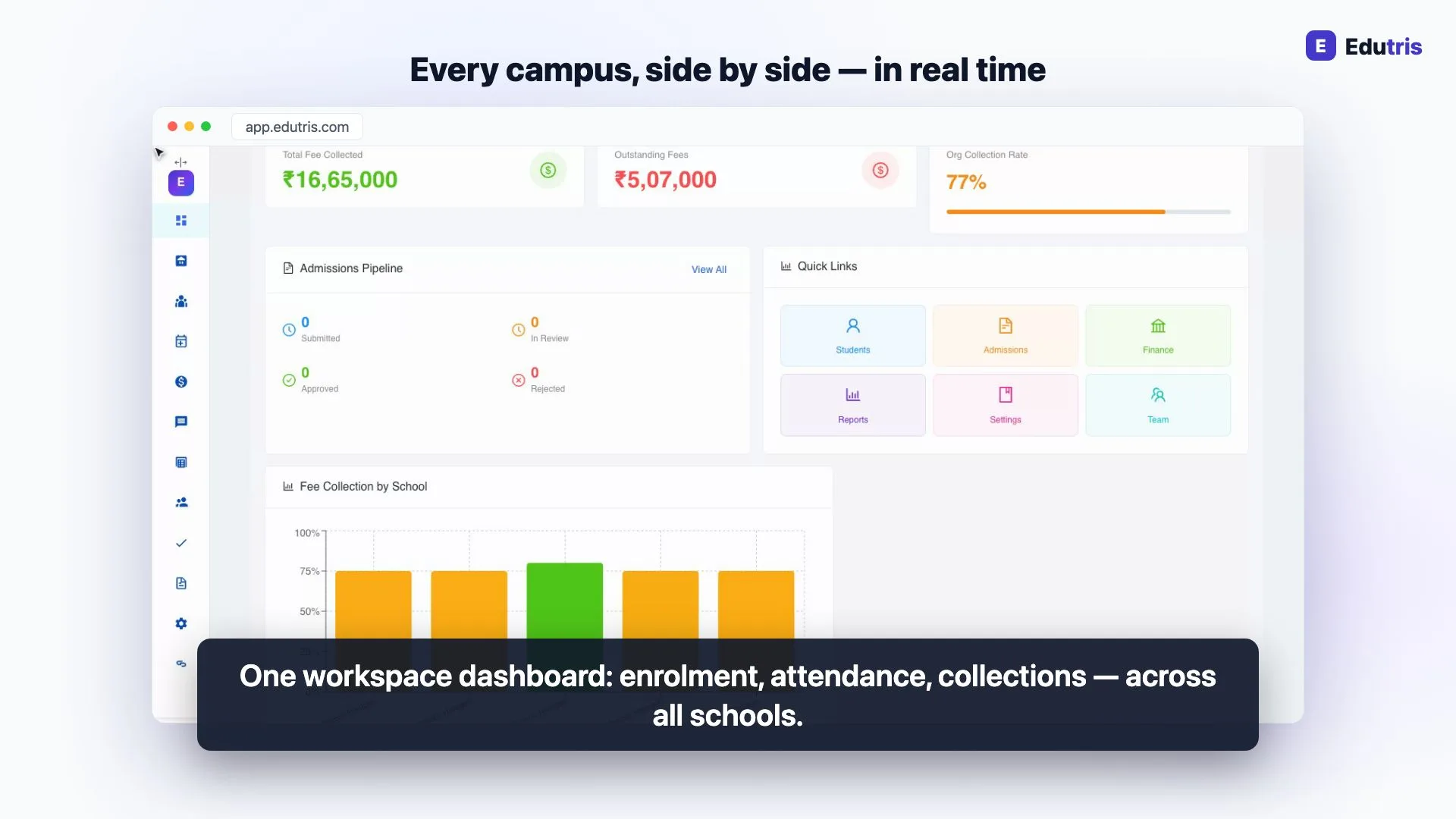
Frequently Asked Questions
When does school admission season start in India?
For the April academic year most Indian schools follow, enquiries build from around November, peak through December to February, and close during March, while state RTE-quota admissions run on their own notified calendars, which do not have to line up with yours. The operational implication is what matters: your groundwork (fee structure approved, age eligibility written down, one intake channel open, a named person answering the phone) has to be finished before the first enquiry arrives, not during the peak.
How should a school prepare for admission season?
Freeze the facts, then fix the plumbing. The facts are next year's fee structure, the age eligibility rule for the target year, the document checklist and what a waitlist means at your school. The plumbing is one place where an application lives, one named person who answers enquiries with a named backup, and one named person allowed to promise a seat. Almost everything that goes wrong in February traces to one of those eight things never being decided, so it gets decided instead by whoever happens to be on the phone.
What documents should be ready for admission season?
The admission form in print and online with identical fields, the approved fee structure for the coming year, the age criteria as notified by your state for the target admission year, the parent-facing document checklist (birth certificate, transfer certificate, photographs, and category or income certificates where they apply), and a working way to receipt the admission fee. Freezing these before enquiries start is what prevents mid-season improvisation, which is where two staff members start giving two different answers.
Who should own admission follow-up in a school office?
One named person, with one named backup, and the name should be written down rather than understood. Shared ownership of follow-up reliably produces no follow-up, because each person assumes the other called. The owner does not have to be senior. They have to be reachable and consistent. What senior staff own instead is the decision: who is allowed to say yes to a seat, and who talks to a family when something has gone wrong.
How many admission enquiries can one front-desk person handle in a peak week?
Do the arithmetic for your own school rather than trusting a number from anyone else's. Count the enquiries you expect in a peak week, multiply by the minutes it takes to log one properly and answer the family's real questions, add the hosted campus visits, the follow-up calls and the document checks, and compare that total against the hours that person actually has after the rest of the front desk's job. If the total exceeds the hours you actually have, that is useful to know in October and painful to discover in January.
What should a school do when two staff have promised the same seat?
Fix it the same day, and have the principal make the calls rather than the staff member who made the promise. Tell both families the truth, offer each a real option (a place in the other section, a dated position on the waitlist, or a review by a named date) and record what was offered against each application. What turns an embarrassing mistake into a lasting reputational problem is silence: leaving both families believing they have the seat until one of them turns up in April to enrol.
How do you run a school waitlist without misleading parents?
A waitlisted family is owed four things: that they are waitlisted rather than pending, what a seat opening actually depends on, when you will next contact them either way, and an honest answer about whether they should hold another school's offer. Give a position on the list only if you genuinely maintain one and honour it, and never imply a seat is likely when it is not. Recording the waitlist as a status on the application rather than a note in someone's memory is what makes the follow-up call happen at all.
Should a school stop using WhatsApp for admission enquiries?
Reply wherever the parent starts, including WhatsApp, but never let the thread be the record. A chat thread cannot tell you who is waiting for an answer, is invisible to the rest of the office, and leaves with the staff member's phone. The workable arrangement is to answer in the parent's channel and log the enquiry in the school's record in the same sitting. Note that Edutris does not send on WhatsApp, school-side updates go out by app notification, SMS, email and in-app message.
Does Edutris track enquiries before a family formally applies?
The Edutris admissions pipeline runs on applications: a family applies through your school's public link, the application arrives with documents attached and a tracking ID for the parent, and the office moves it through review, approval, rejection, waitlist or withdrawal with every decision recorded. An enquiry that has not yet become an application still needs an owner and a next action wherever you keep it, so decide deliberately whether your register or the application link is where the season's list lives, the failure mode is keeping both, half-filled.
How do we tell whether admission season actually went well?
Against your own previous year, using four counts written down at the time: enquiries received, campus visits hosted, applications completed, and children enrolled: plus a list of the reasons families gave for choosing elsewhere. We deliberately publish no benchmark conversion rate, because the honest one depends on your city, fee level, board and how loosely you count an enquiry. The comparison that improves anything is with your own last season, which is why the numbers have to be recorded during the season rather than reconstructed in April.
Read next
- 01For Principals
An Online Admission Process for Schools: Without the Spreadsheet Chaos
How Indian schools can replace paper forms, duplicate entries and lost documents with an online admission pipeline: apply, track, review, approve or waitlist.
- 02For School Owners
How to Increase School Admissions: What Actually Moves the Number, and What Never Will
Most of what decides a school's intake is outside any software. Here is the narrow part you can move this season, and the part you cannot.
- 03For School Owners
CBSE Affiliation, Explained for School Owners: Requirements, Process and the Records That Decide It
Affiliating to CBSE, or renewing? What the Affiliation Bye-Laws expect, how SARAS runs, the mandatory disclosures, and what inspections actually check.
- 04For School Owners
How to Design a School Fee Structure: Heads, Terms, Concessions and Due Dates
A practical guide to designing a school fee structure in India: choosing fee heads, class-wise amounts, collection frequency, concessions and due dates.
- 05For School Owners
NEP 2020 for School Owners and Principals: What Actually Changes in How You Run the School
What the policy says, quoted from the document, and what actually binds your school today. They are not the same thing, and the gap is the whole story.
- 06For School Owners
Reducing Student Dropout: How Schools Improve Retention Year on Year
Why families leave a school mid-cycle (fees, communication, academics, transport) and a practical retention playbook that protects enrolment and revenue.