How to Increase School Admissions: What Actually Moves the Number, and What Never Will
At a glance
| Item | Detail |
|---|---|
| What this covers | Demand, why enquiries do or do not arrive, and which causes a school can actually move |
| What it does not cover | Running the season itself; that is the admission-season playbook, linked throughout |
| The tractable causes | Three, being findable, answering fast, and not losing the families you already have |
| The untractable ones | Reputation, results, the building, fees, distance, and who else opened down the road |
| Cheapest lever, almost always | Keeping the families already enrolled, because they cost nothing to win and they talk |
| Benchmarks published here | None, deliberately. We have no dataset we could draw an honest one from, so we give you a way to measure your own |
| What software does not do | No enquiry CRM, no source-wise conversion report, no automatic chaser to parents, no WhatsApp sending |
We make school software, which tells you what we would like the answer to be. The awkward part of writing this honestly is that most of what determines your intake is not something we sell, and much of it is not something anybody sells.
The short version: your admission numbers are mostly decided by reputation, results, the building, your fee level and how far families travel: none of which move in a season. The part that does move is narrow. Be findable. Answer fast. Stop losing the families you already have.
This article is about demand. Running the season itself (readiness list, calendar, front-desk arithmetic) is the admission-season playbook.
Why are our admission numbers what they are?
Because of about ten things, and a school controls them at wildly different speeds. That ordering is the useful part: it tells you which conversations are worth having in September.
| What decides intake | You control it | It moves in | It costs |
|---|---|---|---|
| What current parents say about you | Completely, via everything else | Years | Attention, not money |
| Results, and whether parents see them | High | One to three cohorts | Teaching capacity |
| How the campus looks on a Saturday | High | Weeks | Repair, paint, care |
| Your fees against nearby schools | High | One season | Revenue, directly |
| Distance, and whether a bus goes | Partly | One season, with a route | Capital and drivers |
| Whether families can find you | Completely | Days | Almost nothing |
| Whether the phone gets answered fast | Completely | Today | A named person |
| Whether enquiries reach enrolment | Completely | Today | Discipline, not money |
| Whether existing families stay | High | A cycle | The same attention |
| A new school opening nearby | Not at all | ( | ) |
The uncomfortable part is the correlation running down it: the rows with most influence over intake move slowest and cost most, and the rows you can fix this week are the smallest. Which is why the usual advice fails, do these seven things and admissions will grow assumes your problem lives in the last four rows, and if it lives in the first five, the seven things produce activity and no children.
Which of those causes can a school move this season?
Three, and the work is different for each.
Being findable. Most families start with a search, and a surprising number of schools lose them there: no listing, a wrong phone number, a site that never says which board or exactly where the school is. Claim the business listing, fix the number and address, and make the site answer the five questions every parent has: board, fees or at least the range, timings, transport, how to apply. A few hours of work, no money, and the one row where a small school stands equal to a large one. We do not do this part for you: Edutris builds no website, manages no listing and runs no advertising.
Answering fast. An enquiry answered within the hour reads as a school that wants your child; the same one answered on Thursday reads as a school that will handle your child the same way. That is the whole insight, and it is still the most underdone thing in Indian school admissions, because whoever would answer is also doing five other jobs. The hours a peak week needs are worked out in the season playbook, do that arithmetic in October.
Not losing what you already have. The one schools skip, and usually the cheapest lever available. Two sections down.
Note what is absent: buying attention. It belongs after these three, since all it does is deliver more people into the process you have.
Why do enquiries arrive and then go nowhere?
Because nobody owns them, and the record is split across a register, a phone and someone's memory.
Before fixing leakage you have to know you have it, and that takes four counts kept for one season: first contacts, campus visits, completed applications, children enrolled. Tallies on a sheet are fine if that is what will actually happen. Then read the shape:
- Very few first contacts, most of them converting. A demand problem, fixable only by the slow rows: visibility, reputation, results, transport. No follow-up discipline rescues the year.
- Plenty of first contacts, few enrolments. A leakage problem, and the good news, because leakage yields to attention rather than budget.
- Plenty of both, and the roll still flat. A retention problem wearing an admissions costume. Next section.
Now the honest part about our own product. The Edutris admissions pipeline runs on applications, not enquiries: a family who rings to ask about Class 3 is not in it until they apply. There is no enquiry CRM, no source-wise conversion report, and nothing that chases a parent automatically. The enquiry stage stays your register's job, four columns, no more: source, owner, status, next action with a date. The failure we see most is two half-filled lists and a chat thread.
One rule is worth enforcing out loud: an enquiry with no dated next action is not being followed up, whatever anyone intends.
Is our admissions problem actually a retention problem?
Very often, and the arithmetic shows it the moment somebody writes it down. Here is a worked year with invented numbers, put your own in.
| Line | Students (illustrative) |
|---|---|
| Roll on the first day of last session | 612 |
| Less: the final-year cohort, leaving as expected | −58 |
| Less: families who moved city or state | −11 |
| Less: families who transferred to another local school | −29 |
| Less: families who left over fees | −7 |
| Continuing students | 507 |
| Plus: new admissions won this season | 96 |
| Roll on the first day of this session | 603 |
Every difference has a named cause, which is the deliverable. Read it and the school's account of itself falls apart: it won 96 admissions, fought for every one, and finished nine children smaller. In the staff room that becomes "we need more admissions". It is not. Fifty-eight departures were always going to happen and eleven were nobody's fault, but thirty-six were a choice a family made about this school, and they cost nothing to keep, while the 96 cost a season.
You cannot build that table unless someone records a reason against every transfer certificate, in one line, while the reason is still known. A year of those lines turns "we seem to be losing students" into a list: transport, a fee increase handled badly, one class transition. The retention side of this is an article of its own; if your table looks like that, read it before spending on marketing.
The reputational half never reaches a spreadsheet. Current parents are the only sales force a school has that families believe, so churn gets asked about by the very people you are recruiting.
What does not work, or works far more slowly than it is sold?
Most of this is actively sold to schools every October.
Hoardings and newspapers as a first move. Name recognition is real but slow, and close to unattributable: nobody tells your front desk they rang because of a hoarding. Defensible once the rest converts, wasteful while it does not.
Discounting to fill seats. Fast and very hard to reverse: the discount becomes next year's expected price, existing parents learn about it, and revenue is cut exactly when it was short. A bounded sibling benefit or a dated early-admission window is different, because it carries a reason other than desperation.
Buying lead lists, or signing an agency retainer before the phone gets answered. Contacts who never asked about your school are interruptions, not enquiries, and working them burns the one resource your front desk lacks in January. Paying for traffic into a process that loses families is the most expensive version of leakage.
Incentivised or fabricated reviews. Parents in a local market compare notes, and a wall of identical five-star reviews is read correctly. Ask ten happy families for honest ones instead.
A rebrand as the opening move. A new logo and brochure feel like progress and are visible to leadership, which is why they get chosen. They rarely change a family's decision.
Announcing facilities that do not exist yet. A promised lab creates a first-term complaint and a second-year exit. Go carefully with eligibility and quota claims too: RTE 25% processes, admission windows and age cut-off dates are state-notified and vary, so work from your own state's current notification rather than a neighbour's advertisement. The RTE quota guide covers that process; our age-for-admission calculator takes the cut-off as your input for the same reason.
What should we measure, and why do we publish no benchmark?
Articles quote a healthy enquiry-to-admission conversion rate, an expected enrolment growth percentage, a cost per admission. We publish none of those, and the reason is not modesty.
A conversion rate depends on your city, your fee band, your board, how many schools sit inside a realistic commute, and (decisively) how loosely you count an enquiry. A school logging every walk-in shows a far worse rate than one logging only families who asked for a form, and the second is not performing better. Any national figure is arithmetic over incompatible definitions. We also hold no dataset we could honestly derive one from, and inventing a plausible number would be the easiest thing in this article to do and the worst.
What replaces a benchmark is your own previous year: keep the four counts during the season rather than reconstructing them in April, add a reason from every family who chose elsewhere, and review it in March.
Two notes on our own software. Edutris shows admissions pipeline counts for the season and flags applications waiting more than 48 hours in the principal's daily attention view, a nudge to you, not an automatic message to the parent. It does not report conversion by source, because it never saw the enquiry. That field lives in your register.
How does this change with school size?
The causes are identical everywhere. Who can act on them is not.
A 240-student school with one office person. The advantage is that the principal can still speak to every family personally, which beats any campaign a larger school buys. The constraint is that the same person answers the phone, hosts the visit and checks documents. So do three things: fix the search listing and the website's five answers in one sitting; protect twenty minutes at day's end for callbacks, because that work has nobody standing in front of it; and record a leaving reason on every TC.
An 1,100-student school with a front desk and an admissions coordinator. The problem moves from capacity to consistency, two people answering the same fee question differently, nobody owning the enquiry list. Split the roles explicitly, keep one register instead of three, and segment departure reasons by class, because a repeated dip after a particular grade is a signal rather than noise.
A trust running four schools. The trap is comparison. Four schools counting an enquiry four different ways produce a board report that is arithmetic over four definitions, and the weakest looks fine because it counts most generously. Settle the definitions centrally before the season, then leave each school its own list.
Our pricing follows the same sizes: Starter ₹2,999 up to 250 students and no AI, Professional ₹7,999 up to 1,000, Growth ₹14,999 up to 3,000, Enterprise custom.
What goes wrong most often, and what to do instead
Ordered by how frequently it actually happens.
Marketing spend is committed before anyone knows whether the problem is demand or leakage. The most common expensive mistake, by a distance. Do the four counts first, even roughly.
Follow-up stops during the busiest fortnight. Nothing looks broken; enquiries simply go quiet. That is a capacity failure, not a motivation failure, and the fix is a protected slot and a visible next-action column, not encouragement.
Nobody records why families left. So the cheapest lever available stays invisible, year after year. One line at TC issue is the whole fix, written while the reason is still known.
The school competes on something families are not choosing on. Schools argue about curriculum and infrastructure; families often decide on distance, the bus, the fee and how the office made them feel. Ask ten recent joiners why they chose you and ten recent leavers why they did not stay.
Nobody writes the season's numbers down. So next October opens with an argument about what happened.
Which parts does software actually touch, and which stay yours?
Precision matters here: vagueness is how a school buys a system and keeps the notebook anyway.
What Edutris does. A public application link per school, no parent login, so a family applies from a phone and attaches documents: images or PDFs, file type verified server-side rather than trusted from its name, held privately for the school, designed with DPDP principles in mind, deleted automatically after a retention period you set once an application is rejected. A tracking ID and status page, so a parent checks progress instead of ringing. A pipeline with real actions (review, approve, reject, waitlist, withdraw) each timestamped, attributed and audit-logged, plus pipeline counts and the 48-hour waiting flag. Approved applications become student records without retyping the child's details. On Professional and above with AI switched on, it drafts the parent reply for any admission status; a person reads, edits and sends it.
On the retention side (the admissions lever this article keeps pointing at) fee status with receipts, attendance and marks visible to parents in the portal and the app, and on Professional and above with AI on, a monthly Child Growth Summary built from the school's own records, facts first and reviewed by a human. Parents are reached by app notification, SMS, email and in-app message.
What it does not do. It does not generate demand. No enquiry or lead CRM, no source-wise conversion reporting, no automatic chaser to parents, no WhatsApp sending. No entrance-test scheduling, no rank-based seat allotment, no seat-cap enforcement. No website, listing or advertising. No public API or webhooks.
What stays yours. The reputation. The results. Answering the phone within the hour. Who gets the seat. And the conversation with a family who is leaving, which is where you find out what is wrong.
The bottom line, stated plainly
Admissions is mostly a slow game played with reputation, results and the building, and partly a fast one played with visibility, response time and not losing families. Schools reach for the fast game because it is the one available, then blame it when the slow game was the problem.
So before spending anything: count first contacts and enrolments for a season, write a reason on every transfer certificate, and read your roll arithmetic with the leavers named. If thirty-six families chose elsewhere while you fought for ninety-six new ones, the cheapest campaign available is aimed at the parents already inside your building.
Download the season planner below for the operational half. To see the pipeline on your own school's process, book a walkthrough or start a 30-day guided pilot.
Written by the Edutris team, led by Manjunath Shedabal, Founder
Every product claim traces to verified capability; unshipped features live on the roadmap. Read our editorial policy.Checked against the product and its sources on .Free: The Admission Season Planner
The whole October-to-March season on one printable page, every checkpoint from fee-structure freeze to the March retrospective.
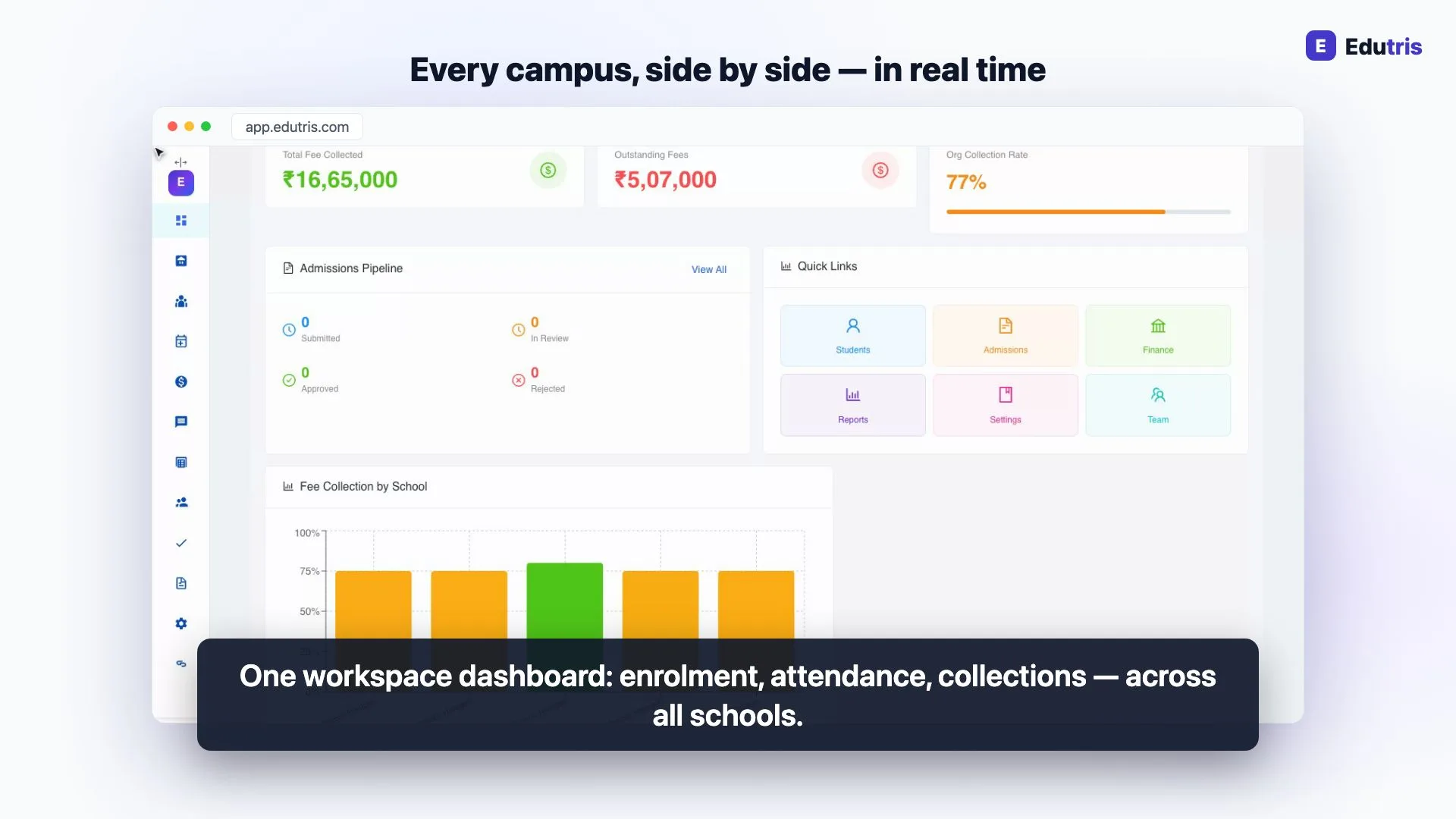
How Edutris gives school owners real-time control
Frequently Asked Questions
What actually decides how many admissions a school gets?
Mostly things that are slow and expensive to change: the school's reputation among parents who already know it, its results, the state of the building, the fee level relative to nearby schools, and how far families have to travel. Marketing sits on top of those; it does not replace them. The causes a school can move inside one season are narrower, whether families can find the school online, whether the phone is answered the same day, and whether the enquiries already arriving survive to enrolment.
How can a school increase admissions quickly?
Only by fixing leakage, because everything else is slow. Answer every enquiry the day it arrives, offer a specific visit slot rather than an open invitation, call back after the visit, and make applying possible without a third trip to campus. None of that creates new demand, it stops you losing demand you already paid for. If enquiries genuinely are not arriving, no amount of speed helps, and the honest answer is that the fix takes longer than one season.
What is a good enquiry-to-admission conversion rate for schools?
We publish no number, and we would treat anyone who does with caution. A conversion rate depends on your city, your fee level, your board, how much competition sits within travelling distance, and (decisively) how loosely you count an enquiry, since a school that logs every walk-in will look worse than one that logs only serious families. We also have no dataset we could draw an honest figure from. Measure your own for one season and compare it with your own next season.
When should a school start admission marketing in India?
For schools on the April session, enquiries build from roughly November and peak between December and February, which means the preparation has to be finished by around October. Starting in January is the expensive mistake: you are competing for attention at the busiest moment with the least ready office. The groundwork worth doing early is unglamorous, a findable listing, a website that answers the obvious questions, a named person who answers the phone, and a decision about where enquiries get written down.
How do we get more parents to visit the campus?
Ask specifically, and make it easy to say yes. An enquiry conversation that ends with two named time slots produces more visits than one ending with an open invitation to drop by, because a vague offer leaves the planning to the parent. Publishing a few fixed open-house dates for the season helps for the same reason: it gives a family a date to discuss at home rather than a decision to make on the phone.
Should a school publish its fees on its website?
Publish at least the range and what it includes. Schools withhold fees to force a phone call, but most families read a hidden fee as either expensive or disorganised and quietly move on to a school that told them. Publishing also filters out enquiries you were never going to convert, which is a gift to a front desk already short of hours in January. If your structure genuinely varies, publish the band per stage rather than one number.
Is it worth advertising a school on hoardings or in newspapers?
It buys name recall rather than enquiries, and it is the hardest spend to attribute, because nobody who saw a hoarding tells the front desk that is why they called. It is defensible once the rest is working, a school that answers its phone, converts visits and keeps its families can afford to build recognition. It is close to wasted while any of those are broken, since it only pushes more people into a process that is already losing them.
Is offering an admission discount a good way to fill seats?
It is fast and it is hard to undo. A discount offered to fill seats becomes the price families expect next year, existing parents find out about it, and the school has cut its own revenue at the moment it most needed the money. If you use one, make it specific and bounded (a sibling benefit, or a genuinely time-limited early-admission window) so it has a stated reason that is not simply that the seats did not fill.
How do we know whether our admission problem is demand or leakage?
Count first contacts for one season, count enrolments, and look at the gap. If very few families make contact at all, you have a demand problem, and the fixes are the slow ones: visibility, reputation, results, transport. If plenty make contact and few enrol, you have a leakage problem, which is usually cheaper and faster to fix than anything a marketing budget buys. The mistake is committing spend before you know which of the two you have.
Do school management systems help with admissions?
In a narrower way than most vendors imply. Software can hold the application itself, keep the documents with it, show the parent a status page instead of a phone call, and record who decided what. Edutris does that. What it does not do is generate demand or manage enquiries before a family formally applies, the Edutris pipeline runs on applications, there is no source-wise conversion report, and nothing chases a parent automatically. Treat any admissions feature list as plumbing, not marketing.
Read next
- 01For School Owners
Reducing Student Dropout: How Schools Improve Retention Year on Year
Why families leave a school mid-cycle (fees, communication, academics, transport) and a practical retention playbook that protects enrolment and revenue.
- 02For School Owners
The Admission Season Playbook: What the Office Needs Ready Before the First Application Arrives
An operational playbook for whoever actually runs admission season: the readiness list, a stage-by-stage calendar, and the front-desk capacity math.
- 03For School Owners
CBSE Affiliation, Explained for School Owners: Requirements, Process and the Records That Decide It
Affiliating to CBSE, or renewing? What the Affiliation Bye-Laws expect, how SARAS runs, the mandatory disclosures, and what inspections actually check.
- 04For School Owners
How to Design a School Fee Structure: Heads, Terms, Concessions and Due Dates
A practical guide to designing a school fee structure in India: choosing fee heads, class-wise amounts, collection frequency, concessions and due dates.
- 05For School Owners
NEP 2020 for School Owners and Principals: What Actually Changes in How You Run the School
What the policy says, quoted from the document, and what actually binds your school today. They are not the same thing, and the gap is the whole story.
- 06For School Owners
Teacher Retention: Why Teachers Leave Schools and How to Keep Them
Why good teachers leave Indian schools (pay delays, admin overload, no growth path) and practical ways school owners can improve teacher retention.