How to Design a School Fee Structure: Heads, Terms, Concessions and Due Dates
The fee structure is the single financial decision a school makes once a year, and it governs every rupee coming in for twelve months. Get it right: collections are predictable, parents understand what they pay for, and the accountant's job is mostly reconciliation. Get it vague (one lumped "annual fee," concessions agreed by phone, no clear due dates) and the office spends the year explaining charges, chasing dues and settling disputes a cleaner structure would prevent.
This guide walks through how to design a fee structure for an Indian private school: the heads to separate, how to set amounts by class, how to choose a collection rhythm, and how to handle the parts that cause the most friction: concessions and refunds. The principles apply whether you run fees on paper, in Excel or in software; the last section covers what software actually changes.
Start with the fee heads
A fee head is a named, separate charge. The instinct to collapse everything into one number is understandable (it looks simpler) but it is the root of most fee disputes, because a parent cannot question or reconcile a figure they can't break down.
Separate at least these:
- Tuition, the core academic charge, and usually the largest head.
- Admission / registration, a one-time charge at entry, typically non-refundable. Keep it distinct from tuition so it never gets confused with recurring fees.
- Transport, charged only to families who opt in, and often varying by route or distance. This must be its own head so it can be added, removed or refunded without disturbing tuition.
- Examination, activity or annual charges: periodic charges for exams, events, and materials.
- Lab / computer / library fees, where they apply, usually class-dependent.
- Caution deposit, a refundable security amount, returned when the student leaves. Because it is refundable, it should never sit in the same head as non-refundable charges.
The test for whether something deserves its own head: could you ever need to charge, waive or refund it independently of the others? If yes, separate it.
Set amounts by class, not by student
Fees in Indian schools almost always scale by grade, a Class 1 tuition differs from Class 9. Design the structure class-wise: one defined set of heads and amounts per class (or per stage: pre-primary, primary, middle, secondary), applied uniformly to every student in that class.
This matters for two reasons. First, fairness and defensibility: every family in a class pays the same published structure, and exceptions are explicit concessions rather than quiet variations. Second, administration, when a student is admitted or promoted, they inherit their class's structure automatically instead of being priced by hand. In Edutris, fee heads and amounts are defined by class and academic year, and the right structure applies to each student based on their class, so promotions and new admissions don't mean re-entering fees.
Choose a collection frequency deliberately
How often you collect is a genuine trade-off, not a default:
- Annual, simplest to run, strongest for cash flow, but raises the barrier at admission and concentrates default risk into one large miss.
- Term-wise (two or three instalments), the common middle ground for private schools. Cash flow stays healthy, families face a manageable amount each time, and each term gets its own due date.
- Monthly, easiest on family budgets, but multiplies receipts, reminders and follow-ups twelve-fold, which is real work for the office.
Most schools land on term-wise. Whatever you choose, tie a specific due date to each instalment: "payable by term start" is not a due date, and vague timing is what turns into arrears. Fees can be structured as term-wise heads, each with its own due date, which effectively schedules the year's collection up front.
Design concessions before you need them
Concessions are where fee structures quietly break. A discount agreed verbally in the principal's office, never written down, becomes a permanent unexplained gap in the ledger. Decide your categories in advance:
- Sibling concession, a discount for the second or third child of a family.
- Staff-ward concession, reduced or waived tuition for children of employees.
- RTE seats, as mandated, with the associated reporting.
- Merit or need-based scholarships, with clear, written criteria.
Then record every concession against the individual student, as a specific amount, not as a changed fee. Edutris applies a discount or a waiver to a student's fee record, so the ledger always shows the original fee, the concession granted, and the net payable, which keeps concessions auditable and reversible instead of dissolving into a lower number nobody can explain later.
Decide refund and transfer rules up front
Before the year starts, write down what happens to each head when a student leaves mid-year: admission fees are typically non-refundable, the caution deposit is returned, and transport is refunded for unused months. Deciding this in advance (and stating it in the fee circular parents receive) prevents the most emotionally charged disputes a school office handles.
Set a late-fee policy, and publish it
If you charge late fees, define the rule plainly: the grace period, the amount or percentage, and how it escalates. Whether or not you levy them, a written policy that parents have seen removes the argument. Treat the late-fee rule as exactly that (a policy the school sets and communicates) rather than something applied inconsistently case by case.
Common mistakes to avoid
- One lumped fee. The single biggest source of disputes. Break it into heads.
- Verbal concessions. If it isn't recorded against the student, it will be forgotten and unexplainable at audit.
- No due dates. "Start of term" is not a date. Arrears grow in the gap.
- Mixing refundable and non-refundable heads. Makes exits messy and refunds error-prone.
- Redesigning mid-year. Changing the structure after collection has started creates two sets of rules for the same year. Design it once, before the session begins.
What software actually changes
A clean fee structure is a design decision, it exists on paper before any software touches it. What a system changes is the administration of that structure: defining the heads by class and year once, applying the correct fees to every student automatically, recording concessions and waivers on the student's record, and keeping a single reconciled ledger of who has paid and who hasn't.
From there, collection moves online (parents pay via UPI, card or net-banking through Razorpay, or at the counter, with both posting to the same ledger) every payment produces a receipt the office can reprint (a standard receipt format helps here), and overdue accounts are flagged for one-click SMS or email reminders instead of phone-call marathons. Instalment timing and late-fee rules stay yours to set; the software applies the structure you designed, consistently, to every student.
If you want to see what current collection gaps are costing you before you redesign anything, the fee-defaulter projection calculator estimates outstanding dues and what a better collection rate would recover.
Want to see fee heads, per-student concessions, online collection and defaulter reminders on a real demo school? Book a walkthrough, we'll run it live on sample data, not in a slideshow.
Written by the Edutris team, led by Manjunath Shedabal, Founder
Every product claim traces to verified capability; unshipped features live on the roadmap. Read our editorial policy.Free: The School Digitalisation Checklist
25 checkpoints across records, attendance, fees, communication, and compliance: score your school in 5 minutes and see exactly where time and fee revenue leak.
How Edutris gives school owners real-time control
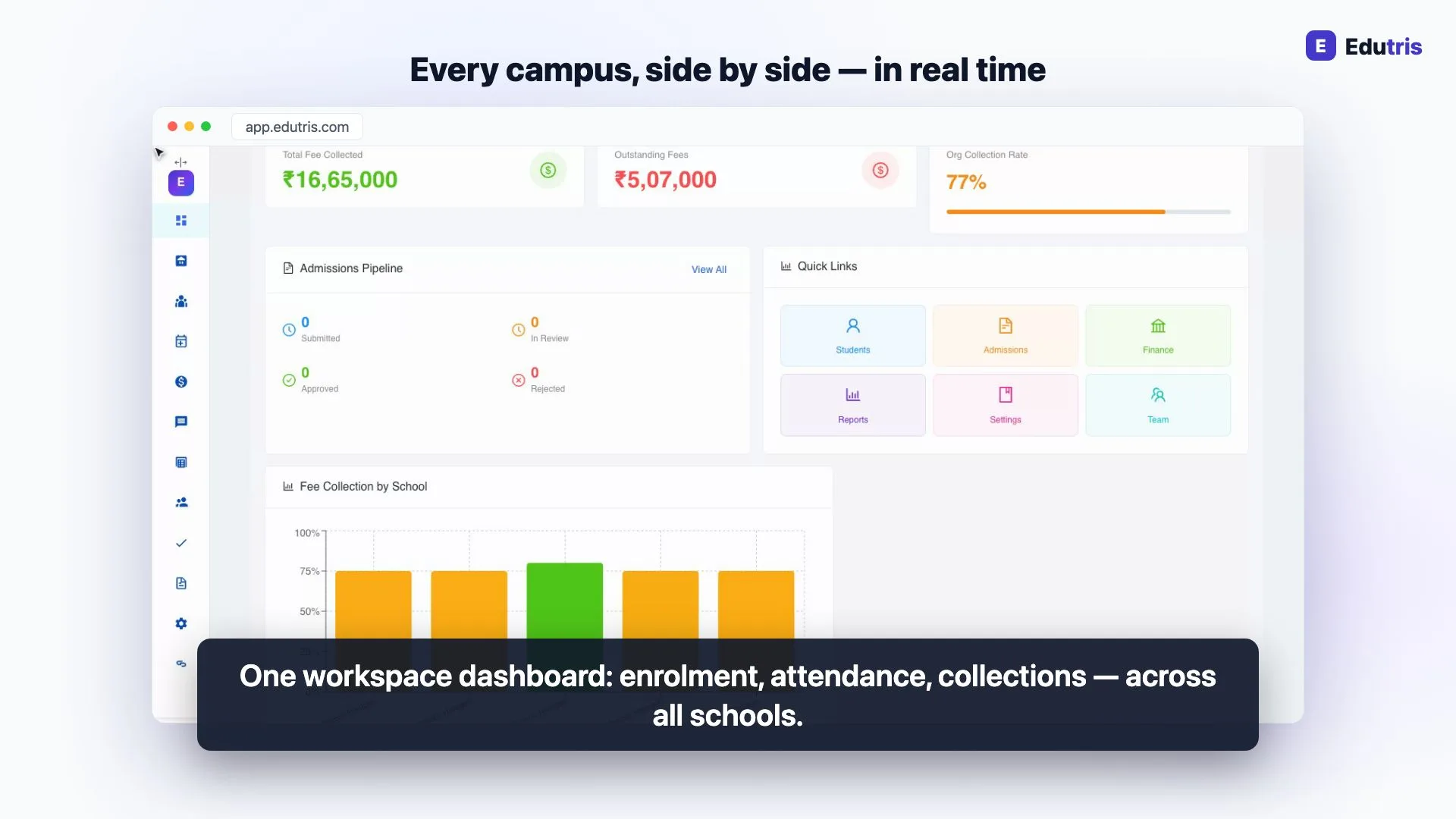
Frequently Asked Questions
What are the standard fee heads a school should separate?
At minimum, keep tuition, admission/registration, and transport as distinct heads, then add whichever apply to your school: examination, activity or annual charges, lab or computer fees, and a refundable caution deposit. Separating heads matters because it makes each charge explainable to a parent, lets you refund one head (like transport) without touching another, and gives clean reporting on where your income actually comes from. A single lumped 'school fee' figure is the most common cause of fee disputes.
Should fees be collected annually, per term, or monthly?
Most Indian private schools settle on term-wise collection (usually two or three instalments a year) because it balances the school's cash flow against what families can pay at once. Annual collection is simplest to administer but raises the barrier at admission time and the risk of large defaults; monthly collection eases affordability but multiplies the number of receipts, reminders and follow-ups your office handles. Term-wise, with a clear due date per term, is the usual middle ground.
How should concessions and scholarships be handled?
Decide the categories in advance (sibling concession, staff-ward concession, RTE seats, merit or need-based scholarships) and record every concession against the individual student's fee record, never as a verbal arrangement. In Edutris, a discount or waiver is applied to a student's fee record as a specific amount, so the ledger always shows the original fee, the concession, and the net payable. That is what keeps concessions auditable and stops them from quietly becoming permanent.
Can school software apply the right fee structure automatically?
Yes. In Edutris you define fee heads and amounts by class and academic year once; the correct structure is then applied to each student based on their class, so a new admission or a promoted student inherits the right fees without re-entry. Per-student concessions and waivers are recorded on the fee record, every payment generates a receipt, and overdue accounts are tracked for one-click SMS or email reminders. Late-fee rules and instalment timing remain policy decisions the school sets.
Read next
- 01For Principals
RTE Admissions Explained: The 25% Quota, Documents and Reporting
How the RTE Act's 25% quota works for private schools in India: who qualifies, the admission process, documents, reimbursement and record-keeping.
- 02For School Owners
Reducing Student Dropout: How Schools Improve Retention Year on Year
Why families leave a school mid-cycle (fees, communication, academics, transport) and a practical retention playbook that protects enrolment and revenue.
- 03For School Owners
Collecting School Fees Online in India: A Practical Guide for School Owners
UPI, cards and net-banking have changed how Indian parents pay for everything, except, often, school fees. What online fee collection actually involves.
- 04For School Owners
7 Practical Ways Indian Schools Cut Fee Defaulters: Without Souring Parent Relationships
Seven working tactics to reduce fee defaulters in your school: a clear fee calendar, digital receipts, UPI payments, gentle reminders and honest reports.
- 05For School Owners
How to Reduce School Fee Defaulters by 40%: A Practical Guide for Indian Schools
Fee defaulters cost Indian schools 8–15% of annual revenue. A step-by-step system for collecting on time with online payments and disciplined reminders.
- 06For Principals
The CBSE Grading System Explained: Grade Bands, Grade Points and CGPA
How CBSE's 9-point grading works: the A1–E band table, grade points, and how CGPA and an indicative percentage are calculated, in plain English.