How to Reduce School Fee Defaulters by 40%: A Practical Guide for Indian Schools
The Fee Collection Problem Every School Principal Knows
It is the 15th of the month. Fee day was the 10th. The school accountant has a list of 60 families who haven't paid. The cashier's office has fielded 30 calls asking for extensions. Three parents have sent messages to the principal directly. Two have simply stopped responding.
This is the reality of fee collection in most Indian private schools. And it costs schools far more than the cash flow pressure suggests.
Beyond the direct revenue impact, there's the administrative time spent on follow-up, the relationship strain when fees become a source of conflict, and the signal it sends about the school's operational professionalism.
The good news: schools that implement a systematic approach to fee collection reduce defaults by 30-50% within one academic year. Here's what that system looks like.
Why Students Default on Fees: The Four Categories
Not all fee defaults are the same. Before you build a collection system, it helps to know which problem you're actually solving.
Category 1: The Forgetters (40-50% of defaults) Parents who genuinely forgot the due date. Busy families. Working parents. People who manage finances across multiple commitments. These parents pay immediately when reminded.
Category 2: The Cash Flow Cases (20-30% of defaults) Parents who intended to pay but had a temporary cash flow issue, a delayed salary, an unexpected expense, a medical bill. They pay 3-7 days late once their situation resolves.
Category 3: The Negotiators (10-15% of defaults) Parents who want to negotiate, a discount, an instalment, a deadline extension. Often these are parents who have been getting informal concessions and have come to expect them.
Category 4: The Genuine Hardship Cases (5-10% of defaults) Families facing real financial difficulty, job loss, family illness, business failure. These cases require a different response from the other three.
Your fee collection system should be designed primarily for Categories 1 and 2, who together represent 60-80% of your default problem.
The Five-Step Fee Collection System
Step 1: Make paying online effortless
The single highest-impact change most Indian schools can make is accepting online payments. Cash collection creates friction, parents need to come to the school, queue, and get a receipt. Every additional step reduces compliance.
With Edutris, parents receive a payment link via SMS and the parent app. One tap → UPI payment → instant digital receipt. The entire transaction takes 45 seconds.
Schools that switch from cash-only to online-first collection typically see an immediate 10-15% improvement in on-time payment rates, before any reminder system is implemented.
Step 2: Send reminders on a fixed 7-day, 3-day, and 1-day cadence
Most Category 1 and Category 2 defaults are solved entirely by reminders. The question is who sends them and when.
Manual reminder calls are expensive in staff time, inconsistent, and create awkward conversations. Bulk SMS/email reminders on a fixed calendar remove all three problems. In Edutris, the accountant opens the defaulter list and sends the reminder round to every pending account in one click, no individual calls, no copy-pasting numbers.
A cadence that works:
- 7 days before due date: "Fee payment due on [Date]. Pay online: [link]"
- 3 days before due date: "Fee payment due in 3 days. [link]"
- Due date: "Today is the last day for fee payment. Pay now to avoid late charges: [link]"
- 3 days after due date: "Your fee payment is overdue. Late fee of ₹[amount] applies after [date]. Pay now: [link]"
This four-message sequence (a few seconds of the accountant's time per round) resolves the majority of Category 1 and Category 2 defaults without any phone calls.
Step 3: Enforce late fees consistently
Late fees only work if they're enforced consistently. A school that applies late fees to some families and waives them for others trains the parent community that the deadline is negotiable.
Set a clear late fee policy (a fixed amount or a percentage per week), communicate it at the start of the year, and enforce it without exceptions except for documented hardship cases.
Edutris automatically calculates and adds late fees to overdue accounts based on the policy you configure. Parents see the late fee clearly on their account, which is more effective at driving payment than a phone call.
Step 4: Handle the Negotiators separately
Category 3 defaults (the negotiators) require human intervention. The accountant or finance team should review accounts that are more than 10 days overdue and have not responded to the reminder sequence.
For these parents, a personal call from the school is more effective than additional automated messages. The call should be matter-of-fact, not confrontational: "We noticed your payment is pending. Would you like to discuss a payment plan?"
Schools using Edutris can generate a list of these accounts in one click, overdue accounts with no payment activity in the last 10 days.
Step 5: Create a formal process for Genuine Hardship Cases
Every school has families facing genuine financial difficulty. These cases require a different approach: empathy, confidentiality, and a formal process.
Create a simple application process for fee concessions or payment plans. Make the criteria clear (job loss, medical emergency, etc.). Handle these cases through the school management or trust, not through individual teachers or class coordinators.
Having a formal process achieves two things: it gives genuine hardship families a dignified path, and it removes the informal negotiation culture that enables Category 3 behaviour.
What the Numbers Look Like
A school implementing this system typically sees:
| Metric | Before | After 3 months |
|---|---|---|
| On-time payment rate | 55-65% | 80-88% |
| Average days to collect | 22 days | 8 days |
| Staff hours on fee follow-up | 15-20 hrs/month | 3-5 hrs/month |
| Late fee revenue | Minimal | Consistent |
The reduction in staff time on fee follow-up is often as significant as the revenue impact. Accountants who previously spent half their month chasing fees can focus on higher-value work.
Implementation Timeline
Week 1: Configure online payment integration (UPI + card). Send parent communication about the new payment process.
Week 2: Agree the reminder cadence and message templates with the accounts team. Configure late fee policy in the system.
Week 3: First fee cycle with the new system running. Monitor response rates.
Month 2: Review data. Identify Category 3 accounts manually. Implement formal hardship process if not already in place.
Month 3: Compare on-time payment rate with the previous three months. Adjust reminder timing or messaging based on data.
See how Edutris fee management works → Book a free demo
Edutris's fee management module includes online payments via Razorpay (UPI, cards, net banking) with instant digital receipts, defaulter tracking with one-click SMS/email reminders, late fee calculation, and real-time collection dashboards. Part of Edutris School Management Software, starting at ₹2,999/month.
Written by the Edutris team, led by Manjunath Shedabal, Founder
Every product claim traces to verified capability; unshipped features live on the roadmap. Read our editorial policy.Free: The School Digitalisation Checklist
25 checkpoints across records, attendance, fees, communication, and compliance: score your school in 5 minutes and see exactly where time and fee revenue leak.
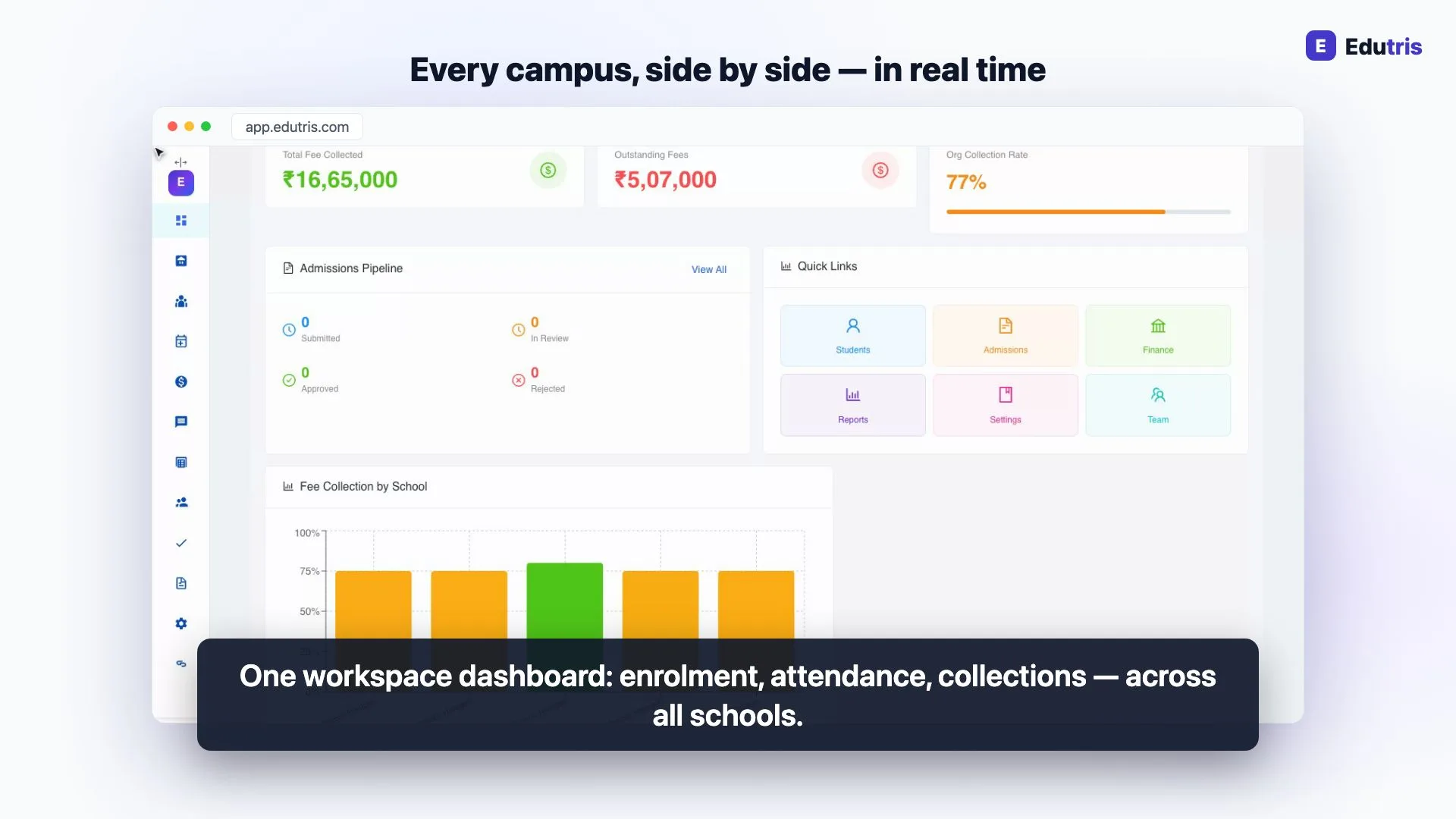
How Edutris gives school owners real-time control
Frequently Asked Questions
What is the best way to collect school fees online in India?
The most effective method is a combination of online payment links (UPI, credit/debit card, net banking) with a disciplined reminder cadence: 7 days, 3 days, and 1 day before the due date. In Edutris, the accountant sends each round of SMS/email reminders to every pending account in one click from the defaulter list, so the cadence survives a busy week instead of depending on someone remembering to chase.
Is it legal to withhold exam results for fee non-payment in Indian schools?
CBSE and several state boards prohibit withholding results or TC solely on grounds of fee non-payment. The most effective and legally safe approach is early communication, payment plans for genuinely struggling families, and strict enforcement of late fees for avoidable delays.
How much do school fee defaults actually cost a school annually?
A typical Indian private school with 500 students and ₹50,000 annual fee per student has a ₹2.5 crore annual fee revenue target. At a 15% default or delay rate, ₹37.5 lakhs is collected late or not at all in any given year. The carrying cost, administrative time, and cash flow pressure of chasing this amount is significant: often equivalent to the salary of 2-3 additional teachers.
Read next
- 01For School Owners
7 Practical Ways Indian Schools Cut Fee Defaulters: Without Souring Parent Relationships
Seven working tactics to reduce fee defaulters in your school: a clear fee calendar, digital receipts, UPI payments, gentle reminders and honest reports.
- 02For School Owners
How to Design a School Fee Structure: Heads, Terms, Concessions and Due Dates
A practical guide to designing a school fee structure in India: choosing fee heads, class-wise amounts, collection frequency, concessions and due dates.
- 03For School Owners
Collecting School Fees Online in India: A Practical Guide for School Owners
UPI, cards and net-banking have changed how Indian parents pay for everything, except, often, school fees. What online fee collection actually involves.
- 04For School Owners
How to Choose School Management Software in India: A Practical Decision Framework
A step-by-step framework for Indian school owners: audit your needs, set a realistic budget, plan the migration, test support, and spot vendor red flags.
- 05For School Owners
The Right Software for a 200-Student School (Hint: It Isn't the Enterprise Suite)
A 200-student school doesn't need enterprise software. What actually matters when one office admin runs everything, and which modules to skip.
- 06For School Owners
The ROI of School Software: Where the Hours and the Money Actually Come Back
Forget vendor percentages. School software pays back in recovered staff hours and plugged fee leakages: here is a worksheet to count your own numbers honestly.