Collecting School Fees Online in India: A Practical Guide for School Owners
Walk into most school offices in a Tier-2 or Tier-3 city during the first week of a fee term and you will see the same tableau: a queue of parents at a counter, a cash box, a carbon-copy receipt book, and an accountant who will spend the evening totalling the day's collections and hoping the total matches the box.
Meanwhile, every parent in that queue paid for their groceries, their electricity and their mobile recharge this month by UPI, from their phone, in seconds. The gap between how Indian parents pay for everything else and how they pay school fees is now the most visible piece of unfinished modernisation in most schools, and for the school owner, it is also a working-capital and control problem, not just a convenience one.
What the receipt-book system actually costs
The costs of manual fee collection hide in plain sight because each one looks like "just how it's done":
- The queue itself. Parents take time off work to pay in person; the office is overwhelmed in the first week of a term and idle afterwards.
- Reconciliation evenings. Cash counted against carbon copies, cheques logged by hand, bank deposits matched to receipt numbers days later. Every mismatch is an investigation.
- The knowledge monopoly. Who has paid, who is partial, who is overdue. This lives in the receipt book and in the accountant's memory. The owner learns the collection position when someone compiles it.
- Partial-payment scribbles. A parent pays half now and half after Diwali. In a receipt book, that becomes a margin note and a verbal promise; in aggregate, it becomes an outstanding figure nobody can state precisely.
- Receipt disputes. "We paid in June", and now someone is searching through carbon copies from June.
None of this is fraud or incompetence. It is what happens when a school's entire revenue system runs on paper designed a century ago.
What online fee collection actually involves
"Collecting fees online" gets used loosely, so it is worth separating the components:
| Component | What it means in practice |
|---|---|
| Payment gateway | The regulated rails that move money, in Edutris's case, Razorpay |
| Payment modes | UPI, debit/credit cards, net-banking: the parent chooses |
| Where parents pay | The Edutris parent mobile app; fee status and history in the parent portal |
| Receipts | Digital receipt generated on payment, downloadable from the portal any time |
| The ledger behind it | Fee structures, per-student balances, payment history: one system of record |
The gateway matters more than owners sometimes realise. Building payment collection directly with a bank means paperwork, integration work, and ongoing compliance. Using an established gateway like Razorpay means the school inherits all of that, UPI, cards and net-banking work on day one, and settlement to the school's account follows the gateway's standard cycle.
The part nobody markets: hybrid collection
Here is the honest reality every Indian school owner already knows: online collection will not be 100% in year one, and possibly not in year three. Some parents will pay by UPI from the sofa the day fees are due. Others will keep coming to the counter with cash, because that is what they trust.
The right question for software is therefore not "does it do online payments?" but "does it treat the counter as a first-class citizen?" In Edutris's fee management, the accountant records collections in every mode a real school sees (cash, cheque, online, bank transfer, demand draft) and each one produces a receipt and lands in the same ledger. Reconciliation stops being an evening ritual because there is nothing to reconcile between systems: the receipt book is the system, and the counter and the app feed the same numbers.
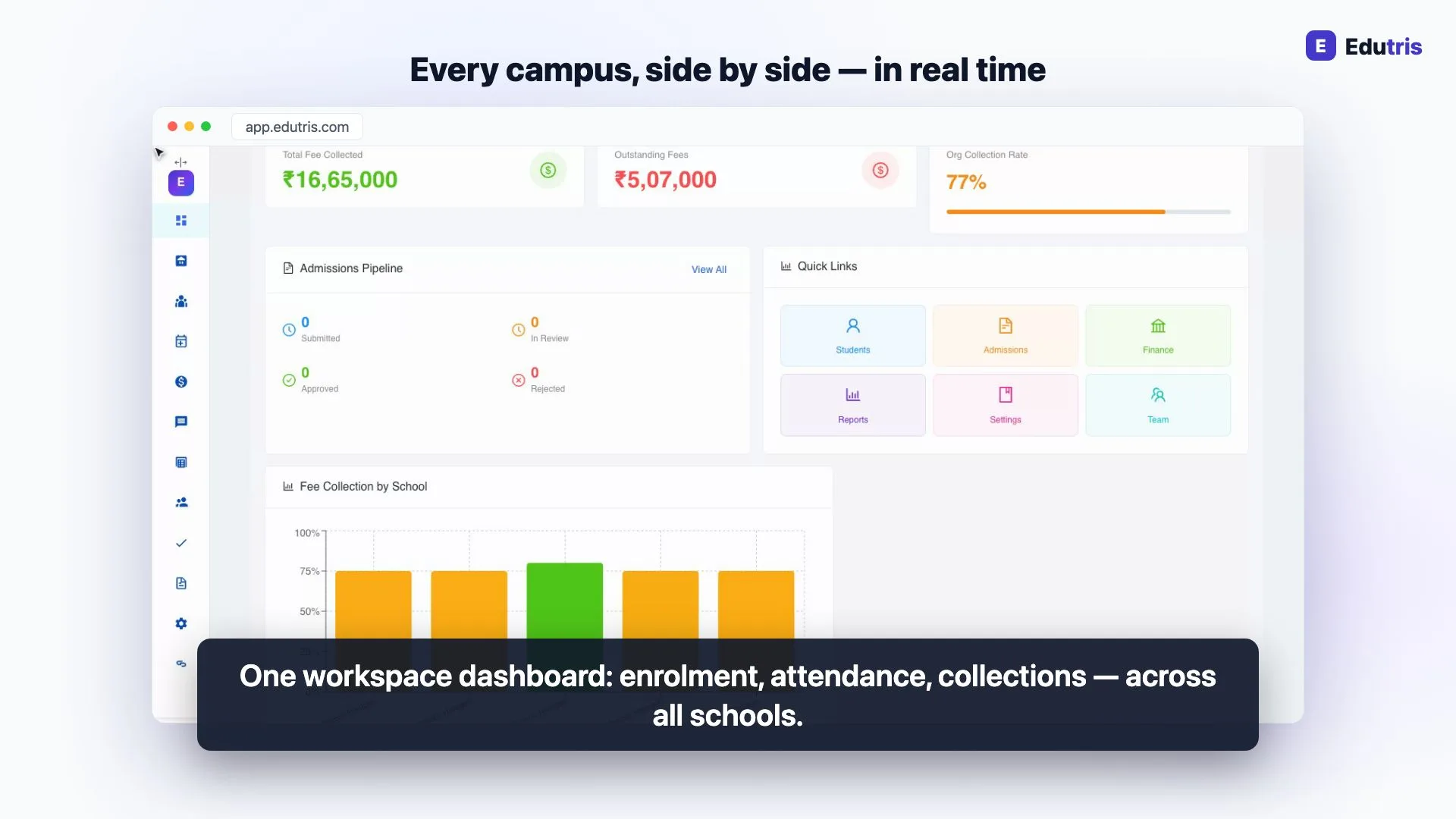
That single ledger is what transforms the owner's position. Collected, pending, overdue, partial. These become figures on the accountant's dashboard (recent payments and defaulter lists included), not questions to ask at month-end.
Partial payments and outstanding tracking
Instalments are how fees actually get paid across much of India, so a fee system that treats "paid in full or not" as the only two states is fighting reality. Edutris tracks paid, partial and pending statuses per student, with every payment recorded against the fee structure, so the outstanding figure is always current and always itemised. When a parent at the counter asks "how much is left?", the answer is on the screen, not in the margins of a receipt book.
Outstanding tracking is also where collection discipline starts. The office can see exactly who is overdue and send a one-click reminder, deliberately, to chosen parents, over the school's channels. To be clear about what we don't do: there are no scheduled or automatic reminders, and no WhatsApp integration. A human decides when a reminder goes out; on AI-enabled plans, the polite wording can be drafted for you first. For a fuller treatment of chasing outstanding fees, see our guide on reducing fee defaulters, and if you want to estimate what defaulters cost you across a year, try the fee defaulter projection calculator.
What changes for the parent
From the parent's side, the experience becomes what they already expect from every other payment in their life: open the app, see the exact amount due (and what has already been paid), pay by UPI or card, and get a receipt immediately: one they can download again in March when the tax-declaration season makes everyone hunt for school fee receipts. No leave application to visit the office; no wondering whether the cheque was deposited.
How Edutris handles this
Edutris fee management runs on Razorpay, so parents can pay by UPI, card or net-banking from the parent mobile app, with digital receipts downloadable from the parent portal. The office side keeps pace with reality: the accountant records cash, cheque, online, bank-transfer and DD collections into the same ledger, tracks paid/partial/pending status per student, and sees collections, outstanding amounts and defaulters on a live dashboard, with one-click manual reminders when the school decides to nudge. Fee actions are captured in the audit log. Plans start at ₹2,999/month for schools up to 250 students, and every school starts with a 30-day guided pilot rather than a sink-or-swim signup, fee collection is the one module where you want the setup done properly.
Written by the Edutris team, led by Manjunath Shedabal, Founder
Every product claim traces to verified capability; unshipped features live on the roadmap. Read our editorial policy.Free: The School Digitalisation Checklist
25 checkpoints across records, attendance, fees, communication, and compliance: score your school in 5 minutes and see exactly where time and fee revenue leak.
How Edutris gives school owners real-time control
Frequently Asked Questions
How do parents pay school fees online with Edutris?
Payments run through Razorpay, one of India's established payment gateways, which means parents can pay by UPI, debit or credit card, or net-banking. A parent can pay from the Edutris parent mobile app and receives a digital receipt, downloadable from the parent portal whenever needed. The school does not need to build any payment integration itself. It comes as part of the fee management module.
Can a school still accept cash and cheque alongside online payments?
Yes, and in most Indian schools this hybrid reality lasts for years, so the software must treat it as normal rather than an exception. In Edutris, the accountant records collections in whatever mode they arrive (cash, cheque, online, bank transfer or demand draft) and every mode lands in the same ledger with a receipt. The point is not to force parents online overnight; it is that whichever way a payment comes in, it is recorded once, in one system, against the right student.
How does Edutris handle partial fee payments?
Partial payments are a first-class case, not a workaround. A student's fee status can be paid, partial or pending, and the accountant dashboard shows counts of each, alongside collected and outstanding amounts. Each payment is recorded against the student's fee structure, so the outstanding balance is always the current, correct figure. This mirrors how fees actually get paid in much of India (in instalments negotiated with the office) and it removes the margin-scribble bookkeeping that partial payments cause in a receipt-book system.
Does Edutris send automatic fee reminders?
No, and we prefer to say so plainly: Edutris does not send scheduled or automatic reminders, and does not have a WhatsApp integration. What it provides is one-click manual reminders, the office sees who is outstanding and sends a reminder deliberately, and on AI-enabled plans the polite reminder message can be drafted for you. Some owners actually prefer this: fee reminders in a school context are sensitive, and a human deciding when and to whom a reminder goes keeps that judgement in the school's hands.
Read next
- 01For School Owners
How to Design a School Fee Structure: Heads, Terms, Concessions and Due Dates
A practical guide to designing a school fee structure in India: choosing fee heads, class-wise amounts, collection frequency, concessions and due dates.
- 02For School Owners
7 Practical Ways Indian Schools Cut Fee Defaulters: Without Souring Parent Relationships
Seven working tactics to reduce fee defaulters in your school: a clear fee calendar, digital receipts, UPI payments, gentle reminders and honest reports.
- 03For School Owners
How to Reduce School Fee Defaulters by 40%: A Practical Guide for Indian Schools
Fee defaulters cost Indian schools 8–15% of annual revenue. A step-by-step system for collecting on time with online payments and disciplined reminders.
- 04For School Owners
The ROI of School Software: Where the Hours and the Money Actually Come Back
Forget vendor percentages. School software pays back in recovered staff hours and plugged fee leakages: here is a worksheet to count your own numbers honestly.
- 05For School Owners
What a School ERP Really Costs in India: Total Cost of Ownership, Not Just the Licence
The licence fee is the visible part of school ERP cost in India. Training time, data migration, per-student traps and renewal hikes decide the real bill.
- 06For School Owners
The Admission Season Playbook: What the Office Needs Ready Before the First Application Arrives
An operational playbook for whoever actually runs admission season: the readiness list, a stage-by-stage calendar, and the front-desk capacity math.