The ROI of School Software: Where the Hours and the Money Actually Come Back
Every school software vendor has a slide that says something like "save 40% of admin time!" We are not going to show you that slide, because we do not know your school. We do not know how many hours your clerk spends tallying registers, or how much fee money sits uncollected because nobody has a current defaulter list. Neither does any vendor waving a percentage at you.
What we can do is show you where the return actually lives, and give you a way to count it with your own numbers. For a school owner, the ROI of software sits in exactly two places: hours that come back and money that stops leaking. Everything else is decoration.
Part One: The Hours
Staff time is the cost owners feel least, because it is already paid for. The clerk's salary goes out whether he spends the afternoon writing receipts or doing something that grows the school. But paid-for time is not free time, every hour spent on manual compilation is an hour not spent on admissions follow-ups, parent relationships, or simply going home on time and staying another year.
Walk through a normal month and note where the hours go:
| Task | Manual version | With software |
|---|---|---|
| Attendance tallying | Registers counted by hand for monthly percentages | Computed continuously; reports on demand |
| Fee receipts and day-book | Written, carbon-copied, totalled at day end | Recorded at collection; receipt printed or downloaded |
| Defaulter list | Someone cross-checks the ledger, when asked | A live outstanding list, always current |
| Report cards | Marks copied from teachers' sheets into templates | Entered once by teachers; grades auto-computed; printed |
| Routine parent calls | "Did my child reach?" "What is due?" | Parents see attendance and fee status themselves |
| Certificates | Typed fresh each time | Generated from the student record |
Your worksheet: for each row, estimate hours per month in your school and who does them. Do not guess low to be kind to the status quo. Then ask what those specific people would do with those specific hours. That answer (not a vendor's percentage) is the time half of your ROI.
Part Two: The Leakages
The second return is blunter: money. Paper fee systems leak, and mostly not through dishonesty: through gaps.
The reconciliation gap. Cash collected in the morning, entered in the ledger at closing, or the next day, or after the weekend. In the gap, memory is the system of record. When the cash box and the receipt book disagree by a few hundred rupees, the school usually absorbs it, because finding the cause costs more than the amount. A few hundred rupees, how many times a term?
The unissued-receipt gap. A parent pays, the receipt is "given later", the entry never happens. Months on, the parent's word stands against a ledger with a hole in it. Whichever way it resolves, the school pays, in money or in trust.
The ageing-dues gap. This is usually the largest. Dues do not vanish; they age. In a paper system, producing a complete, current list of who owes what takes hours, so it is done rarely, and reminders go out in occasional bursts instead of steadily. The follow-up that never happened is invisible in the accounts, which is precisely why owners underestimate it.
Your worksheet: take last term. How much fee income was still uncollected at term end? How many reconciliation mismatches did you shrug at? Could you produce, today, a list of every family with an outstanding balance, and when each was last reminded? If that last question takes more than a minute to answer, you have found the leak.
What software changes is structural, not motivational: payment recorded at the moment of collection, a receipt that exists because the entry exists, an outstanding list that is always current, and a one-click reminder the office actually sends because it costs a click. In Edutris, fee actions also land in an audit log (who recorded what, when) which quietly ends the cash-box-versus-ledger argument.
Now Put the Two Numbers Against the Cost
The cost side is not mysterious. Edutris pricing is public (Starter at ₹2,999/month up to 250 students, Professional at ₹7,999/month up to 1,000 students, Growth at ₹14,999/month up to 3,000) and the school software cost calculator lets you put your enrolment and your current process costs side by side with a subscription. It is deliberately a calculator, not a claim: you enter your numbers, it does the arithmetic.
A fair evaluation looks like this:
- Count the hours (worksheet one) and value them at what those staff members cost you.
- Count the leakages (worksheet two) from last term's actuals, uncollected dues, reconciliation gaps.
- Add the softer returns last, at zero rupees. Faster answers to parents, cleaner records at inspection time, an owner's dashboard you can check from anywhere: real, but keep them out of the arithmetic so the arithmetic stays honest.
- Compare with twelve months of subscription at your school's size, using the calculator.
If the numbers do not clear the bar, do not buy: genuinely. A 150-student school with one meticulous clerk and near-total fee collection has less to recover than a 900-student school reconciling three cash counters. The worksheet will tell you which school you are.
How Edutris Fits This Frame
Edutris is built around exactly the two returns this article counts: it absorbs the repetitive hours (attendance computation, receipts, report-card compilation, certificates, parent queries answered by the parent portal instead of the office phone) and closes the fee gaps (payment recorded at collection, live outstanding lists, one-click manual reminders, an audit trail on every fee action). We would rather you evaluate it with a worksheet than a slogan, the 30-day guided pilot exists so the numbers you check are your own school's, running for real.
Written by the Edutris team, led by Manjunath Shedabal, Founder
Every product claim traces to verified capability; unshipped features live on the roadmap. Read our editorial policy.Free: The School Digitalisation Checklist
25 checkpoints across records, attendance, fees, communication, and compliance: score your school in 5 minutes and see exactly where time and fee revenue leak.
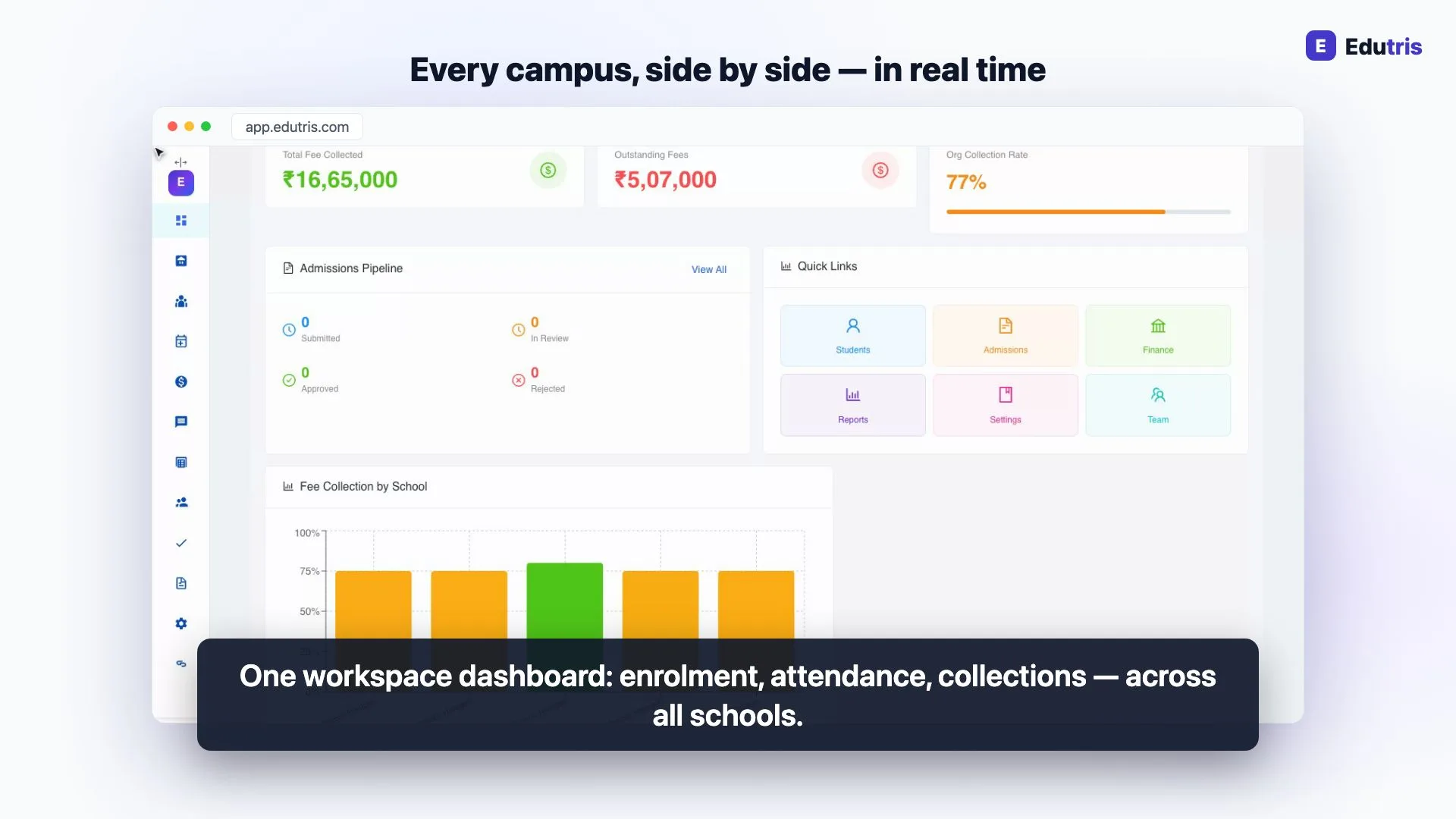
How Edutris gives school owners real-time control
Frequently Asked Questions
How do I calculate the ROI of school management software?
Count two things in your own school: hours and leakages. Hours means the staff time currently spent on tasks software absorbs, tallying attendance registers, writing receipts, compiling report cards, answering routine parent calls. Leakages means money that goes missing or uncollected in a paper system, unreconciled cash, unissued receipts, and dues nobody chased because nobody had a current list. Put your own numbers against both, then compare the total with the subscription cost. Any vendor who hands you a ready-made ROI percentage is telling you about a school that is not yours.
How do I compare software cost against the staff hours it returns?
Edutris pricing is public: Starter at ₹2,999 per month for schools up to 250 students, Professional at ₹7,999 per month for up to 1,000 students with AI features included, Growth at ₹14,999 per month for up to 3,000 students, and custom Enterprise pricing beyond that. That is the full software cost, the comparison you should make is against what your current paper-and-Excel process costs in staff hours and uncollected fees, which most owners have never actually totalled.
Where do schools lose money with manual fee collection?
In the gaps between collection and record. Cash is taken but the entry is made later, or not at all; receipt books and the cash box disagree and nobody can say why; a parent disputes a payment and the school cannot produce its side quickly; and dues age quietly because producing a current defaulter list from paper takes hours, so it happens rarely. None of these is usually theft: most are ordinary slippage. But slippage in a system that handles lakhs of rupees a term is worth taking seriously.
Is there a free trial of Edutris?
Edutris offers a 30-day guided pilot rather than a self-serve free trial. The distinction matters: in a guided pilot our team helps set up your actual classes, fee structures, and staff accounts, so what you evaluate is your school running on the system, not an empty demo account you poke at alone. For an ROI decision this is the honest test, because the hours and leakages you are trying to measure only show up when real work runs through the platform.
Read next
- 01For School Owners
How to Design a School Fee Structure: Heads, Terms, Concessions and Due Dates
A practical guide to designing a school fee structure in India: choosing fee heads, class-wise amounts, collection frequency, concessions and due dates.
- 02For School Owners
Collecting School Fees Online in India: A Practical Guide for School Owners
UPI, cards and net-banking have changed how Indian parents pay for everything, except, often, school fees. What online fee collection actually involves.
- 03For School Owners
7 Practical Ways Indian Schools Cut Fee Defaulters: Without Souring Parent Relationships
Seven working tactics to reduce fee defaulters in your school: a clear fee calendar, digital receipts, UPI payments, gentle reminders and honest reports.
- 04For School Owners
How to Reduce School Fee Defaulters by 40%: A Practical Guide for Indian Schools
Fee defaulters cost Indian schools 8–15% of annual revenue. A step-by-step system for collecting on time with online payments and disciplined reminders.
- 05For Principals
Painless Parent-Teacher Meetings: How Slot Booking Fixes PTM Day
PTM day means queues, crowded corridors, and five-minute rushed conversations. Here is how PTM slot booking works, and why it changes the meeting itself.
- 06For Principals
The Principal's Monday-Morning Dashboard: What You Should Know by 8:05 AM
A principal's week is set by Monday morning. The five-minute dashboard read (attendance, fees, admissions, exams) that replaces a morning of asking around.