What a School ERP Really Costs in India: Total Cost of Ownership, Not Just the Licence
Ask a vendor what their school ERP costs and you'll get a number. Ask a school owner two years into an implementation what it cost and you'll get a different, larger number: plus a pause. The gap between the two is the total cost of ownership: everything the licence fee didn't mention.
We've already published a detailed breakdown of subscription pricing models and contract traps in India. This article is about the rest of the bill, the costs that don't appear on the quotation but absolutely appear in your school's ledger and your staff's working hours.
The visible cost: the licence
The licence is the easy part. Full-platform systems for a single school generally sit in the ₹3,000–₹15,000/month band depending on student strength; large multi-campus ERPs go well beyond. Edutris, for reference, publishes flat tiers: Starter ₹2,999/month (up to 250 students), Professional ₹7,999/month (up to 1,000), Growth ₹14,999/month (up to 3,000), Enterprise custom.
The licence is also the smallest source of nasty surprises, precisely because it's written down. The surprises live below.
Hidden cost 1: staff time for training
Software is only implemented when people use it, and people cost time. Count three groups:
- Office and accounts staff, the heaviest users. They need real training on fee structures, receipts, and reports, not a webinar link.
- Teachers, lighter usage (attendance, marks entry), but there are many of them, and every session happens inside an already-full school day.
- New joiners, schools have staff turnover every year; someone must train the replacements, forever.
The money question is not "does the vendor charge for training?" (though ask, some charge per session after an included quota). It is: how many hours of my staff's time will this consume, and in which month? Rolling out in report-card week is how good software gets a bad reputation. Budget the hours explicitly and schedule training in a calm fortnight.
Hidden cost 2: data migration
Your school's data currently lives in some mix of paper registers, Excel sheets, and an old system. Getting it into the new ERP has two cost components:
- Cleaning. Duplicate student entries, missing guardian phone numbers, fee concessions recorded only in someone's memory. Cleaning this is office-staff days of work, and it's your work: no vendor can invent your missing data.
- Loading. Someone must map your columns to the system's import format and actually run the import. If the vendor's answer is "here's the CSV template, good luck", that whole burden lands on your office.
Ask every vendor: who prepares the import file, who validates the loaded data, and what happens to the fee dues already outstanding mid-year? A vendor that does guided data loading is charging you less in disguise, even at an identical licence price.
Hidden cost 3: the per-student trap
Per-student pricing deserves its own line in any TCO estimate because it converts your growth into the vendor's revenue. The arithmetic is simple: at ₹10/student/month, a 400-student school pays ₹4,000/month. Grow to 900 students over three years (the point of running a good school) and the same software costs ₹9,000/month. Nothing improved; the bill more than doubled.
Watch also for slab minimums ("billed for a minimum of 500 students"), and for renewal-time escalation clauses that raise the per-student rate itself. If you're comparing a per-student quote against a flat tier, run both numbers at your projected strength two years out, not today's roll.
Hidden cost 4 (actually a myth): hardware
A generation ago, a school ERP meant a server humming in the office, a UPS for it, an annual maintenance contract, and an "IT sir" to restart it. Some vendors still trade on that memory to justify implementation fees.
For a modern cloud system, none of it applies. There is no server to buy; staff use existing desktops and phones; parents use their own phones. The genuinely optional hardware (biometric attendance devices, a barcode scanner for the library) should be bought only when the paper process it replaces is a proven pain, and priced separately from the software decision.
The one real infrastructure line item is connectivity: a reliable broadband connection at the office and workable mobile data for teachers. Most schools already have both.
Putting it together: a two-year TCO worksheet
Compare every shortlisted vendor on the same grid. Illustrative structure (fill in your own quotes):
| Cost line | Year 1 | Year 2 |
|---|---|---|
| Licence (all needed modules, all-in) | ₹ __ | ₹ __ (renewal price!) |
| One-time setup / implementation fee | ₹ __ | , |
| Data cleaning + migration (staff days × day cost) | ₹ __ | , |
| Training (vendor charges + staff hours) | ₹ __ | ₹ __ (new joiners) |
| SMS / communication charges | ₹ __ | ₹ __ |
| Optional hardware (only if genuinely needed) | ₹ __ | , |
| Total | ₹ __ | ₹ __ |
Two patterns to expect. First, year one is always the expensive year: migration and training happen once. Second, the vendors that look cheapest on licence price often look worst on this grid, because the missing money reappears as your staff's unpaid project time. Our school software cost calculator is a quick way to build the licence side of this estimate for your student strength.
Questions that surface the real price
Take these into every sales conversation:
- What is the all-in monthly price for the modules we listed, nothing extra to buy later?
- What is the renewal price in year two, in writing?
- Is there any one-time fee? What exactly does it cover?
- Who prepares and loads our data, and is that included?
- How much training is included, and what does more cost?
- What do SMS messages cost, and who bills them?
- Can we export all our data free, any time, in CSV or Excel?
A vendor comfortable answering all seven in writing is a vendor whose TCO will resemble their quote.
Where Edutris stands on total cost
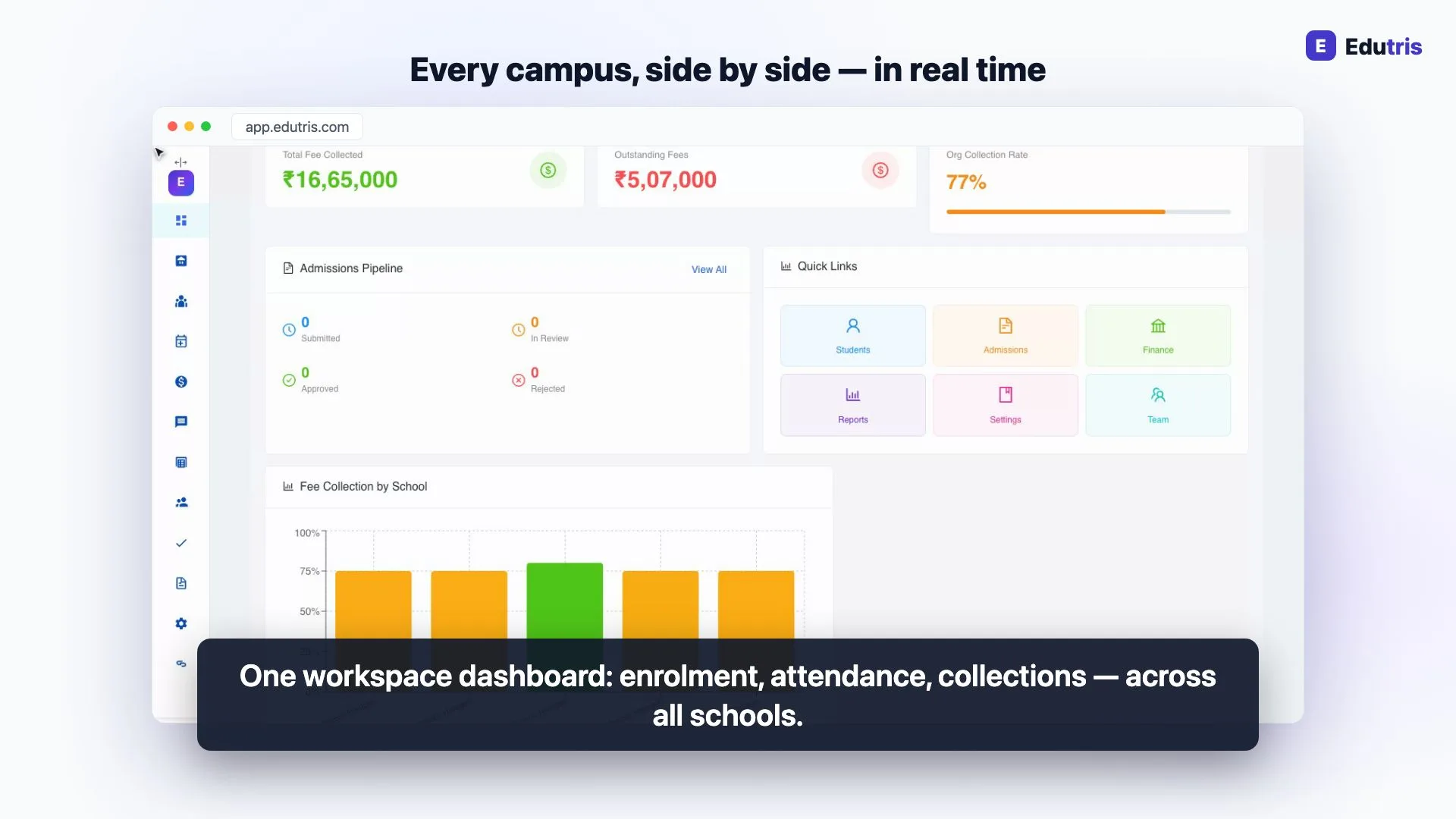
Edutris keeps the controllable parts of TCO deliberately boring: flat published tiers with no per-student billing within a tier and no per-module add-ons, attendance, fee management, exams, report cards, timetable, admissions, and the parent app are all in the platform, with AI-assisted features included from the Professional plan up. It's cloud-based, so there is no server or hardware requirement. And instead of a free trial that leaves the migration to you, we run a 30-day guided pilot: our team helps set up your classes and fee structures and load your student data, so the biggest hidden cost (implementation) is one we carry with you before you commit. We're early-stage, currently running a pilot with an education society in Belagavi district, Karnataka, and we'd rather earn the annual contract by doing the year-one work well.
Written by the Edutris team, led by Manjunath Shedabal, Founder
Every product claim traces to verified capability; unshipped features live on the roadmap. Read our editorial policy.Free: The School Digitalisation Checklist
25 checkpoints across records, attendance, fees, communication, and compliance: score your school in 5 minutes and see exactly where time and fee revenue leak.
How Edutris gives school owners real-time control
Frequently Asked Questions
What is the total cost of ownership of a school ERP?
Total cost of ownership (TCO) is everything the system costs you over its life, not just the subscription: the licence fee, one-time setup or implementation charges, the staff hours spent preparing and migrating data, teacher and office training time, per-message SMS charges, any paid add-on modules, and the renewal price after year one. For most schools the non-licence items are largest in the first year and shrink afterwards, which is why comparing vendors on year-one licence price alone is misleading. Always build a simple two-year estimate before signing.
Does a school need to buy servers or special hardware for an ERP?
For a cloud-based (SaaS) school ERP, no. The system runs in the vendor's cloud and staff use it from the computers, tablets, and phones the school already owns; parents use their own phones. The hardware myth comes from an older generation of self-hosted school ERPs that genuinely needed an on-premise server and an IT person to maintain it. Optional devices like biometric attendance machines are a separate purchase decision, not a requirement.
Why do per-student pricing plans become expensive?
Per-student pricing looks attractive when quoted, a few rupees per student per month sounds trivial. But the bill scales with every admission, so a growing school pays more each year for the same software, and vendors often add minimum-billing floors or slab jumps that move the effective rate up. A school growing from 400 to 900 students can see its software bill more than double with no change in what it receives. Flat tiers by school-size band keep the cost predictable through growth within the band.
How much staff time does ERP implementation really take?
Plan for three kinds of time in the first two months: office staff time to clean and prepare student and fee data for import (often the largest chunk, because paper and Excel records have gaps and duplicates); configuration time to set up classes, fee structures, and user accounts; and training time for teachers and the accounts desk. A realistic single-school estimate is a few full working days of office time plus short training sessions for teaching staff. A vendor-guided implementation compresses this significantly because the vendor has done it before and you have not.
Read next
- 01For School Owners
How to Design a School Fee Structure: Heads, Terms, Concessions and Due Dates
A practical guide to designing a school fee structure in India: choosing fee heads, class-wise amounts, collection frequency, concessions and due dates.
- 02For School Owners
Collecting School Fees Online in India: A Practical Guide for School Owners
UPI, cards and net-banking have changed how Indian parents pay for everything, except, often, school fees. What online fee collection actually involves.
- 03For School Owners
7 Practical Ways Indian Schools Cut Fee Defaulters: Without Souring Parent Relationships
Seven working tactics to reduce fee defaulters in your school: a clear fee calendar, digital receipts, UPI payments, gentle reminders and honest reports.
- 04For School Owners
How to Reduce School Fee Defaulters by 40%: A Practical Guide for Indian Schools
Fee defaulters cost Indian schools 8–15% of annual revenue. A step-by-step system for collecting on time with online payments and disciplined reminders.
- 05For School Owners
The Admission Season Playbook: What the Office Needs Ready Before the First Application Arrives
An operational playbook for whoever actually runs admission season: the readiness list, a stage-by-stage calendar, and the front-desk capacity math.
- 06For School Owners
CBSE Affiliation, Explained for School Owners: Requirements, Process and the Records That Decide It
Affiliating to CBSE, or renewing? What the Affiliation Bye-Laws expect, how SARAS runs, the mandatory disclosures, and what inspections actually check.