CBSE Affiliation, Explained for School Owners: Requirements, Process and the Records That Decide It
CBSE affiliation is the most consequential paperwork project a private school undertakes. Done well, it is a season of disciplined document work. Done casually, it becomes a multi-year loop of deficiency letters. The difference, in almost every case we have seen discussed by school operators, is not money or influence. It is whether the school's records were inspection-ready before the application was filed.
This guide maps the terrain for owners and principals. One rule above all: the CBSE Affiliation Bye-Laws (current edition) and the board's live circulars are the law here, treat this article as the map, not the territory.
Who can even apply
CBSE affiliates schools run by registered societies, trusts or not-for-profit companies, not proprietary ventures. Before the board looks at your labs, it looks at your legal skeleton:
- Registered society/trust/company with education in its objects.
- State NOC, the state government's no-objection to your school seeking CBSE affiliation. In practice this is often the longest-lead item in the whole project; sequence it first.
- Recognition under the applicable state education act and, for the elementary years, RTE-linked recognition.
- Land and building compliance, norms vary by city class and school category, and this is where amendments matter, so read the current bye-laws rather than a forum post from three years ago.
The application: SARAS, categories and season
Applications are filed online on CBSE's SARAS portal, in categories that matter operationally:
- Fresh affiliation, new schools joining CBSE (typically after establishing the school under state recognition first).
- Upgradation, extending from Secondary to Senior Secondary, etc.
- Extension of affiliation, the periodic renewal every affiliated school must file before its current affiliation lapses. Diary this; lapsed renewals create genuinely painful situations in board-exam years.
Windows for each category are announced by the board, a school planning fresh affiliation should be assembling documents a full season before the window it targets.
What inspection actually checks (the operator's translation)
The bye-laws enumerate infrastructure, staffing and safety norms; the inspection committee verifies them against reality and against your paperwork. The recurring themes:
- Teachers, qualifications per norms, appointment records, salary payment evidence (through bank, at prescribed scales), PF/statutory compliance where applicable. A staff register with complete qualification records is worth more than any brochure.
- Infrastructure & safety (classrooms, labs, library per norms; and the certificate set: building safety, fire safety, sanitation/potable water) valid on the date of inspection, not merely obtained once.
- Records, admission & withdrawal registers, TC counterfoils, attendance registers, fee records. Boards look for serial integrity: TC numbers that match the register, enrolment that matches UDISE+ filings, fees that match the published structure.
- Mandatory public disclosure, the specified documents and data published on the school's own website, current and matching what you filed. Stale disclosure pages are the most easily avoided deficiency in the entire process.
- OASIS, once affiliated, your data in CBSE's Online Affiliated School Information System must be kept current; treat it as a standing register, not a one-time form.
The pattern behind deficiency letters
Read enough operator accounts and the same failure repeats: the school is real, the documents are scattered. The society's papers are with a lawyer, salary proofs are in the accountant's system, the fire certificate expired quietly, the TC register has a gap from the clerk who left, and the website's disclosure page shows last year's fees.
The schools that clear smoothly run the project like an audit: one owner (usually the principal + one senior admin), one checklist built from the current bye-laws, one binder (physical and digital) where every certificate lives with its expiry date, and a records system where registers reconcile before the inspector arrives, because someone can actually query them.
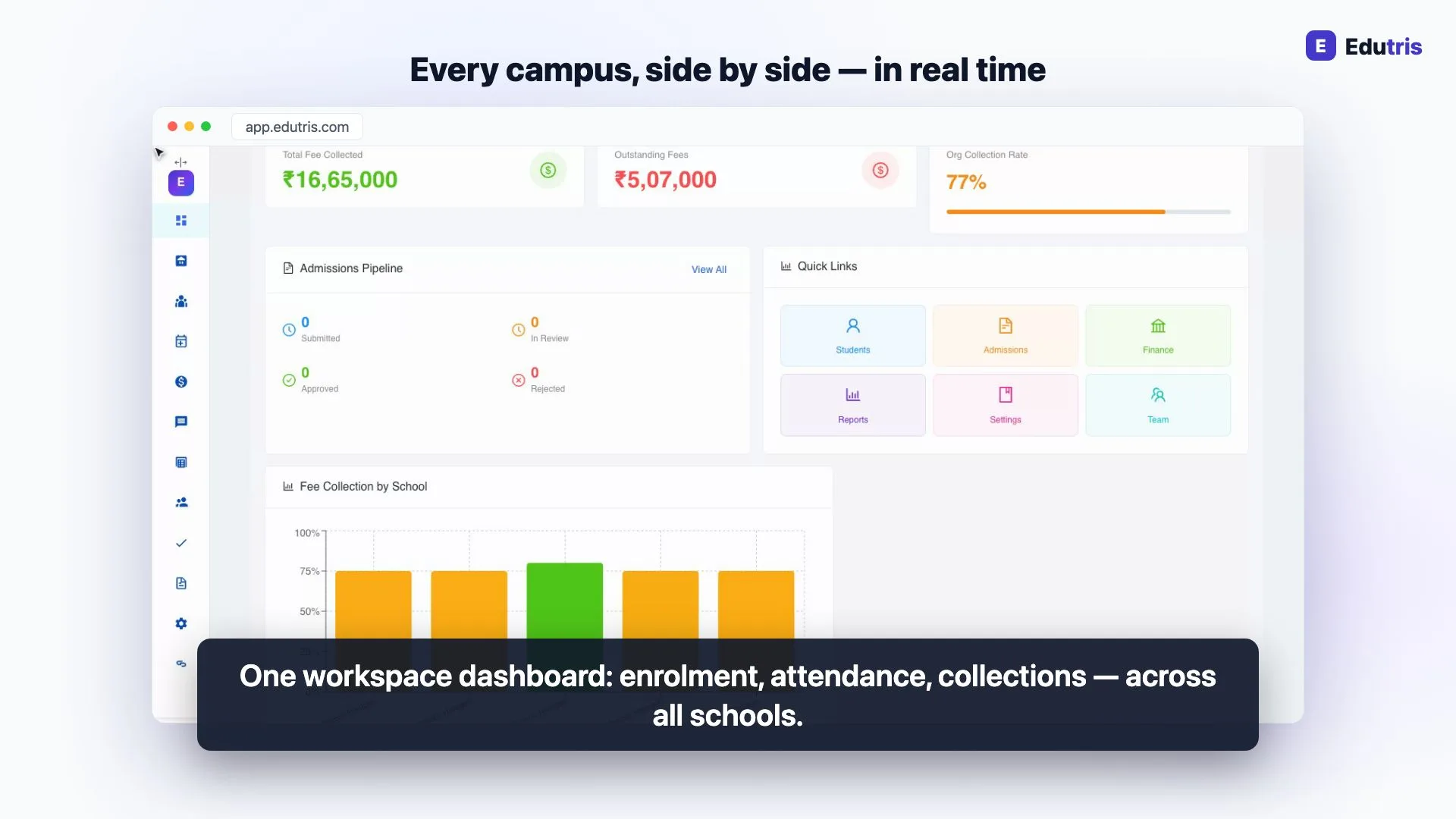
That last part is where a school ERP quietly earns its keep in an affiliation season: enrolment counts, TC serials, fee records and staff data that agree with each other because they come from one system. (Edutris keeps exactly these registers as part of normal operations. We do not file SARAS for you, and no software can, but walking into an inspection with reconciled registers is a different experience from walking in with seventeen Excel files.)
An owner's sequencing checklist
- Legal skeleton first, society/trust papers, state recognition, NOC. Longest lead-times live here.
- Certificates calendar, fire, building, sanitation: obtain, and diarise expiries with a two-month buffer.
- Staff file completion, qualifications, appointments, salary-through-bank evidence.
- Registers reconciliation, admissions, TCs, enrolment, fees; fix the gaps now, not in the deficiency response.
- Disclosure page live, build the mandatory public disclosure on your website and assign an owner for keeping it current.
- File in-window on SARAS, with the document set scanned, named and complete.
- After affiliation: OASIS current, renewals diarised: extension filings before expiry, every cycle.
Affiliation is not a mystery. It is the discipline of a school that knows where its records are, proven once, then maintained. Which, you may notice, is the same sentence we keep writing about UDISE+, APAAR and NEP 2020. That is not repetition; that is the whole point.
Written by the Edutris team, led by Manjunath Shedabal, Founder
Every product claim traces to verified capability; unshipped features live on the roadmap. Read our editorial policy.Free: The School Digitalisation Checklist
25 checkpoints across records, attendance, fees, communication, and compliance: score your school in 5 minutes and see exactly where time and fee revenue leak.
How Edutris gives school owners real-time control
Frequently Asked Questions
What are the basic requirements for CBSE affiliation?
In broad strokes: the school must be run by a registered society/trust/company (not proprietary), hold a No Objection Certificate (NOC) from the state government and recognition under applicable state law, meet land and infrastructure norms (which vary by location class), employ qualified teachers per norms, pay prescribed salaries, and comply with safety requirements (fire, building, sanitation). The authoritative source is the current CBSE Affiliation Bye-Laws, always verify against the current edition and the board's circulars, because norms are amended.
How does a school apply for CBSE affiliation?
Applications run online through CBSE's SARAS portal, schools create an account, file the application for the relevant category (fresh affiliation, upgradation, extension), upload the required documents and pay the fees. Inspection follows per the board's process. Timelines are announced in application windows each year, so plan a season ahead.
What is OASIS and why does it matter for affiliated schools?
OASIS is CBSE's Online Affiliated School Information System, affiliated schools maintain and update their institutional data there (infrastructure, staff, facilities). Keeping OASIS current is a standing obligation, and mismatches between OASIS, your mandatory public disclosure and ground reality are exactly what inspections notice.
What is the mandatory public disclosure requirement?
CBSE requires affiliated (and applicant) schools to publish specified information prominently on their own website, affiliation details, infrastructure, faculty, fee structure, results and specified documents. It is one of the most commonly slipped requirements because websites go stale; treat the disclosure page as a living document with an owner.
Sources
- CBSE Affiliation Bye-Laws (2012 edition), Read 2026-09-10. The only edition available as extractable text, the current 2018 edition is published as scanned images, so nothing on this site is attributed to it. Check the current bye-laws on cbse.gov.in before relying on any wording.
- CBSE SARAS, affiliation and school information system, Where an affiliated CBSE school maintains its own particulars with the board.
Read next
- 01For School Owners
The Admission Season Playbook: What the Office Needs Ready Before the First Application Arrives
An operational playbook for whoever actually runs admission season: the readiness list, a stage-by-stage calendar, and the front-desk capacity math.
- 02For School Owners
How to Design a School Fee Structure: Heads, Terms, Concessions and Due Dates
A practical guide to designing a school fee structure in India: choosing fee heads, class-wise amounts, collection frequency, concessions and due dates.
- 03For School Owners
How to Increase School Admissions: What Actually Moves the Number, and What Never Will
Most of what decides a school's intake is outside any software. Here is the narrow part you can move this season, and the part you cannot.
- 04For School Owners
NEP 2020 for School Owners and Principals: What Actually Changes in How You Run the School
What the policy says, quoted from the document, and what actually binds your school today. They are not the same thing, and the gap is the whole story.
- 05For School Owners
Reducing Student Dropout: How Schools Improve Retention Year on Year
Why families leave a school mid-cycle (fees, communication, academics, transport) and a practical retention playbook that protects enrolment and revenue.
- 06For School Owners
Teacher Retention: Why Teachers Leave Schools and How to Keep Them
Why good teachers leave Indian schools (pay delays, admin overload, no growth path) and practical ways school owners can improve teacher retention.