The Best School Management Software in India: Why We Won't Rank It, and What to Do Instead
At a glance
| Item | Detail |
|---|---|
| Who wrote this | Edutris, which sells one of the products a ranking would rank, so this page ranks nothing |
| What it gives you instead | The four categories vendors fall into, and a scorecard for three of them on your own week |
| The question that decides it | Is your priority teaching delivery, or running the school? Vendors are built around one |
| What every listicle omits | What ships today, the two-year total, and what it costs to leave |
| Where we lose | No LMS, no live classes, no hardware, no WhatsApp channel, no public API: stated plainly below |
| Time to do it properly | About two weeks: three vendors, one week's real operations each, answers in writing |
A confession that changes what this article can be: we make school software. So we are not going to give you a ranked list of the best school management software in India, because a ranking published by one of the candidates is marketing wearing a lab coat, and you should distrust every one you find written by a vendor, including any we have written before.
An earlier version of this page did rank the field, with a sentence or two of judgement about each competitor's pricing, interface and support. We removed all of it, because we could not point to where any of those judgements came from. That is the standard we hold our own product claims to, and it would be strange to apply it less strictly to claims about somebody else's.
What we can do is the part the listicles skip, which is also the part that actually decides the outcome.
What question actually eliminates most of the field?
This one: is your school's priority teaching delivery, or running the school?
Almost every vendor in this market is built around one of those and has bolted the other on. Their feature lists will not tell you which, because every feature list contains everything. But it decides your experience entirely, because the module a company started with is still the one that works best, and the one it added to close a deal is the one that will disappoint you in month four.
Answer it honestly and more than half the market stops being relevant. That is a bigger reduction than any ranking would give you, and you can do it before a single demo.
What kinds of product will I meet?
Four, and telling them apart matters more than telling brands apart.
| Category | What it is built around | The real cost | Suits |
|---|---|---|---|
| Teaching-led platform | Learning system, digital content, often interactive panels or devices | You pay for teaching breadth whether or not the office uses it | Schools wanting one vendor for pedagogy and administration |
| Administration-first system | Admissions, fees, exams, attendance, records, parent communication | Teaching content is somebody else's problem, so you may need a second tool | Schools whose pain is the office, not the classroom |
| Open-core, self-hosted | A licence you can run yourself | Your own IT capability, hosting, patching, backups, restores | Institutions with genuine technical staff |
| Free tier | A funded free product | Understand how it is funded before it holds your fee records | Small schools with a technical operator |
How to place a vendor in this table without their help: look at what their own home page leads with, not what its feature list contains. Then ask in the demo which module the company built first. Both answers are usually honest, because neither feels like a trap.
We are in the second row, and we will come back to what that costs you.
How do you evaluate three vendors in two weeks?
Not by watching three tours. By making each of them run one real week of your school.
Pick the week, not the feature list. Choose a week with an admission enquiry, a fee collection day, an attendance exception, one exam entry and one parent complaint. Every vendor demos beautifully against a tidy scenario; the value is in the messy one.
Watch the forty-times-a-day tasks at your speed. Marking a section's attendance. Entering marks for one subject. Generating one receipt. Finding one student's full history. If any of those is slower than what the school does today, the staff will quietly keep doing it the old way, and you will have bought software that is used for reports only.
Ask what is not live yet. Every vendor's site describes roadmap as product somewhere. The question is not whether they do it; it is how comfortably they answer when asked. Write down the list, and check it against what you were shown.
Get the money answers in writing. The two-year total at your expected enrolment, the setup charge, who does the migration and how many of your staff-hours it assumes, what is outside the quoted price, and the renewal figure.
Get the exit answer in writing too. Which records can you export, in what format, and how long does it take? A vendor confident in the product answers this plainly. A vendor who treats it as hostile has answered it.
| What to score | Why it predicts your experience |
|---|---|
| Speed of the four daily tasks | Decides whether staff adopt it or work around it |
| What is live today versus described | Decides whether you bought a product or a plan |
| Two-year total at your enrolment | Decides whether the cheap quote was actually cheap |
| Response-time commitment in writing | Decides what month four feels like |
| Export and exit terms | Decides whether the next decision is yours or theirs |
Three vendors scored this way beats eight demoed, and the scoring takes about two weeks.
What can you learn from a vendor's own website?
More than from their demo, because a website is written before anyone knows what you need and is therefore less tailored to you.
Read the order, not the list. The first three things on a home page are what the company believes it sells. The feature grid further down is what it believes it must not be missing. When those two disagree, the top of the page is the truthful one.
Look for what is described without being shown. A capability with a screenshot, a number and a name behind it is usually real. A capability that exists only as a phrase in a grid may be real, may be in progress, or may be a competitor's feature copied into a list. This is not dishonesty so much as how feature grids get written, but it is why "ask what is not live yet" is on the demo list above.
Check whether the absences are stated anywhere. A vendor who publishes what their product does not do is unusual, and it is a strong signal, because it means somebody internally is willing to lose a deal rather than mislead. We publish ours, which is self-serving to point out, so weight it accordingly, but go looking for the equivalent page on every vendor you shortlist and notice who has one.
Watch for pricing that cannot be reached. A published price is a commitment; a "contact us" is a negotiation. Neither is wrong, but a site that implies a price and then does not have one is telling you the number varies by how the call goes.
Who should you talk to besides the salesperson?
Two people, and neither is on the vendor's reference list.
Somebody in an office like yours. Ask the vendor for a reference school of roughly your size, your board, and your state, and then ask that school four things a salesperson cannot script: what took longer than expected during setup, what their staff still do outside the system, how long support takes to answer on a normal day rather than a crisis, and whether they would buy it again. The fourth question is the one that produces the honest pause.
Your own office staff, before the decision. The person who marks attendance and the person who collects fees will use this software far more than you will, and they can tell you in ten minutes which of two systems they would rather operate. Schools that skip this step buy the system the principal liked in a demo and then spend a year wondering why adoption is poor. If your staff cannot sit in a demo, have them do the four daily tasks in each shortlisted system and ask which they would choose.
One more thing worth doing and almost never done: ask the vendor what kind of school they are a bad fit for. A company that can answer immediately and specifically has thought about it and will probably tell you the truth later, when it costs them something. A company that says it suits everyone has just answered a different question, which is how confident they are rather than how suitable they are.
Where does Edutris fit, and where does it lose?
We are administration-first, and precise about what that means.
What it is. Admissions pipeline, fees with online collection, exams through to printed report cards, daily attendance, timetable with auto-generation, certificates, library, transport, staff records and payroll, a parent and student portal, and UDISE+ data export: three CSVs of the records we keep, which is a head start on your filing and explicitly not filing or portal integration. Published flat tiers at ₹2,999, ₹7,999 and ₹14,999 a month by school size, Enterprise quoted, and a 30-day guided pilot rather than a free trial. AI features are on Professional and above, and every one of them produces a draft a person reviews and approves.
Where we lose, plainly. We ship no learning management system, no live classes, no digital content and no hardware. There is no WhatsApp channel: messages go by SMS, email, push and in-app. There is no public API and no webhooks. The interface is English only. Report cards print in CBSE and ICSE formats alongside a standard format, and IB is not supported.
If your priority is teaching delivery from the same vendor, that list should send you to the first row of the category table rather than to us, and we would rather you read it here than discover it in month three. Where a direct, maintained comparison with a specific product exists, it is on our alternatives page.
What does this look like at your size?
Under 250 students. Your binding constraint is people, not features. The winning system is the one your single office person is fastest in, and the evaluation should weight the four daily tasks above almost everything else. Be sceptical of any option whose setup assumes a coordinator you do not employ.
Between 400 and 1,000 students. This is where the category question bites hardest, because you are big enough to feel a bad fit in both directions: an administration system with no teaching story, or a teaching platform whose fee module frustrates your accountant. Run the real week with both categories represented before narrowing, then shortlist three within one category.
A trust with several schools. Evaluate at one school and buy for the group, and make the pilot school the one with the messiest data rather than the tidiest. Ask how pricing and administration work across schools before anything else, because that structure is what you will renegotiate in three years.
What goes wrong
Choosing from a list instead of a week. The default, and the reason most switches disappoint.
Weighting reports over daily speed. Reports are what principals see in a demo; daily speed is what the school lives in. Adoption is decided by the second one.
Believing the feature list over the origin story. Everything is on every list. What the company built first is still what works best.
Treating the licence as the cost. Migration time, training and the renewal are usually larger, and none of them is on the quote.
Skipping the exit question. It is the cheapest question to ask and the most expensive to have skipped.
The honest bottom line
Nobody can tell you the best school management software in India, and the vendors telling you loudest are the least able to. What decides it is a question you can answer this afternoon (teaching delivery or running the school) followed by two weeks of making three vendors work a real week of your operations.
Do that, and it stops being a matter of opinion. If we come out of it, good. If we do not, you will have chosen well, which is the outcome this page is actually written for.
Written by the Edutris team, led by Manjunath Shedabal, Founder
Every product claim traces to verified capability; unshipped features live on the roadmap. Read our editorial policy.Checked against the product and its sources on .Free: The School Digitalisation Checklist
25 checkpoints across records, attendance, fees, communication, and compliance: score your school in 5 minutes and see exactly where time and fee revenue leak.
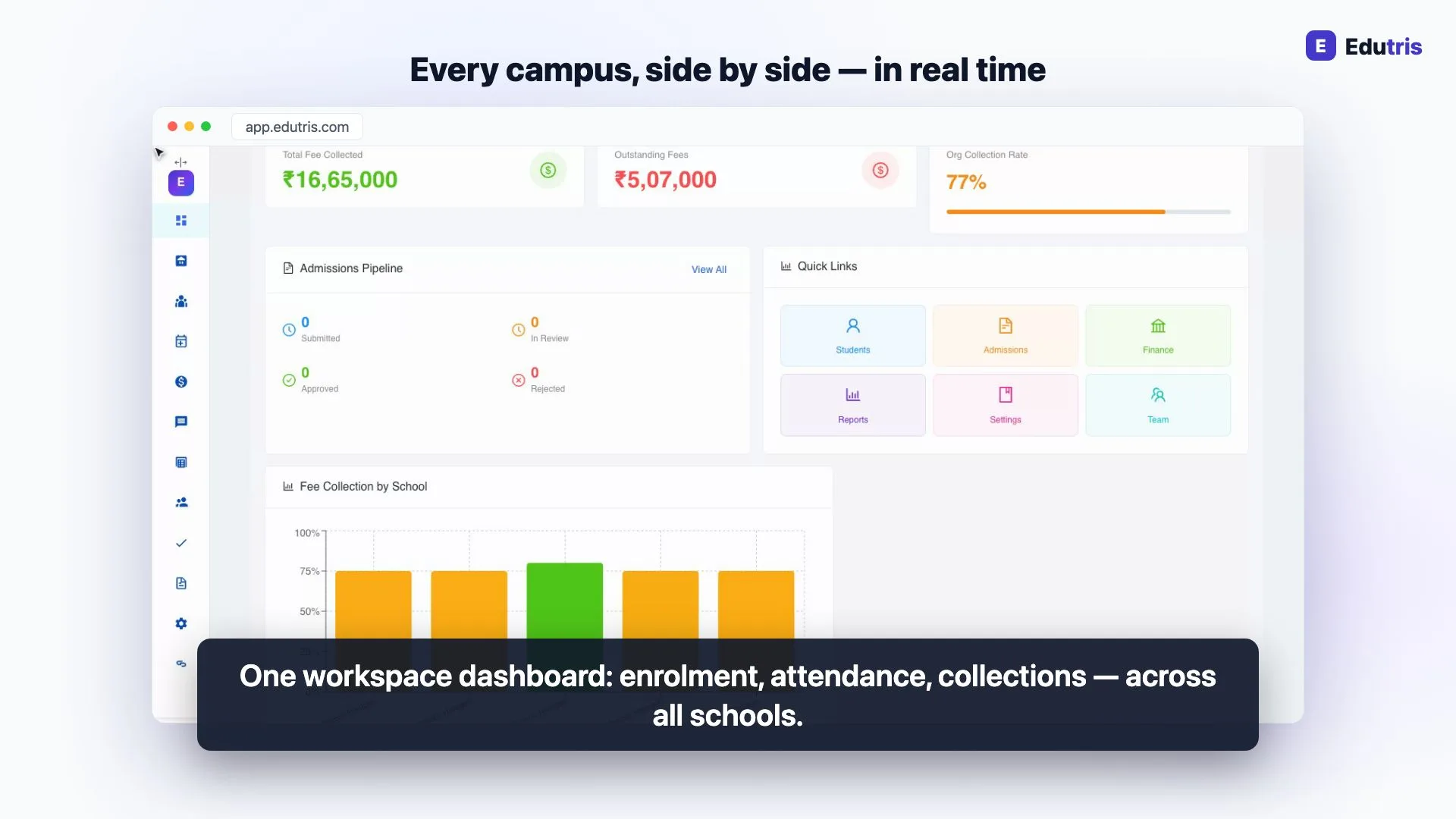
How Edutris gives school owners real-time control
Frequently Asked Questions
Can a software vendor honestly tell you which system is best?
No, and that is worth saying before anything else on a page with this title. We sell one of the candidates, so our ranking would be marketing. What exists is a best fit for a particular school, decided by whether your priority is teaching delivery or running the office, your size, your budget shape, and what you are willing to change about how you work. This article gives you the method rather than a winner.
Why won't you rank your competitors?
Because a ranking published by a vendor is marketing wearing a lab coat, and because we cannot verify most of what we would have to assert. To rank honestly we would need current, sourced facts about every rival's pricing, roadmap and support performance, and we do not have them. An earlier version of this page did carry those judgements and we removed them, because we could not point to where any of them came from.
How should a school actually shortlist school software?
Decide your centre of gravity first (teaching delivery or school operations) because that single question eliminates more than half the field and nobody's brochure will answer it for you. Then take three vendors from the right category, run each through one real week of your own operations, and get the money and exit answers in writing. Three properly evaluated beats eight demoed.
What are the four kinds of product I will meet?
Teaching-led platforms, which bundle a learning system, content and often hardware, and treat administration as an attachment. Administration-first systems, which run admissions, fees, exams, attendance and records, and treat teaching content as somebody else's job. Open-core products you can self-host, where the licence is cheap and your IT capability is the real cost. And free tiers, which are genuine but funded somehow, and worth understanding before you put fee records in them.
How do I tell which category a vendor is in?
Look at what their own home page leads with, not their feature list. Every vendor lists everything; almost none lead with something they are not built around. Then ask in the demo which module the company started with, because the first module is usually still the best one. A vendor that leads with classroom content and answers fee reconciliation questions vaguely has told you where it lives.
What should I ask in a demo that vendors do not expect?
Ask to see the thing you do forty times a day, done at your speed, on your data. Not a tour. Marking a section's attendance, entering marks for one subject, generating one fee receipt and finding one student's history. A system that is slower than what you do now for those four will not be adopted, however good the reports are. Also ask which features on their site are not live yet, and watch how comfortably they answer.
Does the biggest vendor make the safest choice?
It makes a different risk, not a smaller one. Scale usually buys you stability and a support process, and it can cost you attention: a small school is a small account anywhere. What actually predicts your experience is what the vendor commits to in writing about response times and exit, so ask for that rather than reading size as a proxy for it.
What does Edutris not do?
We are administration-first, so we do not ship a learning management system, live classes, digital content or hardware. There is no WhatsApp channel: communication goes by SMS, email, push and in-app. There is no public API or webhooks, the interface is English only, and report cards print in CBSE and ICSE formats plus a standard format, with IB not supported. If your priority is teaching delivery in the same vendor, a teaching-led platform is a better fit and you should shortlist from that category instead.
Is a free tool ever the right answer for a school?
For a small school with a genuinely technical operator, sometimes. The licence is the smallest line in the decision either way, so the question is not price but who hosts it, who patches it, who restores it when it breaks, and what happens when the person who set it up leaves. We wrote that comparison out separately rather than dismissing free options, because dismissing them would be exactly the self-serving move this page is trying not to make.
Should we just pick from a listicle to save time?
A listicle is fine for discovering that a vendor exists and useless for deciding between them, because the author is either selling one of the options or has never run your school. Use articles to build the long list, then spend the two weeks. The cost of choosing badly is not the licence fee, it is a migration you do twice and an office that stops trusting software.
Read next
- 01For School Owners
How to Evaluate School Software Before Signing a Contract: 12 Questions to Ask
Most schools sign a software contract after a 30-minute demo, then fight implementation for months. The 12 questions that reveal what a demo won't show.
- 02For School Owners
How to Choose School Management Software in India: A Practical Decision Framework
A step-by-step framework for Indian school owners: audit your needs, set a realistic budget, plan the migration, test support, and spot vendor red flags.
- 03For School Owners
A Fedena Alternative for Schools That Want Something Simpler and Flat-Priced
Fedena is one of India's longest-standing school ERPs. If you want a modern, admin-first system on transparent flat pricing, here's how to compare: honestly.
- 04For School Owners
Looking for a Teachmint Alternative? What CBSE Schools Should Actually Compare
Teachmint is a strong teaching-first platform. If your priority is running the office on flat, transparent pricing, here's how to compare it fairly.
- 05For School Owners
Best School ERP for CBSE Schools in 2026: An Honest Buyer's Shortlist
What CBSE schools should actually weigh when choosing an ERP in 2026, a neutral look at the main contenders, and an honest note on where Edutris fits.
- 06For School Owners
The Admission Season Playbook: What the Office Needs Ready Before the First Application Arrives
An operational playbook for whoever actually runs admission season: the readiness list, a stage-by-stage calendar, and the front-desk capacity math.