Best School ERP for CBSE Schools in 2026: An Honest Buyer's Shortlist
The disclosure most "best ERP" listicles bury: this article is written by Edutris, and Edutris sells a school ERP. Read everything below (especially the part about our own product) with that in mind. What we can promise is the thing most vendor-written lists don't: no invented ratings, no made-up user counts, no pretend neutrality. Real evaluation criteria, a fair description of the established players, and an honest account of where we fit and where we don't.
If you run a CBSE school and are shortlisting software for 2026-27, here is how we would think about it if we were in your chair.
What a CBSE school should actually weigh
Feature checklists between ERPs look interchangeable on brochures. The differences that matter show up in five places:
1. The attendance-to-eligibility chain. CBSE's 75% attendance requirement for board-exam eligibility means attendance is a compliance record, not just a register. You want daily marking that teachers genuinely complete (which means it must be fast), same-day parent alerts on absence, and percentages that roll up per student without manual tallying.
2. The examination cycle, end to end. Exam scheduling, marks entry by teachers, computed grades, hall tickets, and report cards, and crucially, release control: nothing should reach students or parents until the school decides. Ask every vendor to walk you through one complete exam cycle in a live system, not slides.
3. Fee management with real accountability. Receipts generated on every payment, a live outstanding view, and defaulter follow-up your accountant controls. Ask specifically how reminders work (automatic, scheduled, or staff-triggered) and decide which your school actually wants.
4. A parent channel families use. A parent app changes the school-parent relationship only if parents adopt it. Ask what parents can actually do in it (see fees and pay? book PTM slots? sign permission slips?) and whether the app costs extra per parent.
5. Total cost of ownership and exit. Per-student pricing compounds as you grow; per-module pricing grows as you discover what "core" didn't include. And ask the uncomfortable question early: if we leave in two years, how do we get our data out?
For a deeper checklist, we keep a vendor-neutral version in 12 questions to ask before buying school software.
The established players, fairly described
These four come up in most CBSE-school shortlists. We compete with all of them; what follows is limited to safe general knowledge, and we link our detailed comparison pages for the specifics.
Teachmint rose to prominence as a teaching and live-class app and has since expanded into a broad school-management suite with a strong mobile focus and significant marketing reach. Schools drawn to a mobile-first experience shortlist it often. See our detailed Edutris vs Teachmint comparison.
Fedena (from Foradian Technologies) is one of the longest-standing Indian school ERPs, with roots in an open-source project and a mature, modular feature set accumulated over many years. Its longevity is genuinely reassuring; the trade-off schools sometimes report with older platforms generally is interface age. Details: Edutris vs Fedena.
myClassboard is a long-established Hyderabad-based ERP with a reputation among multi-branch school groups and a comprehensive module list built over a long operating history. Details: Edutris vs myClassboard.
Entab (CampusCare) is among the oldest names in Indian school software, with a long association with CBSE-affiliated and convent schools, particularly in North India. For schools that weight vendor tenure heavily, it belongs on the list. Details: Edutris vs Entab.
We are deliberately not quoting pricing, user counts, or ratings for any of them: those change, vendors package deals differently, and second-hand figures in a competitor's blog are exactly the kind of "data" you should distrust. Get current quotes directly, and put every vendor through the same live walkthrough.
Where Edutris fits, the honest version
Now our own entry, held to the same standard.
What we believe we do well:
- Flat, published pricing. ₹2,999/month up to 250 students, ₹7,999/month up to 1,000 (AI features included from this tier), ₹14,999/month up to 3,000, Enterprise custom above. No per-student meter, no per-module surprises: the price on the pricing page is the price.
- The CBSE-relevant core, complete and connected. Daily attendance with parent alerts, full exam cycle with hall-ticket and report-card release control, fee management with instant receipts and defaulter views, timetable auto-generation, certificates (bonafide/TC/conduct), and a public online admissions portal: one system, one data set. The specifics are on our CBSE solutions page.
- A genuinely useful parent app, included. Fees with online payment, report cards, messaging, PTM slot booking, digital permission slips, and live bus GPS in the parent mobile app, at no per-parent charge.
- Built for Indian schools, not localised for them. Fee heads, admission workflows, and communication patterns follow how schools here actually operate.
The honest caveats:
- We are the newest product on this page. Our deployment history is a pilot with a multi-school education society in Karnataka's Belagavi district, not hundreds of schools. If vendor tenure is your primary criterion, the established players above beat us on it today.
- We don't do everything. No WhatsApp integration, no scheduled/automatic fee reminders (reminders are one-click, staff-triggered), no UDISE+ auto-export, and our report cards are a clean standard format with computed grades, not CBSE board-replica templates. We would rather you know this now than after signing.
- No self-serve free trial. We onboard every school through a 30-day guided pilot (structured setup with your real data and staff) because we think that is how ERP decisions should actually be made, but it does mean talking to us first.
How to run the decision
Whichever way you lean, the process matters more than the shortlist:
- Shortlist two or three vendors, ideally one established, one newer.
- Demand a live walkthrough of your three hardest workflows (for most CBSE schools: exam-to-report-card, fee-to-receipt-to-defaulter, attendance-to-parent-alert).
- Get all-in written pricing for your actual enrolment, three years out.
- Pilot with real data before any annual commitment.
How Edutris handles this
If Edutris makes your shortlist, the path is the 30-day guided pilot: we set up your school with your classes, fee structure, and staff, your teachers run real attendance and marks entry, and you judge the product on your own operations rather than our claims, including the caveats above. Start from the CBSE solutions page or the comparison pages if you want the feature-by-feature detail first.
Written by the Edutris team, led by Manjunath Shedabal, Founder
Every product claim traces to verified capability; unshipped features live on the roadmap. Read our editorial policy.Free: The School Digitalisation Checklist
25 checkpoints across records, attendance, fees, communication, and compliance: score your school in 5 minutes and see exactly where time and fee revenue leak.
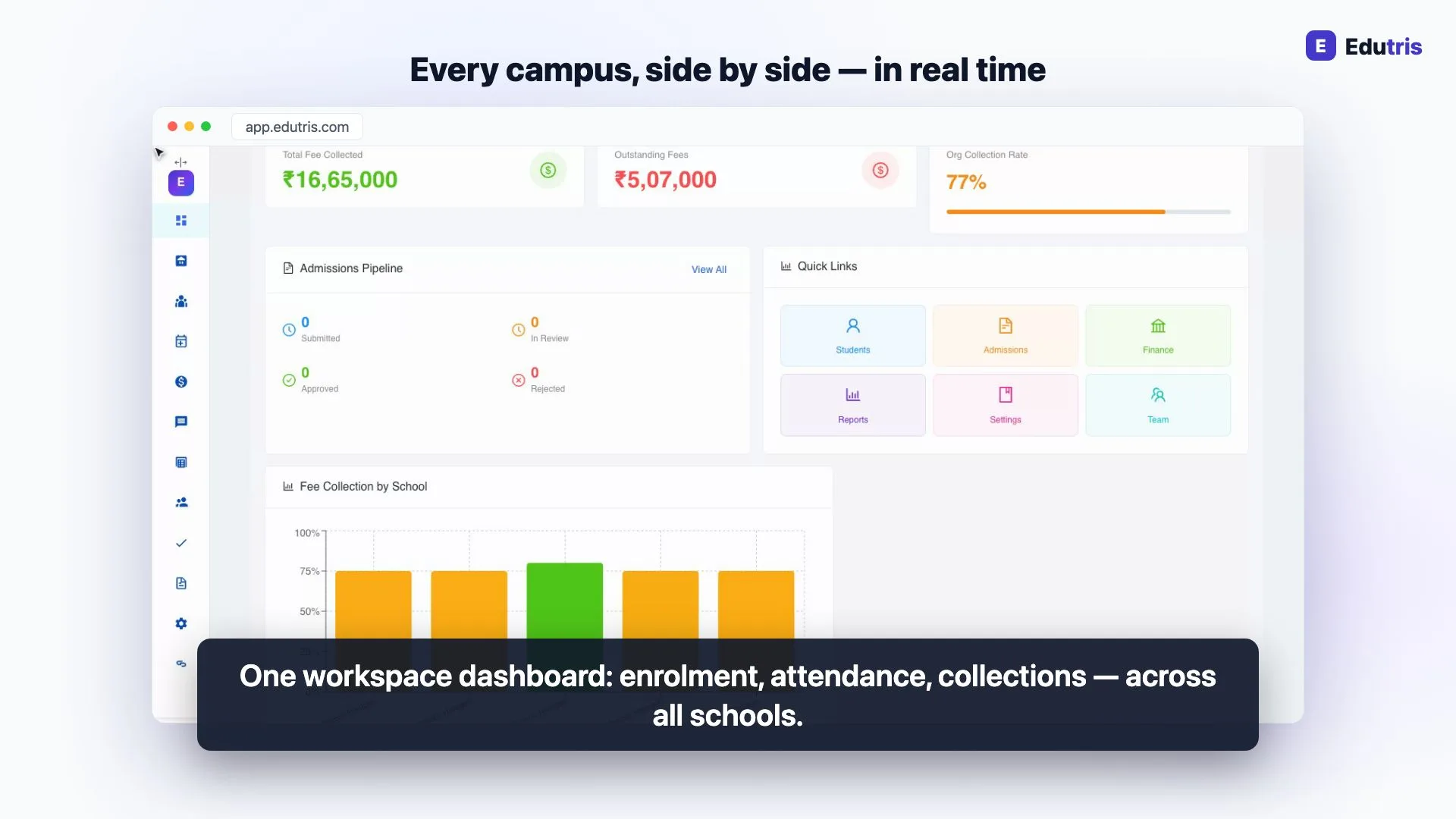
How Edutris gives school owners real-time control
Frequently Asked Questions
What features matter most in a school ERP for CBSE schools?
Four clusters do most of the work: daily attendance with parent alerts (CBSE's 75% eligibility rule makes accurate attendance records non-negotiable); examination management covering schedules, marks entry, hall tickets, and report cards; fee management with proper receipts and defaulter visibility; and a parent communication channel families actually use. Beyond features, weigh total cost of ownership (per-student pricing compounds as you grow), data ownership and export, and the quality of onboarding support: most ERP failures are implementation failures, not feature gaps.
Does a CBSE school need software with official board-format report cards?
Check what your school actually submits versus what it prints. Board-registered classes (10 and 12) have their results processed through CBSE's own systems, while the report cards a school gives parents in other classes are the school's own format. Some ERPs offer CBSE-styled report card templates; Edutris, to be specific, currently generates a standard report-card format with auto-computed grades and school-controlled release, not board-replica templates. If a board-styled layout is a hard requirement for your school, ask each vendor to show you a real sample rather than a brochure claim.
Should a CBSE school choose an established ERP or a newer product?
Established products carry more deployments and longer track records; newer products tend to be faster-moving, cleaner to use, and more attentive per customer because each school matters more to them. The rational approach is to judge the software in front of you rather than the brand age: run a real pilot with your own data, your own teachers, and one full fee-collection and exam cycle. A vendor confident in their product will agree to a structured pilot; hesitation on that point is itself information.
How much does school ERP software cost for a CBSE school in India?
Pricing models vary more than features do. Common models are per-student per-month (costs scale with enrolment), per-module (a lean core price that grows as you add functions), and flat tiers. Edutris publishes flat pricing: ₹2,999/month up to 250 students, ₹7,999/month up to 1,000 students with AI features included, ₹14,999/month up to 3,000 students, and custom Enterprise plans above that. Whatever vendor you evaluate, insist on the all-in figure (implementation, training, SMS charges, and parent-app access included) not just the headline licence.
Read next
- 01For School Owners
Looking for a Teachmint Alternative? What CBSE Schools Should Actually Compare
Teachmint is a strong teaching-first platform. If your priority is running the office on flat, transparent pricing, here's how to compare it fairly.
- 02For School Owners
A Fedena Alternative for Schools That Want Something Simpler and Flat-Priced
Fedena is one of India's longest-standing school ERPs. If you want a modern, admin-first system on transparent flat pricing, here's how to compare: honestly.
- 03For School Owners
The Best School Management Software in India: Why We Won't Rank It, and What to Do Instead
We sell one of the options, so our ranking would be worthless. Here is the evaluation that beats every listicle, including this one.
- 04For School Owners
The Admission Season Playbook: What the Office Needs Ready Before the First Application Arrives
An operational playbook for whoever actually runs admission season: the readiness list, a stage-by-stage calendar, and the front-desk capacity math.
- 05For School Owners
CBSE Affiliation, Explained for School Owners: Requirements, Process and the Records That Decide It
Affiliating to CBSE, or renewing? What the Affiliation Bye-Laws expect, how SARAS runs, the mandatory disclosures, and what inspections actually check.
- 06For School Owners
How to Design a School Fee Structure: Heads, Terms, Concessions and Due Dates
A practical guide to designing a school fee structure in India: choosing fee heads, class-wise amounts, collection frequency, concessions and due dates.