School ERP vs School Management Software: What's the Difference and What Do You Need?
The Jargon Problem in School Software
Walk into any school software sales conversation and you'll hear: ERP, SIMS, SMS, SIS, school management platform, school administration system. These terms are used interchangeably by vendors and mean very different things.
This ambiguity is not accidental. "ERP" sounds more sophisticated than "school software," so vendors use the term to justify higher prices and longer implementation timelines. School owners, unfamiliar with enterprise software concepts, may end up buying something far more complex (and expensive) than they actually need.
This guide cuts through the jargon.
What Each Term Actually Means
ERP (Enterprise Resource Planning): Originally designed for manufacturing companies to integrate production, inventory, finance, and HR into one system. In the school context, an ERP typically adds financial accounting, procurement, multi-entity management, and advanced HR (payroll, ESI/PF compliance) on top of academic management. Examples: SAP Education, Oracle for Education, some Indian-built enterprise school ERPs.
SIMS (School Information Management System) / SMS (School Management System): Focused on the operational core of a school, student information, attendance, grades, fee management, parent communication, and basic HR. This is what 90% of Indian private schools actually need. Edutris is a SIMS.
SIS (Student Information System): Used more in American/international contexts; roughly equivalent to the student records component of a SIMS.
What Does a Typical Indian Private School Actually Need?
Let's be specific. A private school with 300-800 students in India needs:
- Student records: Admission to alumni, TC generation, category/caste/disability tracking for government submissions
- Attendance: Daily marking with parent notification, monthly reports, board exam eligibility tracking
- Academic management: Marks entry, auto-computed grades, printable report cards with controlled release to parents
- Fee management: Fee structure configuration, online payment acceptance, one-click bulk reminders to pending accounts, receipt generation, collection reports
- Parent communication: Notice board, event calendar, individual messaging, emergency alerts
- Staff management: Basic HR, attendance, leave, timetable assignment
- Clean data exports: CSV/Excel exports of student, attendance and academic data: the raw material for annual government submissions like UDISE
- Reporting: Attendance reports, collection reports, academic performance summaries
A well-built SIMS handles all of this. An ERP adds layers of financial accounting, procurement workflows, and multi-company management that a single school doesn't need and will never use.
When Does a School Actually Need an ERP?
There are situations where ERP-level features become relevant:
Large education groups (15+ schools): If you're managing 15 or more schools under one trust, with centralized procurement, consolidated accounting across entities, and complex payroll including ESI/PF compliance for hundreds of staff, ERP-level features start to matter.
Institutions with residential facilities (hostels, canteens, transport): Large boarding schools with hostels, canteens with inventory management, and large fleet operations may need more than a standard SIMS.
Groups with multiple entity types: An education group that runs schools, colleges, a coaching institute, and a skills training centre under different legal entities may need ERP-level multi-entity financial management.
For these situations, a SIMS can still handle the academic core, while a separate accounting package (Tally, for example) handles the financial complexity. The two systems don't need to be the same product.
The Hidden Costs of ERP Overkill
Here's what happens when a school buys an ERP they don't need:
Implementation cost: Enterprise school ERPs cost ₹5-20 lakhs in implementation fees before you've entered a single student record. This is often framed as a "one-time cost", but it's a real cash outflow at the start.
Training burden: ERPs require extensive staff training because of their complexity. Features that aren't needed get in the way of features that are. Teachers and accounts staff spend weeks learning a system before it's usable.
Configuration time: ERPs are flexible by design. This means everything needs to be configured, fee structures, academic calendars, grade boundaries, report card templates. What should take a week takes three months.
Ongoing license cost: Enterprise ERP licenses for schools typically cost ₹2-5 lakhs per year. A purpose-built SIMS costs ₹30,000-2,00,000 per year depending on school size.
The all-in cost of an ERP for a 500-student school over three years can easily exceed ₹30 lakhs. A SIMS for the same school costs ₹1-2 lakhs over the same period.
The Right Question to Ask
Instead of asking "do we need an ERP or an SMS?", ask these questions:
- Do we have more than 15 schools under one management? If no, you need an SMS, not an ERP.
- Do we need integrated financial accounting (P&L, balance sheet) within the school software? If no, a separate accounting package + SMS is more cost-effective.
- Do we need multi-entity legal entity management? If no, an SMS handles your needs.
- Do we have more than 100 non-teaching staff where full HR/payroll software is needed? If no, basic HR in an SMS is sufficient.
For most Indian private schools (including groups running 5-10 schools) the answers to all four questions are "no." A purpose-built SIMS is the right choice.
What to Look for in a School Management System
If you've decided an SMS is the right choice (as it is for most schools), here's what to evaluate:
Academic fit: Can it handle your exam structure (exam scheduling, marks entry, auto-computed grades, and printable report cards) without a months-long configuration project?
Indian payment integration: Does it accept UPI, credit/debit cards, and net banking? Cash-only fee collection is an immediate bottleneck.
Parent app: Is there a dedicated mobile app for parents, or just a web portal? Parent engagement through mobile is significantly higher.
Connectivity fit: For schools in areas with unreliable internet, ask each vendor how their product behaves on a slow connection: whether that means offline support or, as with cloud-first products like Edutris, a lightweight interface that stays fast on an ordinary mobile-data signal.
Pricing model: Per-student pricing or flat fee? For growing schools, flat-fee subscription models are more predictable.
Implementation support: Does the vendor provide data migration and onboarding support, or is it self-serve?
Edutris is designed to score well on these criteria, purpose-built for Indian schools, with online payments (UPI, cards, net banking) via Razorpay, a dedicated parent mobile app, a fast low-bandwidth interface, and transparent flat-tier pricing from ₹2,999/month.
See Edutris in action → Book a free demo
Edutris is a School Information Management System (SIMS) built for Indian schools, not an ERP. Purpose-built for CBSE, ICSE, and state board schools. Starting at ₹2,999/month.
Written by the Edutris team, led by Manjunath Shedabal, Founder
Every product claim traces to verified capability; unshipped features live on the roadmap. Read our editorial policy.Free: The School Digitalisation Checklist
25 checkpoints across records, attendance, fees, communication, and compliance: score your school in 5 minutes and see exactly where time and fee revenue leak.
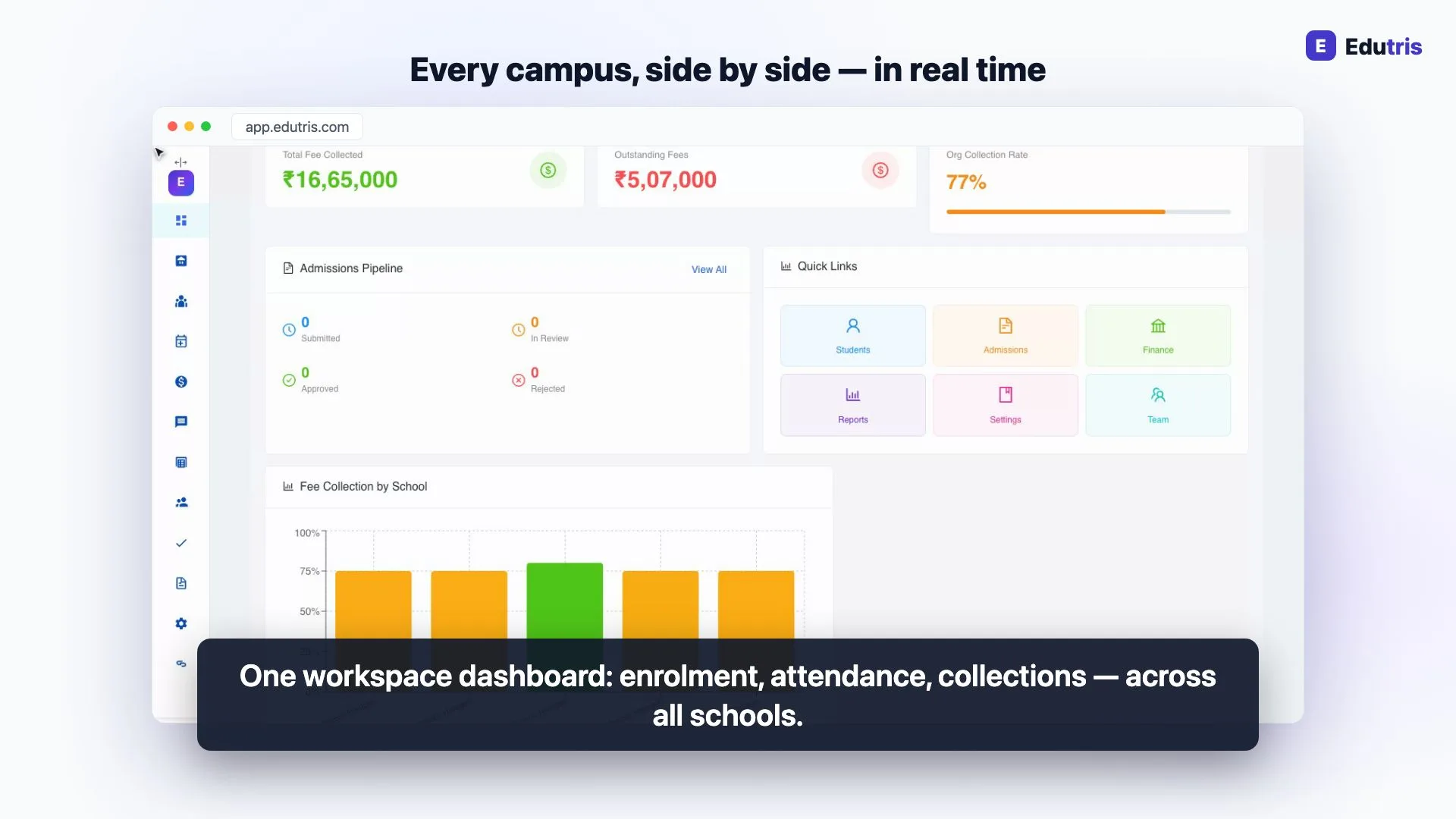
How Edutris gives school owners real-time control
Frequently Asked Questions
What is the difference between a School ERP and a School Management System?
A School ERP (Enterprise Resource Planning) is a comprehensive platform that integrates academic management with HR, finance, procurement, and facility management: typically suited for large education groups with complex administrative structures. A School Management System (SMS) or SIMS (School Information Management System) focuses on the core operations of a school: student records, attendance, grades, fees, and parent communication. For most Indian private schools with under 2,000 students, an SMS/SIMS is more appropriate, more affordable, and faster to implement than a full ERP.
How much does a School ERP cost in India vs a School Management System?
School ERPs from enterprise vendors typically cost ₹5-20 lakhs upfront in implementation fees plus ₹2-5 lakhs/year in licensing. School Management Systems like Edutris are subscription-based on published flat tiers, starting at ₹2,999/month (₹28,790/year on yearly billing), with no implementation fees. For most schools, the ROI calculation strongly favors an SMS.
Do small schools need an ERP or is a school management system enough?
For schools with under 500 students, a school management system is almost always sufficient. ERPs are designed for organisations with complex multi-departmental processes, multiple cost centers, and large procurement operations. A school's primary needs (student management, attendance, grades, fees, and parent communication) are handled comprehensively by a purpose-built SMS.
Read next
- 01For School Owners
How to Choose School Management Software in India: A Practical Decision Framework
A step-by-step framework for Indian school owners: audit your needs, set a realistic budget, plan the migration, test support, and spot vendor red flags.
- 02For School Owners
Switching School ERPs Mid-Year: When It Makes Sense and How to Do It Safely
When switching your school ERP mid-session makes sense, when to wait for April, and a practical checklist for moving students, fee ledgers and marks.
- 03For Principals
10 School Tasks You Can Automate Today (Without Changing How You Teach)
Ten genuinely automatable school tasks (from absence alerts and fee receipts to hall tickets and timetables) with what each one replaces in the office.
- 04For School Owners
Free vs Paid School Management Software: The Honest Trade-Off for Indian Schools
Free school software is real, and sometimes right. But the licence fee is the smallest line: who hosts it, who patches it, and who restores it.
- 05For School Owners
The Right Software for a 200-Student School (Hint: It Isn't the Enterprise Suite)
A 200-student school doesn't need enterprise software. What actually matters when one office admin runs everything, and which modules to skip.
- 06For School Owners
School Data and India's DPDP Act: A Plain-English Guide for School Owners
What India's DPDP Act 2023 means for schools holding student and parent data: consent, purpose limitation and breach duties, without the jargon.