School Software for State-Board Schools: What KSEEB, SSC and Other Board Schools Actually Need
Search for school management software and you would think every school in India is a CBSE school. Vendor sites lead with CBSE terminology, CBSE assessment structures, CBSE everything. Yet the majority of Indian schools are affiliated to state boards (KSEEB in Karnataka, SSC in Maharashtra, and their counterparts in every state) and a large share of them teach in Kannada, Marathi, Telugu, Tamil, Hindi, or another regional medium.
These schools are not a lesser market that CBSE-flavoured software happens to also serve. They have their own realities: leaner office staff, fee structures parents pay in instalments through the year, the SSLC or Class 10 board year as the annual high-stakes event, and staff who may prefer a Hindi interface to an English one. This article is about what software should actually do for a state-board school, including the places where vendors routinely overclaim.
The State-Board Reality Checklist
A state-board school evaluating software should test it against its own week, not a vendor's demo script:
Class structures and terminology that fit. Standards 1 through 10, sections named the school's way, term-based exams rather than someone else's assessment jargon hard-coded into the screens.
Fee structures with instalments. State-board school parents commonly pay term-wise or in negotiated instalments, in cash more often than not. The software must record cash, cheque, and online payments equally well, show partial payments cleanly, and produce a live picture of who has paid what: the fee module is where a state-board school usually feels the value first.
Exams as the school actually runs them. Unit tests, mid-terms, preparatory exams before boards: scheduled per section and subject, marks entered by teachers on a roster grid, grades computed automatically, results released when the head decides. Edutris's examination flow covers this whole cycle, and it fits a KSEEB or SSC school's internal assessment calendar exactly as well as a CBSE school's.
Printable term report cards. Parents of state-board students expect a physical report card at term end. Edutris prints a standard-format report card (subject-wise marks, auto-computed grades) from a clean print route, released per section under the school's control.
Communication that reaches non-smartphone households. SMS still matters in state-board catchments. Announcements and alerts should travel by SMS and email as well as app push, so no family is out of reach.
The SSLC Year: Where Clean Records Earn Their Keep
Every state-board school orbits its Class 10 board year, SSLC in Karnataka, SSC in Maharashtra. Software does not conduct board exams and never will; what it does is make the school's side of that year orderly.
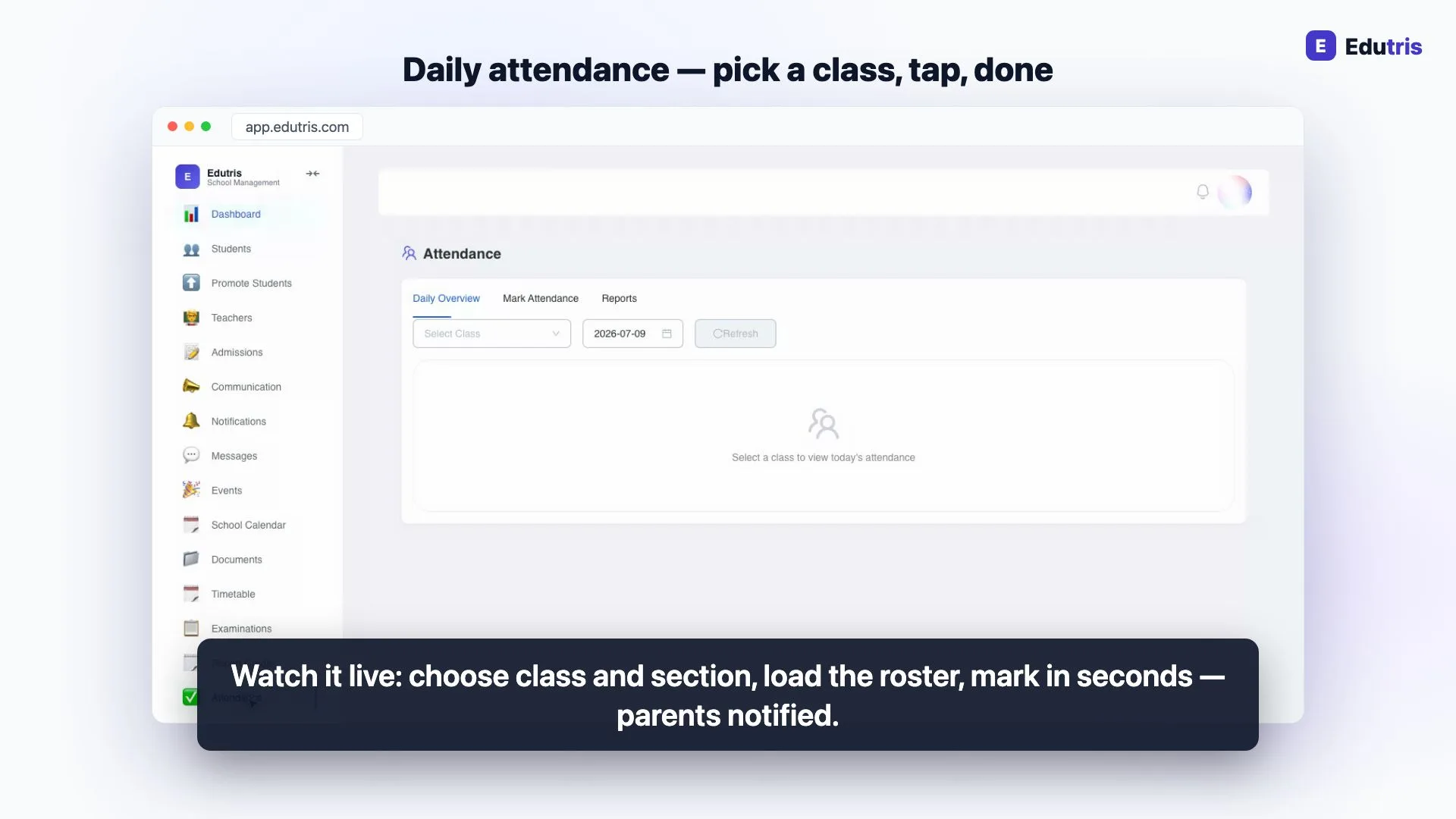
Attendance, continuously computed. Board-year attendance eligibility should never be a surprise discovered while filling forms. With digital attendance, every SSLC student's percentage is current every day, and a slipping student is visible in weeks one to four, not month nine.
A complete internal exam record. By February, an SSLC cohort has been through unit tests, mid-terms, and preparatory exams. When each of those lived in the same system (scheduled, marks entered, grades computed) a class teacher can see any student's full-year trajectory in one screen and aim the final revision push where it belongs.
Student master data, already clean. Board registration runs on exact names, dates of birth, and guardian details. A school whose student records live in software, exportable as CSV, starts registration season from clean data instead of reconciling admission registers. To be precise about the boundary: Edutris gives you clean, exportable records. It does not integrate with board portals or auto-fill government submissions, and any vendor who implies push-button board filing deserves sharp questions.
Regional-Medium Schools: The Honest Language Answer
Here is the claim to scrutinise hardest, because it is the one most often fudged: "available in all regional languages."
Edutris's answer is narrower and true. The medium of instruction does not matter at all, a Kannada-medium school's classes, subjects, exams, and fees are managed identically to an English-medium school's. The platform interface is English today; a Hindi interface is on our public roadmap, ahead of Kannada, Marathi, Telugu, Tamil, Bengali, or Gujarati. In practice this works because office staff and teachers operate a small, learnable set of screens. Parents, meanwhile, receive communication by SMS, email, and app notification, and the AI assistant (Professional plan and up) can translate announcements into Hindi and other Indian languages before they go out. If a full regional-language interface is a hard requirement for your school, we would rather you know our answer now than after a purchase.
It is worth saying where this confidence comes from: Edutris's pilot deployment is with an education society in Belagavi district, Karnataka: KSEEB territory, where Kannada- and Marathi-medium schools are the norm, not the exception. The product's state-board fit is being proven in exactly this environment, and we say "pilot" because that is what it is: one deployment, not a customer wall.
Questions to Ask Any Vendor (Including Us)
| Question | The fudge to watch for |
|---|---|
| Is the interface in my language, or just "supports" my medium? | Medium-of-instruction claims dressed up as UI language support |
| Do report cards match my board's official template? | "Board-ready" meaning a generic printable format |
| Does it file or export to board/government portals? | Clean CSV data being pitched as portal integration |
| What happens on our internet, on our phones? | Demos run only on office WiFi |
| Free trial or guided pilot, and who does the setup? | An empty trial account with no help configuring your school |
Edutris's own answers are in this article: English interface today, Hindi on the roadmap; standard-format report cards, not board templates; CSV export, not portal integration; browser-based and light enough for mobile data; and a 30-day guided pilot where our team sets up your actual school.
How Edutris Handles State-Board Schools
Edutris runs the full administrative cycle a KSEEB, SSC, or other state-board school needs: student records with CSV import and export, daily attendance with same-day parent alerts, instalment-friendly fee collection across cash and online modes, per-section exam scheduling with roster-grid marks entry and auto-computed grades, printable term report cards under per-section release control, and communication by SMS, email, and app push. The interface is English (Hindi is on the roadmap), plans are published openly starting at ₹2,999/month, and the state-board schools page sets out the fit in detail, including, as above, what we do not claim.
Written by the Edutris team, led by Manjunath Shedabal, Founder
Every product claim traces to verified capability; unshipped features live on the roadmap. Read our editorial policy.Free: The School Digitalisation Checklist
25 checkpoints across records, attendance, fees, communication, and compliance: score your school in 5 minutes and see exactly where time and fee revenue leak.
How Edutris removes the daily chaos for principals
Frequently Asked Questions
Does school management software work for Kannada or Marathi medium schools?
Yes, with one honest caveat about what 'work' means. Edutris runs schools of any medium of instruction, the students, classes, exams, and fees of a Kannada- or Marathi-medium school are managed exactly like anyone else's. The platform interface itself is English today; a Hindi interface is on our public roadmap, ahead of other regional languages. In practice, office staff and teachers at regional-medium schools operate the English interface comfortably, and parents receive school communication through SMS, email, and app notifications.
Can Edutris print report cards in the KSEEB or SSC board format?
No, and you should ask this question of every vendor precisely. Edutris produces a clean, printable standard-format term report card: subject-wise marks with auto-computed grades, released per section under the school's control. It does not replicate official board templates such as the KSEEB or Maharashtra SSC layouts, and official board documents like SSLC marks cards are issued by the board itself, not by any school software. For the school's own term exams and parent communication, the standard format covers the need.
How does software help in the SSLC or Class 10 board year?
By keeping the school's own records for that cohort complete and instantly retrievable. Attendance for the year is computed continuously rather than tallied from registers, so eligibility concerns surface early instead of at form-filling time. Every internal exam (unit tests, mid-terms, preparatory exams) has scheduled dates, entered marks, and computed grades in one place, so a subject teacher or principal can see a student's trajectory across the year at a glance. When board registration season arrives, student records with names, dates of birth, and guardian details are already clean and exportable as CSV rather than scattered across registers.
Is Edutris affordable for a state-board school budget?
The pricing is public and starts at ₹2,999 per month for schools up to 250 students; Professional is ₹7,999 per month for up to 1,000 students, and Growth is ₹14,999 per month for up to 3,000. There are no per-student charges within a plan's limit. For a typical state-board school, the honest comparison is against the staff hours currently spent on registers, receipt books, and report-card compilation, and Edutris offers a 30-day guided pilot so a school can verify the fit on its own data before paying.
Read next
- 01For Principals
The CBSE Grading System Explained: Grade Bands, Grade Points and CGPA
How CBSE's 9-point grading works: the A1–E band table, grade points, and how CGPA and an indicative percentage are calculated, in plain English.
- 02For Principals
5 Admin Tasks Your Teachers Should Never Do by Hand Again
Teacher workload reduction starts with naming the clerical work. Five tasks (from attendance tallying to remark writing) that software should be absorbing.
- 03For Principals
AI-Drafted Report-Card Remarks: How They Work, and Why the Teacher Still Signs Off
How AI-drafted report-card remarks work in practice (the teacher always reviews and signs off) and why generic copy-paste remarks fail parents.
- 04For Principals
The CBSE School Exam Flow: From Scheduling and Marks Entry to the Printed Report Card
How a CBSE school's internal exam cycle runs digitally: scheduling, hall tickets, marks entry, auto-computed grades, controlled report-card release.
- 05For Principals
RTE Admissions Explained: The 25% Quota, Documents and Reporting
How the RTE Act's 25% quota works for private schools in India: who qualifies, the admission process, documents, reimbursement and record-keeping.
- 06For Principals
Setting Up a New Academic Year: Promotions, Sections, Fees and Timetables
The year-end rollover in the order the work has to happen, the students who don't roll over cleanly, and a reconciliation that proves the new roll.