The Right Software for a 200-Student School (Hint: It Isn't the Enterprise Suite)
Sit through a school-software demo as the owner of a 200-student school and you will be shown modules you will never open: hostel management, multi-campus consolidation, API integrations, dashboards for a "management committee" that in your school is you, your spouse, and the head teacher. The pitch is built for a 2,000-student institution and priced accordingly, and it quietly implies your school is a smaller version of that one.
It isn't. A 200-student school is a different organism, not a scaled-down enterprise. It has one office, usually one administrator, a principal who also teaches, and no IT department whatsoever. The right software for it is not the enterprise suite with modules switched off. Here is what actually matters, and what you can skip without a second thought.
The one-admin-office reality
In most 200-student schools, a single person (the office admin, sometimes the owner) collects fees, maintains records, answers parents, prepares TCs and chases the printer cartridge. Whatever software you buy, that person runs it, between interruptions, without training days.
This single fact should drive the whole purchase:
- If it takes a manual, it fails. There is no one to call down the corridor. Screens must be self-evident to someone competent but busy.
- Setup help matters more than feature count. The admin cannot spend three weeks configuring modules. The vendor must carry the setup, which is why Edutris runs a 30-day guided pilot rather than handing over logins and wishing you luck.
- The system must degrade gracefully around one person's absence. When the admin is on leave, the principal should be able to collect a fee and print a receipt without archaeology.
The five jobs that actually matter
Strip away the brochure and a small school needs software to do five things well:
- One record per student. Admission details, parent phone numbers, class placement, documents, in one place instead of five registers. This is the foundation everything else reads from.
- Attendance with same-day parent alerts. Marking should take a teacher a minute or two per class, and a parent should know about an absence the same morning, not at the next PTM. See how attendance works when it is built for speed.
- Fees with receipts and a truthful outstanding list. For a small school, fee leakage is the difference between a decent year and a stressful one. Every payment recorded against the student, a proper receipt every time, and a defaulter list the owner can trust: that alone can justify the software. This is the heart of fee management.
- Report cards from marks, not from scratch. Teachers enter marks once; grades compute; report cards print. Remark-writing stays human; assembly stops being manual.
- Announcements that reach parents. Holiday notices, fee reminders, event circulars: sent once from the office, delivered by SMS, email and app notification, instead of photocopied circulars that die in school bags.
If a product does these five well, one admin genuinely can run the school's paperwork. If it does forty things adequately, the same admin will use five of them badly.
What a 200-student school can skip
Just as useful is the permission not to buy things:
| Commonly pitched | Verdict at 200 students |
|---|---|
| Multi-school / trust dashboards | Skip until you actually have a second school |
| API access and integrations | Skip. There is nothing to integrate with |
| Advanced analytics suites | Skip, at this size the principal already knows every student by name; a clear fee and attendance summary is enough |
| Biometric / hardware add-ons | Skip at first, phone-based marking works, and hardware adds a maintenance burden with no one to maintain it |
| AI features | Genuinely useful, but optional at this size: see the plan note below |
None of these are bad features. They are answers to problems a 200-student school does not have yet. Buying them anyway means paying for them, and, worse, navigating around them daily.
What this should cost
Pricing should match the school's shape. The Edutris Starter plan is ₹2,999 per month and covers up to 250 students: sized precisely for this article's school, with headroom for a couple of years of growth before anything changes. It deliberately excludes the AI features (those arrive with the Professional plan at ₹7,999/month, up to 1,000 students), because a small school's first-year wins come from the five jobs above, not from AI.
At 200 students, ₹2,999 a month is about ₹15 per student per month. Compare that honestly against the current cost of the status quo: the untraceable fee gaps, the office hours spent tallying registers, the circulars that never reach home. For a fuller market picture, our breakdown of what school management software costs in India covers the pricing models you will encounter.
How Edutris handles the small-school case
Edutris was not designed as an enterprise suite with a discount tier bolted on, the small, single-campus school is a first-class case, with a dedicated small schools configuration of exactly the five jobs above: student records with CSV import, one-tap attendance with parent alerts, fee collection with downloadable receipts and outstanding reports, report cards with auto-computed grades, and announcements across SMS, email and app. Our first deployment is a pilot with an education society in Belagavi district, Karnataka: Tier-2 and Tier-3 school realities, including patchy connectivity and one-person offices, are the environment we build for, not an afterthought. And rather than a self-serve free trial, every school starts with a 30-day guided pilot: our team does the setup with your admin, on your data, so you judge the system by your own office's Monday morning, not by a demo.
Written by the Edutris team, led by Manjunath Shedabal, Founder
Every product claim traces to verified capability; unshipped features live on the roadmap. Read our editorial policy.Free: The School Digitalisation Checklist
25 checkpoints across records, attendance, fees, communication, and compliance: score your school in 5 minutes and see exactly where time and fee revenue leak.
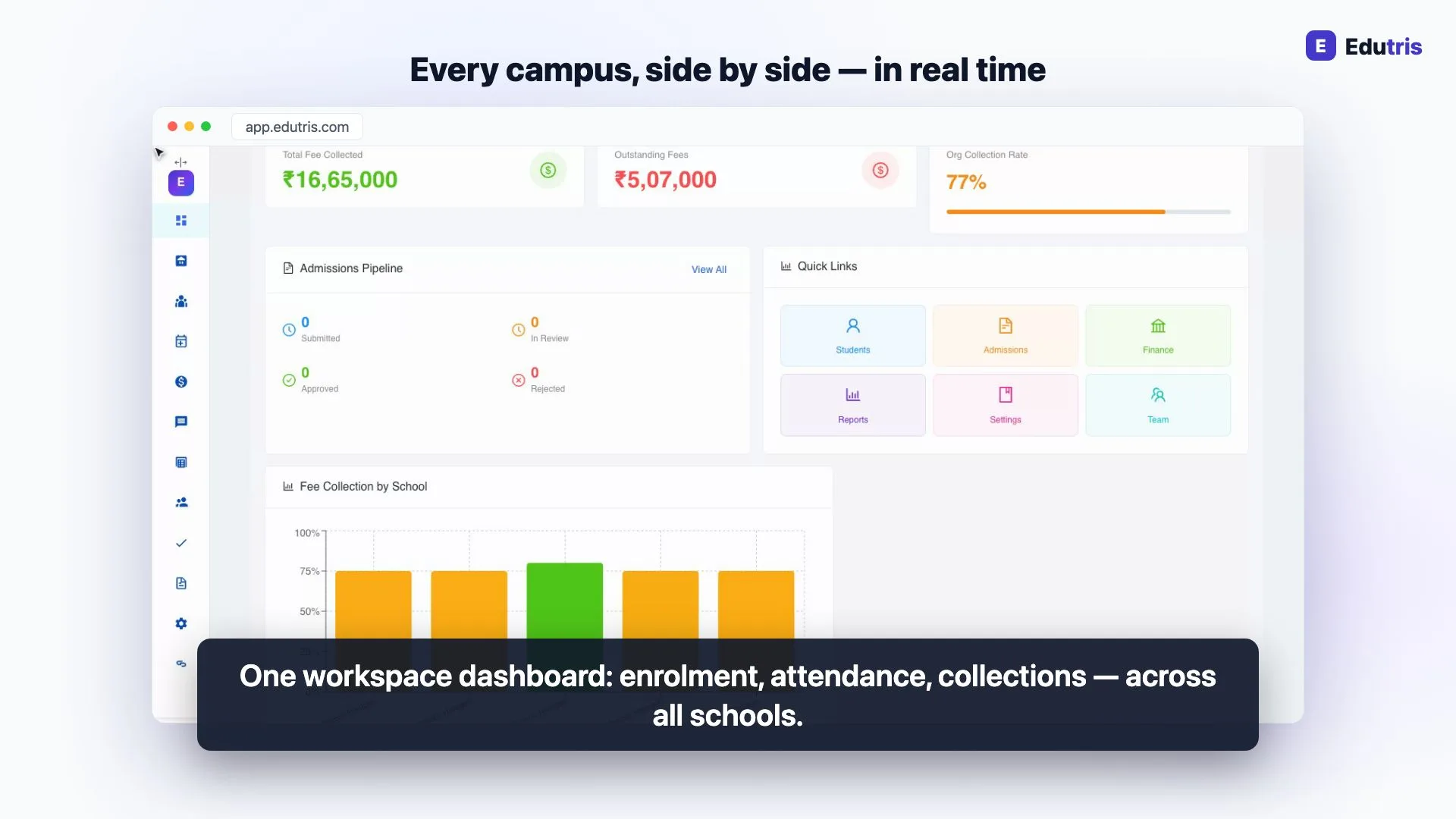
How Edutris gives school owners real-time control
Frequently Asked Questions
Does a small school of 200 students really need management software?
Need is the wrong word, plenty of 200-student schools run on registers and a Tally file, as schools have for decades. The better question is what the current setup costs you: fee dues nobody can total quickly, parents informed of absences days late, and report-card weeks that consume the whole office. At 200 students the volume is exactly large enough for these problems to hurt and exactly small enough that one affordable system, run by one admin, fixes them. The case is practical, not fashionable.
How much should a 200-student school pay for management software?
As a reference point, the Edutris Starter plan is ₹2,999 per month and covers schools up to 250 students. At 200 students that works out to roughly ₹15 per student per month, comparable to a fraction of a single textbook over the year. Be wary at both ends of the market: enterprise suites that quote per-module prices designed for 2,000-student institutions, and near-free tools whose real cost shows up in lost data or a vendor who disappears. Whatever you pay, make sure the price covers support, not just software.
What features matter most for a small school?
Five jobs cover most of what a small school office actually does: student records in one place, daily attendance with parent alerts, fee collection with proper receipts and an accurate outstanding list, report cards generated from marks rather than assembled by hand, and announcements that reliably reach parents. If a system does those five well, one admin can run it. Everything beyond that (analytics dashboards, API integrations, multi-school management) is worth having only after the five basics are solid.
What happens when the school grows past 250 students?
Crossing a plan limit should be an upgrade, not a migration. In Edutris, a school that outgrows the Starter plan's 250-student ceiling moves to the Professional plan (₹7,999/month, up to 1,000 students, AI features included) with the same data, the same logins and the same workflows: nothing is re-entered. This is worth checking with any vendor before you sign: ask specifically what happens at the plan boundary, because some products handle growth as a new contract and a fresh setup.
Read next
- 01For School Owners
How to Design a School Fee Structure: Heads, Terms, Concessions and Due Dates
A practical guide to designing a school fee structure in India: choosing fee heads, class-wise amounts, collection frequency, concessions and due dates.
- 02For School Owners
Reducing Student Dropout: How Schools Improve Retention Year on Year
Why families leave a school mid-cycle (fees, communication, academics, transport) and a practical retention playbook that protects enrolment and revenue.
- 03For School Owners
Teacher Retention: Why Teachers Leave Schools and How to Keep Them
Why good teachers leave Indian schools (pay delays, admin overload, no growth path) and practical ways school owners can improve teacher retention.
- 04For School Owners
Digitising a School in India: A Realistic 90-Day Plan for Owners
A phased school digitisation guide for Indian owners: data and attendance in month one, fees and the parent app in month two, exams and reports in month three.
- 05For School Owners
How to Choose School Management Software in India: A Practical Decision Framework
A step-by-step framework for Indian school owners: audit your needs, set a realistic budget, plan the migration, test support, and spot vendor red flags.
- 06For School Owners
Switching School ERPs Mid-Year: When It Makes Sense and How to Do It Safely
When switching your school ERP mid-session makes sense, when to wait for April, and a practical checklist for moving students, fee ledgers and marks.